
William Walter Phelps, Man of Distinction
Once owned 1500 acres from the Hackensack to Hudson Rivers, Phelps is linked more closely with Teaneck’s history and development than any other individual.
Phelps Manor — Undated brochure possibly published in the last 1920s. It was created by the Estate of William Walter Phelps, Inc. promoting the land sale owned by Mr. Phelps as residence lots and plots, a new development to be hereafter called as “Phelps Manor”.
 William Walter Phelps
(August 24, 1839 – June 17, 1894)
According to an article in the Teaneck News of 1928, Teaneck owes much of its beauty to William Walter Phelps. Phelps is linked more closely with Teaneck’s history and development than any other individual.
Phelps was born in Pennsylvania. He graduated from Yale University and Columbia Law School. In 1869 he purchased the Garrit Brinkerhoff homestead (site of present Municipal Green). Over the years he expanded on the house and his property holdings. At one time, he owned 1500 acres from the Hackensack to Hudson Rivers.
While the Phelps estate was designed as a private demesne, it greatly influenced the development of Teaneck as a mostly residential community. He planted over 600,000 trees on his property and was a prime advocate in the movement to improve Bergen County’s roads. He spent $35,000 to widen and macademize Cedar Lane on his own property. His purpose? To enhance the beauty and add to the conveniences of his homestead acres.
In 1888 his home, the Teaneck Grange, burned to the ground and his family moved to the Griggs mansion which is now the site of Holy Name Hospital.
Phelps served in Congress from 1873-1875 and from 1883 to 1889. He held several diplomatic posts overseas and was appointed a special judge in 1893. He died from illness in June 17, 1894.
Portrait of William Walter Phelps:
Agnes Norton (Director of Teaneck Public Library from 1929 until 1961) reports that the painting was found in a local private home, unframed and in poor condition. How it came to be donated to the Library is lost in the fog of history. It was originally hung in the Library’s stairwell up the completion of the 1950 addition to the building, after restoration by a Miss Dribble, an art dealer/restorer from Englewood. In 1995, after vandalism to the painting was discovered, the Library board of Trustees again had the painting restored, this time by Zbigniew Pietruszewski of the Laboratory for Conservation of Fine Arts, Teaneck.
Chester Loomis (1852-1924): The Artist
Chester Loomis was born near Syracuse, NY. He attended Cornell University and later studied and lived in Paris before moving to Englewood, New jersey. According to Bergen County Panorama , he was a portrait and mural painter who was noted for his strong use of color. He was a member of the National Society of Mural Painters, American National Academy of Art and the Architectural League.
William Walter Phelps, congressman, and judge – no single person influenced the development of Teaneck as much as W. W. Phelps. In 1865, he purchased the Garrit Brinkerhoff Homestead, a Jersey Dutch Farmhouse that stood at the intersection of Teaneck Road and Cedar Lane. From then on, he added to his holdings until they encompassed more than 2,000 acres from the Hackensack River to the Hudson River, and virtually all of central Teaneck. As a result, Teaneck’s growth was concentrated along the perimeter of Phelps’ estate. It wasn’t until Ellen Marie (Sheffield) Phelps, Judge Phelps’ widow, died that the vast Teaneck property was opened to development.
William Walter Phelps was already a wealthy man when he arrived in Teaneck. His father John Jay Phelps was a founder and president of the Delaware & Lackawanna Railroad and, among many other ventures, he also owned a huge department store called Eno-Phelps, in Manhattan. Young Phelps was an attorney and after moving to Teaneck he became interested in politics. Elected to Congress three times, he was later appointed ambassador to Germany. In 1888 he was presented as a vice presidential candidate at the Republican Convention, and late in his life he was appointed special judge of the Court of Errors and Appeals of the State of New Jersey.
But his Teaneck home remained his favorite occupation, and he devoted much money planting trees and paving roads.
SOURCE: The Suburbanite, Oct 14, 1981, pp. 1, 10
William W. Phelps: Man of Distinction
Phelps Park, which honors William Walter Phelps, is located on River Road opposite the Fairleigh Dickinson University campus. The 9.45-acre open space has facilities for picnics, barbecues, tennis, swimming, basketball, and volleyball.
By Tricia Duffy
Staff Writer
William Walter Phelps, the son of a successful New York City merchant and financier, was born in Dundaff, Pa. on Aug. 24, 1839. Several decades later, at the height of a successful banking career in Manhattan, he made the decision to “go West” and settled in the thriving hamlet of Teaneck.
Young Phelps’ first school experience was at Mount Washington Institute in New York. He was described by contemporaries as a round-faced, rosy-cheeked boy, with sparkling dark eyes; active though not physically strong. Phelps then attended private school at Golden Hill near Bridgeport, Conn., where his academic advancement was so rapid that he was fully prepared for college at the age of 15.
 He graduated from Yale University in 1860 with high honors and toured Europe extensively before receiving his degree from Columbia College Law School, where he was awarded the valedictory appointment of his class. Phelps married Ellen Maria Sheffield of New Haven, Conn. in 1861.
Following his family career in banking and industry, Phelps served as a director for the National City Bank, the Second National Bank of New York, the United States Trust Co., the Farmer’s Loan & Trust Co. and nine railroad firms.
After the birth of his two sons,, he bought a summer home in Bergen County — an old-fashioned Dutch farmhouse on the “Teaneck Ridge,” an area of Teaneck now adjacent to Route 4. that had been the Garret-Brinkerhoff House in Revolutionary days.
Phelps extensively renovated the old homestead, converting it into one of the most beautiful and celebrated mansions of its time. The Phelps family – made this their permanent residence and the youngest child Marion, was born in the house.
Congressman
Combining eloquence with an interest in politics, Phelps, a Republican, sought and won a seat in the U.S. House of Representatives at the age of 34. A renowned journalist of the day described William Walter Phelps upon his first day in Congress thusly:
“Mr. Phelps is just five feet nine-and-a-half inches tall and weighs about 170 pounds. He is lithe of limb and very active. He walks with a live, springy step. His face is refined and handsome, with a wide grasping, intellectual forehead and we think he has the finest eyes of any man in Congress. Mr. Phelps’ manner is simple, gracious and winning and in pleasing harmony with his thoughts, and he never utters a platitude. Patient, industrious and resigned, he is a model of the highest type of culture.”
During his first term in Congress. Phelps was considered by his colleagues to be a serious, well-versed and mature public servant–a successful young lawyer, ambitious, with money and energy who was expected to make his mark on politics and statesmanship.
After his term, Phelps returned in 1875 to his Teaneck home, where he spent hour upon hour planning the improvements to the homestead and looking for additional land investments nearby. In the next year, he embarked upon a European tour, partly to regain his health which had suffered from a bout of typhoid fever. While abroad, Phelps investigated institutions of learning and art in England, France and Germany, and enjoyed the society of scholars, authors and scientists.
Arborculturist
Returning to the United, states, Phelps spent most of his time resting and working on his most important hobby — his estate. His great passion was trees and the woods; he was a devotee of arboriculture. Between 1875 and 1880 Phelps was responsible for planting and seeing to maturity approximately 600,000 trees of numerous varieties.
In 1880 Phelps was tapped to manage the Republican Presidential campaign but he was unable to complete the assignment because of feeble health. Special honors awaited him, however, and in 1881 President John A. Garfield named Phelps minister to Austria-Hungary, But he held this post for only a few months, resigning after Garfield was assassinated.
Still active in politics, Phelps was re-elected to Congress in 1883 and again in 1885.
Art collector
In 1886 the Phelps mansion was completed. At Christmas time the family held a glorious celebration with people from all over the country viewing the mansion for the first time. Phelps’ favorite room was a gallery which he had designed himself to hold his priceless collection of art treasures from the ends of the earth.
It was nearly midnight on the first day of April 1888 when Phelps, returning to his apartments in Washington after an evening with friends, found on the table in his bedroom two telegrams which told him that his mansion in Teaneck, where his family then was, had been totally destroyed by fire, with a loss of nearly all its valuable contents. He disturbed no one upon receiving this startling news, but very early in the morning awakened his secretary, told him what had happened, and said that he was going to take an immediate train for New York. He left on the train without once alluding to the great calamity.
The mansion, once the most beautiful in the area, became known as “Phelps’ Ruin” and local residents picnicked near the destroyed home — marveling at what it once had been. Phelps immediately began renovation of the house.
German ambassador
On Oct. 11, 1889 William Phelps was presented to the German Empress at a gala performance at the Royal Opera House, given in honor of the Czar of Russia. Phelps was appointed Minister to Germany, remaining in the post for one year until a case of homesickness prompted his request for a short leave of absence. He sailed for America in September of 1890.
In his diary Phelps wrote, “I have come home to rest and enjoy myself. I intend to spend my vacation upon my Teaneck farm. I feel as if I were already a Jersey farmer again. See, there is one of my farm wagons on the pier, ready to take off my luggage and those lusty-looking fellows have come down fresh from Teaneck to give me an early welcome. I expect to live among the trees until I get rested, and then hunt up my friends to see that they have not forgotten me. No politics this time, only that I shall vote the Republican ticket in Bergen County at the coming election, and soon after return to my official duties at Berlin.”
Phelps returned to Germany a year later, remaining until January 1893 when his health began to suffer from the climate and he traveled south through Spain, Morocco, Tunis, Algiers and Italy.
State judge
While Phelps was vacationing, Governor Werts of New Jersey appointed him judge of the state Court of Errors and Appeals. Turning over the affairs of the legislation to his success, Phelps again returned to the United States to be sworn into his judicial role on June 20, 1893.
In February of 1894, Phelps’ throat began to trouble him seriously, and the illness confined him to his home for days. He continued to try to keep up with his work and in fact was present until the adjournment of the term. A few days later he traveled to the Hygeia Hotel at Old Point Comfort in Virginia, a resort that in the past had been a place of rest for him.
Here Phelps became withdrawn and quiet, an attitude brought on by his physical inability to converse. The last entry in his diary is dated April 10, 1894. Phelps moved himself to Hot Springs, W. Va., where he enjoyed a temporary return of strength. Finding no lasting improvement in his health in Hot Springs, Phelps returned to his home in Teaneck on May 18.
By May 31 he was bedridden, and in June he lapsed into a coma. He died June 17, 1894.
Hundreds of people lined the streets of Teaneck and Englewood to honor his funeral procession. The trees he had planted himself lined the path of this final journey.
Upon his burial the New York Tribune wrote: “He possessed a rich store of affection and sympathy on which all who knew him drew at will, with full assurance that their drafts would never be dishonored. Not on friends alone, but wherever he detected the need of assistance or of consolation, he bestowed the best gift in his keeping. He won in life the only reward he wanted, but the tribute of tears which would have grieved him must follow him to the grave.”
At the time of his death William Walter Phelps owned half of what is presently Teaneck. His estate was left equally to his widow and three children. His youngest son, Sheffield, died of typhoid fever in 1917, Mrs. Phelps died in 1920 and Marion Phelps in 1923. John Jay, William’s eldest son, lived until 1948, when he died at the age of 87.
Source: Chapter 8: William Walter Phelps: a lasting imprint. The History of Teaneck, Mildred Taylor. [Teaneck, N. J.] : Teaneck American Revolution Bicentennial Committee, c1977. pp.46-52.
William Walter Phelps: A Lasting Imprint
The outbreak of the Civil War found Bergen County once again divided in its loyalties. About a fifth of the county’s residents had been slaves in 1790. The number had increased after 1804 when legislation for their gradual emancipation was adopted. Many had arrived from Southern states, looking toward freedom. Bergen County voted against Lincoln in 1860, giving Breckenridge 2,112 votes and the Great Emancipator 1,455.
Residents of Teaneck and the rest of Bergen County resolved to “stand by our banner in this eventful crisis” at a meeting in Hackensack on April 22, 1861. Henry M. Low of Teaneck was appointed to the war committee at a meeting in front of the flag-draped courthouse the next afternoon when the book was opened for volunteers to uphold the Union.
Bergen County supplied one full regiment of volunteers and soldiers for various other divisions of the Union armies. Once again the Demarests, Christies, Terhunes, Brinkerhoffs, Ackermans, Loziers, Kipps and Van Buskirks sent their sons off to war. Most of them were in the Twenty-Second Regiment which joined the Army of the Potomac. Henry Brinkerhoff, better known as “Bully Hank,” died of typhoid fever at Belle Plain. According to a correspondent for the Bergen Democrat published in March, 1863, after Aquia Creek:
Then came our move to Belle Plain. Our move upon Fredericksburg frustrated by the elements, our three days in the woods — mud and storm; our march back; our stay in one place until the wood is gone and then “changing camp” for we were chasing forests that seemed to melt before us. We are called “an army of occupation.” Our work seems to be clearing Virginia.
The day after General Lee surrendered to General Grant at Appomattox an agreement was signed which would determine the future development of Teaneck. On April 10, 1865, Jacob Finck of Hoboken sold a tract of land to William Walter Phelps of New York. The transaction for several pieces of property totaling eighty-eight and a half acres was the beginning of what was to become the vast Phelps Estate.
William Walter Phelps arrived in Teaneck a week later, in a horse-drawn station wagon, draped in mourning for Abraham Lincoln. The late Mrs. Nellie Clausen remembered her parents speaking often of Phelps’ dramatic arrival. He was twenty-five years old at the time, a graduate of Yale University’s Class of 1863 and of Columbia University Law School. On the night of his graduation from Yale he married Ellen Maria Sheffield, daughter of Joseph Earle Sheffield, founder of the Yale Scientific School. Phelps’s father, John Jay Phelps, was a prominent merchant and financier in New York. He was the first president of the Delaware & Lackawanna Railroad, which he had been largely instrumental in building.
After a honeymoon of almost a year in Europe, the young couple returned to New York, where Phelps set up a large and lucrative law practice. His tastes were esthetic and his health was not robust. He wanted a home in the country, intending to use it as a summer place. He selected the old Garrit Brinkerhoff place in Teaneck, built before the Revolution by the Zabriskies.
The property, now the site of the Municipal Building, is described in the deed dated June 14, 1763 as a part of the Sarah Kiersted Patent “bounded Northeasterly by the land of Garrit Dedrickse, southeasterly by the road commonly called Teen Neck Road, Northwesterly by the land of Jacob Banta.” By this deed Christian Zabriskie acquired the land “together with all and singular buildings orchards gardens water mines minerals and all other property commodities &c.” from John Jost Zabriskie, Jacob Hendrickse Brinkerhoff, Jacob Van Waggoner, Samuel Demarest, Wiert Banta, David Banta, Hendrick Banta, Garrit Dedrickse, Jacob Banta and Johannes Terhuen of Hackensack for one hundred pounds proclamation money.”
Phelps’s first intention was to use the Dutch farmhouse temporarily and build a large new home on the property. Following the birth of his daughter Marian, the old place became so dear to Mr. and Mrs. Phelps that they decided to keep it and add onto it, retaining the charm of the Dutch cottage. Two sons, John Jay and Sheffield, were born there later.
Phelps’ father died in 1869 and left him an estate so large that looking after it became a full-time job. He gave up his law practice and moved to his home in the country, which he called the Teaneck Grange. He commuted to New York, discussing local, state, and national affairs with a coterie of friends in transit. These new friends, influential Bergen County Republicans, were so charmed by the personality and background of their young companion that they sent him as a delegate to a political convention in Paterson in 1870.
There he met other influential Republicans and began a distinguished political career. He was appointed minister to Austria by President Garfield, ambassador to Berlin by President Harrison, was twice elected to Congress and, a year before his death, appointed judge of the New Jersey Court of Errors and Appeals by a Democratic governor.
Harriet Beecher Stowe happened to be going to Washington in the same parlor car with Phelps one day in 1873, and listened as he talked with a judge who was going to show him the way around the Capitol. The next week the intrepid Mrs. Stowe wrote in the New York Independent :
William Walter Phelps, the new young member from the desert of New Jersey, has the reputation of owning more railroads than I can take the time to count. That he is a most loquacious gentleman I can bear witness for coming to Washington in the same car with him, I decided that he talked faster and longer than any masculine mortal I ever beheld and concluded that he was a wild Bohemian just let loose from his lair on his way to the capital to write “Injun” story chronicles of Congress. Instead, he is one of the menagerie himself, and threw off from that flying tongue of his, the other day, a bright speech which made everybody laugh, even when translated to the newspapers–a very stern test.
Phelps attracted and courted the favor of bright people. He seldom came home to Teaneck without bringing guests. One of those guests was General Grant. Phelps wanted to make Teaneck a select residential community like Tuxedo Park, and persuaded some distinguished people to take up residence in the town. These included his brother-in-law, General Thomas B. Van Buren, who later became United States Commissioner to the Vienna Exposition and was for many years consul general at Yokohama. General Van Buren’s daughter Edith became the Countess Castelmenardo. She occupied the Van Buren home as recently as 1913. The home was on the present site of Volk’s Colonial Home on Teaneck Road.
Before the panic of 1873 Phelps formed the Palisade Land Company at Closter. Among the investors in the enterprise, which bought acreage between the Hackensack and the Hudson, were General Grant, President Rutherford B. Hayes, Samuel J. Tilden and General Van Buren. Phelps was continually adding to his holdings in Teaneck, buying up a farm here and a farm there until he owned more than 2,000 acres in the present township. He traveled extensively, and at the height of his career spent much of his time in Europe, but Teaneck was on his mind wherever he went.
He had two absorbing interests–trees and roads. He began planting trees the year after he came to Teaneck and did not stop as long as he lived. In all, he planted 600,000 trees, including some of the handsome copper beeches that grace the town today. At first he had only the help of his coachman, but later engaged experienced nurserymen. He grew 2,000 oaks from acorns, experimented with growing chestnut trees from the nut, and planted 70,000 Norway spruce, 65,000 American elms, and 50,000 white pines.
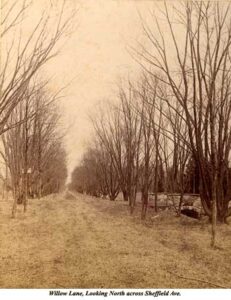
Vestiges of the Phelps avenues of trees may still be seen here and there in Teaneck. What he called the poplar experiment was an avenue leading from The Grange to the Nordhoff railroad station in Englewood. Lombardy poplars were alternated with laurel-leaved willows and white oaks which produced an effect not equaled in any other portion of the grounds.
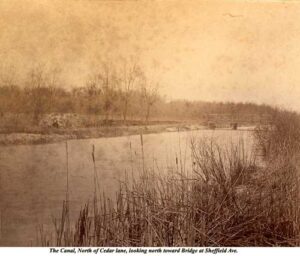
Phelps made the most of every dip and rise in the land he owned, planting trees and shrubbery to produce enchanting effects from every angle. Road building went along with tree planting in his plan to surround himself with an estate of unusual beauty. At the time New Jersey’s roads were noted for their red mud and deep sand which stalled horse-drawn vehicles. Phelps went to work on the roads on his own property and set out to build public sentiment for road improvement in general. After voters approved what was considered a liberal sum for road improvement, he offered to duplicate any additional sum they would name. He offered to pay a third of the cost of a steam roller, to pay half the expense of dredging the canal which was the main sewer channel, and to pay half the cost of macadamizing Cedar Lane from the track of the West Shore Railroad to the Hackensack River.
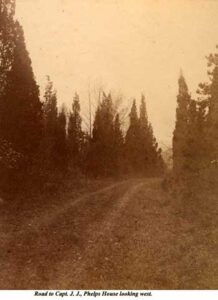
On his own property Phelps built thirty miles of road, eight miles being macadamized. The roads all radiated from The Grange. Because his daughter was fond of horseback riding, he cut and widened bridle paths through the woods. He built sixty little bridges of wood and stone just to please the eye. He purchased a stone crusher and located it on the Palisades where the land company had been.
When Phelps came to Teaneck, Cedar Lane Road was a spring-breaking, horse-miring thoroughfare except under the most favorable weather conditions. He widened it, cut down the steep grades, and spread macadam at a cost of $35,000.
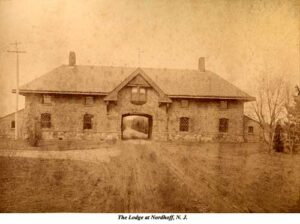
Phelps built gate lodges where his private roads intersected public thoroughfares. The lodges were closed for a day or part of a day each year to maintain the legal privacy of his roads. Some of the lodges still exist. There is one at the entrance to Mackay Park in Englewood and another on Lafayette Avenue, just over the Teaneck boundary line in Englewood near East Forest Avenue. Across the street is a former gate lodge, but the carriage entrance has been closed in and it is a private dwelling.
Phelps’s fondness for curved roads did not always find favor with owners whose property was being used for curves. Mrs. Kuntze took matters and an axe in her own hands when he decided to make a curving road from The Grange to Red Towers on River Road, where his son lived. When Phelps’ employees started rounding off a curve on the Kuntze property (later Clausen’s) in the present area of Route 4 and Queen Anne Road, she took an axe and promptly and efficiently squared off her property.
Nothing Phelps did so endeared him to the people of Teaneck and Bergen County as his offer to help when the Bergen County Savings Bank in Hackensack closed in 1880. Because of his poor health, his doctors had advised him to give up activity and travel abroad. He was en route to Italy when he received mail and newspapers from the United States telling of the bank closing. He cabled his New York office to pay immediately all deposits of $100 and under. There were about 1,078 such accounts. The Atlantic Monthly commented thus in its issue of July, 1881:
Leaving the realms of prayer and faith and returning to the palpable ground of good works, we actually have some magnificent charities. When the Bergen Savings Bank failed, Mr. William Walter Phelps, a politician and an office holder, late a member of Congress and now Minister to Austria, paid the small depositors their dues. It is said to have cost $20,000 and from a business point of sight I do not see how it can be justified; but for solid happiness, how can it be surpassed?
 Mr. Phelps wasn’t fooling when he decided in 1869 to retain the Teaneck farmhouse and add onto it rather than build a new house. Add onto it he did. With the aid of architects he made additions and alterations until in 1886 the building was 350 feet long, varying from 25 to 50 feet in width. He occupied the north room with a fireplace so high a man could stand in it. His bedroom was a platform above this huge room that served as study, office, and workshop. Adjoining this was a large library. The living, dining, and music rooms looked out over the broad park that surrounded the house.
Upstairs were the sleeping rooms and in the basement the billiard room, kitchen, servants’ quarters and laundry. The picture gallery at the southwestern end of the building was the final touch to the home that was described as the most pretentious in Bergen County. Hundreds came to call when Phelps held his annual open house on New Year’s Day, 1888. There were farmers from Teaneck, men of affairs from New York, political and literary friends from all over. One of the guests paid a flowery tribute to the host. It included these lines:
May his cup o’erflow with health and honor
And may The Grange stand
A fit setting for Bergen’s noblest son.
Alas, The Grange did not stand much longer. On April 1, 1888, an explosion in the newly added art gallery with its seventy-five gas jets set the house on fire. Phelps was in Washington at the time. He was notified by telegram; there were no telephones. Messengers summoned Hackensack and Englewood fire departments. A timber at the south end of the art gallery was the only piece of wood left by the fire. It protruded over an iron door that impeded fire fighting efforts. In the spring of 1950 workmen excavating to lay the foundation of the present Police Headquarters dug up an iron door and found what appeared to be a wine cellar. To the workmen’s regret, no wine was found. The Phelps Ruin was a spectacle in Teaneck until1925 when the Municipal Building was erected there. Covered with vines and lush growth, the tall chimneys, foundations, and eyeless windows were reminders of past grandeur. Many Teaneck men today who were boys then recall happy hours spent playing in The Ruins.
After viewing what had once been his beautiful homestead, Phelps set out to find a new home. He leased and later bought the house and twenty acres of land across Cedar Lane owned by C. R. Griggs, a New York cotton broker. It is the site today of Holy Name Hospital. In August of that year the stables and all of the outbuildings of The Grange burned. The carriages and such contents of The Grange as had been saved and stored there were also destroyed. Only the horses were saved. Phelps later purchased additional land near the Griggs house so that his farm took in both sides of Cedar Lane and stretched far east of Teaneck Road. His greenhouses were across from the present Municipal Building.
Early in 1889 Phelps was sent as a commissioner to Germany to settle with Prince Bismarck a controversy over Samoa. In September President Harrison appointed him ambassador to Berlin. He served until 1893 when, in failing health, he took a leave of absence. While on vacation he was appointed to a judgeship in New Jersey. He served until the spring of 1894 when his illness — tuberculosis — forced him to resign. He died at his Teaneck home on June 15. Services were at the Presbyterian Church of Englewood. Newspapers all over the United States noted his death. Eugene Field wrote: “He was always strong to sustain the weak. Struggling men received from him a helping hand, but his charities were never on parade.”
At his death Phelps owned a good half of the present Township of Teaneck. He had planned to open his property to a few selected people who would maintain its exclusive character. His estate was left equally to his widow and three children, providing that his widow could live on the Englewood Farm (as he called the former Griggs property) as long as she cared to. His son, John Jay, headed a group of three executors who were to maintain the property as long as Mrs. Phelps wished it. When on of the executors died, the others, fearing that they might die before Mrs. Phelps, formed the William Walter Phelps Estate in 1917. Sheffield, the second son, died of typhoid fever, leaving minor children. The elder Mrs. Phelps died in 1920, Marian in 1923, and John Jay in 1948 at the age of eighty-seven.
Source: Teaneck Shopper, Wednesday, 8/5/1970.
 The William Walter Phelps Mansion “The Grange”
By Mrs. Mildred Taylor
Teaneck was a pleasant farming community in the latter half of the 19th century. There were 35 farms between Liberty and Fort Lee Roads with mileposts all the way from Jersey City to Tappan. Teaneck Road was a sweet sight in the spring when cherry, peach, pear and apple blossoms perfumed the air.
John V. H. Terhune operated a saw and grist mill in Fycke Woods below Teaneck Road at about Johnson Avenue. A creek ran through the Fycke to the Overpeck in the vicinity of the present Thomas Jefferson Junior High School. One of the stones from Terhune’s mill is now a doorstep at the Teaneck Public Library.
This was the atmosphere in Teaneck when William Walter Phelps arrived. He came in a horse-drawn station wagon, draped in mouring for President Lincoln, who had been assassinated on April 10, 1865, the day before Phelps signed an agreement to buy the Garrit Brinkerhoff place in Teaneck from Jacob Finck.
 The Late Mrs. Nellie Clausen, told me of hearing her parents often speak of Phelps’ dramatic arrival in Teaneck. Her parents, Charles and Mary Kuntze, owned a farm, which was later bisected by the Jersey City and Albany Railroad tracks, now crossed by the Grayson Place Bridge.
Phelps was 25 when he came to Teaneck. He and his bride, the former Ellen Maria Sheffield, had returned from a year in Europe and he had set up law offices in New York. He was a man of aesthetic tastes and delicate health. He wanted a home in the country to use as a summer place.
Phelps’ selection of Teaneck as his place of residence, determined the character of what was to become a township of distinction. At first he intended to use the Dutch farmhouse built by the Zabriskie family before the Revolution as a temporary home and later build a large new house. Following the birth of a daughter, Marian, the old place became so dear to Mr. and Mrs. Phelps, that they decided to keep it and add on to it.
And add onto it he did! The Grange, as he called it, stood on the site of the present Municipal Building. With the aid of architects he made additions and alterations until at last, 1886, the old Dutch farmhouse had been transformed into the residence he and Mrs. Phelps desired. The low, rambling building was about 350 feet long and varied from 25 to 50 feet in width. He occupied a room at the north with a fireplace so high, a man could stand in it. His bedroom was a platform above the huge room that served as a study, office and workshop. Adjoining this room was a huge library. The living room, dining room, and music rooms looked out over the broad park that surrounded the house.
Upstairs were the sleeping rooms. In the basement the billiard room, kitchen, servants’ quarters and laundry. The final touch to the home, described as the most pretentious in Bergen County, was the picture gallery at the southwestern end of the building.
When Phelps father, John Jay Phelps, who was a noted financier, died in 1869, he left an estate so large that looking after it became a full time job for his son. He gave up his growing law practice and settled in Teaneck. It was his dream to make Teaneck a select residential community like Tuxedo Park. He continually added to his land holdings, buying up a farm here and a farm there, until he owned more than 2,000 acres in Teaneck. Before the panic of 1873, he formed the Palisade Land Company at Closter. Among the investors in this enterprise which bought large acreage between the Hackensack and Hudson rivers, were U. S. Grant, Rutherford B. Hayes, Samuel J. Tilden and General Van Buren.
Young Phelps so charmed a group of commuters with whom he traveled to New York, that he was sent as a delegate to a political convention in Paterson in 1870. There he met several influential Republicans and started a brilliant political career. President Garfield latter appointed him minister to Austria. President Harrison sent him as ambassador to Berlin. He was twice elected to Congress and was appointed judge of the New Jersey Court of Errors and Appeals by a Democratic Governor.
He attracted and courted the favor of bright people. Many of these followed him to Teaneck. General Van Buren, who married one of the Phelps’ sisters, moved here and lived in a large house on the site now occupied by the Volk Funeral Home. Van Buren was for many years, consul general in Yokohama. Lebbeus Chapman, a New York Banker, moved into a comfortable house at Teaneck Road and West Englewood Avenue. Griggs, a New York cotton broker, built a handsome home on the present site of Holy Name Hospital.
 Although Phelps traveled extensively, Teaneck was on his mind whenever he went. Trees and roads were his absorbing interests. He began planting trees the year after he came here and did not stop until he died. In all, he planted 70,000 Norway spruce, 65,000 American elms and 50,000 white pines. He make the most of every dig and rise in the land he owned. He built 30 miles of roads on his own property.
Roads to the Teaneck and Englewood railroad station radiated from The Grange. He build gate lodges at intersections with public thoroughfares. Carriages could pass confortable through the arches which were closed by gates part of one day a year to maintain legal privacy of the roads. One such gatehouse still stands at Mackay Park in Englewood.
The Phelps mansion went up in flames on April 1, 1888. An explosion in the art gallery which was lighted by 75 gas jets caused the fire. Phelps was in Washington at the time. There were no telephones. Messengers summoned fire departments from Englewood and Hackensack. When Phelps returned and viewed the ruins of his home, he leased the Griggs home on the south side of Cedar Lane, later buying the house and 20 acres of land. Later he purchased more land, so that his farm took in both sides of Cedar Lane.
He served as ambassador to Berlin from 1889 until 1893 when, in failing health, he returned to New jersey and was appointed to the judgeship. Tuberculosis forced his retirement in the spring of 1894. He died at his Teaneck home on June 15, 1894, a year before Teaneck became a township with William Bennett, superintendent of the Phelps property, as the first chairman of the Township Committee.
Many old timers remember the phelps ruins, which stood for years on the site of the present Municipal Building. Covered with vines and luch growth, the tall chimneys, foundations and the eyeless windows were beautiful reminders of past grandeur.
Source: Unidentified. Teaneck Collection, Teaneck Public Library.
Phelps Influence Felt In Teaneck’s Growth
— He Carved Out Huge Estate Which Extended From The Hackensack To Hudson
The name Teaneck probably is of Indian origin and since the Redmen were there first, rightly so. But if the town were given another name, it certainly should by Phelps Township.
For William Walter Phelps, more than any other single individual, is linked closely to Teaneck’s history and development. This almost legendary figure started form his huge estate 35 years before the turn of the century, at the same time as the nation was emerging from a struggle which nearly tore it asunder.
In 1895, Mr. Phelps purchased the Garrit Brinkerhoff homestead, a Dutch farmhouse. From then on he added to his holdings until at one time they stretched from the Hackensack River to the Hudson River. But the heart of the great estate lay in what is now central Teaneck, and the Township’s development can be traced directly to two factors, the breaking up of the estate and the opening of the George Washington Bridge in 1930.
William Walter Phelps was born in 1839 in Pennsylvania, a member of a family which arrived in America front England in 1630. Young William pursued his studies at Mount Washington Institute in New York City, a Connecticut private school, and Yale.
The young student married upon his graduation from Yale and went abroad, to Germany, a country to which he was later named United States Ambassador. Columbia Law School was his next scholastic stop, and then he began a law career.
John Jay Phelps, William’s father died in 1869 and his son and heir took over development of the estate. In 1892, well known in North Jersey, he was elected to Congress, a Republican.
Adds To Holdings
After a trip to Europe in 1876 he returned to New Jersey and worked intensively to beautify his holdings. He planted many trees, built roads and bridle paths. Many of his trees still offer cooling shade in Township residents in the summertime.
Teaneck Grange, which Phelps called his home, stood right where the Municipal Building is today. A few months ago, when contractors were digging the foundation for the new police headquarters, their tools struck the remains of the old mansion’s wine cellar.
But the mansion burned down in 1878, when its owner was in Washington, and most of its treasures were destroyed. Phelps then moved into what was known as the Griggs house, which lay where Holy Name Hospital is now. His widow continued to live there until her death in 1920.
President Benjamin Harrison named Phelps ambassador to Germany in 1889 and he spent four years in that diplomatic post. He was named a State Appeals Judge in 1893. Death ended his career in 1894 in early summer when his beautiful trees were in all their green glory.
Influence Felt
But death of the great Teaneck patriarch hardly ended his influence upon his community. Much land belonging to him is today owned by his estate, now engaged in selling it for profit for real estate purposes.
The golf course, which lay along Route 4 was broken up a few years ago for garden apartments and single family homes, was called the Phelps Manor Golf Club. Its demise was part of a new-famous controversy in Teaneck, the celebrated Phelps Manor land exchange. This took place in 1948 and was the center of some bitter fights between the Township Council and the residents of what is now called the Phelps Manor section. Part of the exchange involved transfer of title from the Township to the Phelps Estate of some 150 building lots in West Englewood. Thus the historic estate of William Walter Phelps added to its holding, instead of disposing of them.
William Walter Phelps is rightly called the father of Teaneck. Although he died before the twentieth century was born, his activities laid the foundation for what is now known as a model community.
This neighborhood park is situated in the west central section of Teaneck. Access to the park may be made by car from River Road, the western boundary of the park. Part of the eastern border of the park, Wilson Avenue provides pedestrian access. The park may also be reached on foot from the end of Catalpa Avenue to the south. Phelps Park is a neighborhood park adjacent to Fairleigh Dickinson University, and is utilized extensively by FDU students and people living in the west-central neighborhood in Teaneck. Facilities include: an above ground swimming pool, a children’s wading pool, sets of tot swings, adult swings, horse swings a climbing structure, see-saws, a sandbox, two ballfields for hardball, little league baseball and softball, four tennis courts, 15 permanent picnic tables with charcoal burners, one basketball court and a volleyball court.
PHELPS PARK: In the heart of Teaneck lies a one-acre arboretum
by Howard Prosnitz, Staff Writer
Teaneck Suburbanite, June 11, 2008, p. 5
 In 1952, when Fairleign Dickinson University acquired the campus of the former Bergen Junior College, it sought to add a township-owned parcel of land to its River Road campus. A land swap was arranged, and the township gave up the property along the river in exchange for a piece of land on the west side of River Road owned by FDU. That 15.71-acre property became Phelps Park.
Located in the heart of Teaneck, only four blocks from Cedar Lane, Phelps Park is one of the township’s most heavily used parks. Its amenties include two baseball fields, a basketball and a tennis court, the latter serving the Teaneck High School tennis team, and a picnic area. Phelps Park is also one of four township parks that has a swimming pool.
But the park is unique among Teaneck’s park for another reason: it is the only park to have an arboretum, a collectiom or museum of trees.
Begun in 2002 and yet to be given an official opening, the arboretum occupies approximately one acre of the park and is home to about 150 trees which have been identified.
It is appropriate that Teaneck’s arboretum is located in a park named for William Walter Phelps, the 19th century lawyer and congressman whose estate occupied much of the area that is Teaneck today. Phelps was an ardent arbori-culturist and was said to have planted more than 600,000 trees between 1875-1880.
Those that comprise the arboretum are collected in rows and gathered by species, said George Reskakis, chair of the township’s Parks, Playgrounds and Recreation Advisory Board.
“The arrangement indicates that they did not grow hazardously, but were planted by design,” Reskakis said. He noted that Phelps’s estate extended from Teaneck Road to River Road and from Route 4 to the area of DeGraw Avenue.
“River Road was a main frontage to his land, so it would make sense that he would plant a beautiful grove in this area,” Reskakis said.
 He noted that the PPRAB had considered other sites for the arboretum, including the picnic area of Amman Park, but chose Phelps because of the greater abundance and variety of trees.
Oaks are the most prevalent species in the collection, with six different types represented, including red oak, the state tree.
Among the oak species is a large cottonwood, “an unfortunate tree,” said Jim Ilgenfritz, a professional arborist and PPRAB member. “We try to get those taken away as soon as we can, but they are massive,” he said. Cottonwoods are undesireable because their soft wood makes them vulnerable to storm damage. They are also short-lived and disease prone.
“If a red oak lives for 100 years, then a cottonwood lives about 35,” Ilgenfritz said.
Other oaks found at the arboretum include the pine oak, white oak and English oak.
The British navy owed much of its strength in the days of sailing ships to the English oak, said Ilgenfritz.
“The story is that they were so successful because they had plenty of oak trees to make into masts.”
All arboretum trees will eventually be identified by labels giving both their popular and scientific names. The labeling project is underway, but about 14 of the labels have been stolen, said Reskakis. Newer labels are being placed higher up on trees to discourage vandals.
Phelps Park also boasts a small wetland in the northeast corner. Reskakis noted that 19th century maps of Bergen County show a stream running through the area that drains into the Hackensack River.
“The wetland is a remnant of that stream,” Reskakis said, noting that it is uncommon to find a wetland in the middle of an urban park.
“Phelps Park is one of the real jewels of the Teaneck park system,” Reskakis said, noting that the parks are on of the reason that he lives in town. “People who haven’t visited Phelps Park are missing a beautiful thing.”
Introduction
Biographers make their choices as to what material to present to the reader and the reasons for them are not always clear. When a biography is commissioned, it’s assumed that best feet will be vigorously thrust to the fore and any glaring flaws glossed over or blended with the overall picture especially those with a broad audience, enhance any subject. That is why it is all the more surprising that Hugh M. Herrick’s biography of William Walter Phelps, William Walter Phelps: His Life and Public Times, commissioned by his daughter Marian following his death in 1894, makes no mention of Samuel Clemens (Mark Twain), other than to note the instance of an address by the celebrity to Phelps’s mission and its guests at the Thanksgiving Day celebration in Berlin, in 1891.
The distinguished author and personality was a visitor on several occasions in the 1870s to the Grange at Teaneck, William Walter’s*
(*Author’s Note: William Walter Phelps was addressed by his friends and associates in a variety of ways — “Walter,” “William Waler,” the New York Tribune editor Whitelaw Reid simply by his initials “WWP,” the historian Henry Adams, “Willy-Wally,” even; in the newspapers he was “William Walter Phelps.” I have always thought of him idiosyncratically as “William Walter.”) New Jersey home. In Berlin, during William Walter’s term as Minister(ambassador) in the early 1890s, Clemens was a frequent visitor to the legation and their families socialized together. In a letter to Mrs. Crane, Mrs. Clemens’ sister, in 1892, he wrote from Lucerne, Switzerland, “…The Phelpses came to Frankfort and we had some great times–dinner at his hotel, the Masons, supper at our inn…” And William Walter’s papers at the Huntinton Library include several letters from the author, who writes a humorous sketch of a dinner at the Berlin legation in his autobiography. Who can say why Herrick made no mention of any of this? Perhaps Mr. Clemens’ humor was not to the liking of some of Mr. Phelps’s survising family. Herrick, however, does not overlook William Walter’s sociable nature.
When men of wealth belonged to clubs as a way of life, they were, if known for their hospitality, described as ‘clubbable.’ William Walter was one who deserved the epithet. He was a generous host at Teaneck, his New York City home on Madison Avenue and his Washington D. C. house at Dupont Circle. When he sold another house at Dupont Circle to his friend James G. Blaine, a proviso was that the buyer incorporate “a commodious dining-room” for guests.
William Walter’s genial nature expressed itself in a tolerance for those with differing views. As a politician he cultivated a broad spectrum of opinion, as the list of dinner guests in the following account demonstrates. Indeed, he seems to have been less concerned with dissuading others of their views than bringing them together in ways that might offer opportunities for consensus. His diplomacy was evident at all levels of life – in the House, as a Minister, and in relations with friends and relatives.
Though a loyal Republican on most issues, he was not afraid to oppose his party on the grounds of principle. In his first congressional term he voted against the “salary grab,” a scheme to back-pay congressional salaries, and spoke against the abuses of the franking privilege. His lone party vote against the Republican-sponsored Civil Rights bill of 1874, on the grounds that it lacked constitutionality and ran counter to his opposition to legislating human behavior, put him out of office in the next elections. Through ratified in 1875, the act is rejected by the Supreme Court in 1883 as unconstitutional, serving to confirming his view. Again, in 1884, he spoke cogently in favor of a bill to exonerate a Union general and constituent, Fitz-John Porter. The general had been cashiered for dereliction of duty during the war and then exonerated by a board of enquiry in Hayes’ administration, but this had never formally been recognized by Congress. Republicans, scapegoating the general, had exploited the issue to score off the Democrats and were loath to pass the bill. When William Walter spoke on its behalf in a strong speech that attracted the press, he was lambasted by his own party and cheered by the Democrats. The bill passed. In another strong performance in 1886, he spoke out against the US failure to uphold its agreement in indemnity payments with China. Attacked by a mob in Wyoming when they refused to join a strike, the Chinese had suffered twenty-eight dead and fifteen wounded. In taking this stand William Walter clashed with his political mentor and friend, James G. Blaine, whose sentiments were anti-Chinese. The associated bill passed.
While politics may make enemies amongst paticipants, little evidence exists that any were so aggrieved by William Walter, other than in the customary cut and thrust of the public arena. If anything was untoward about his public figure it was perhaps an element of the absurd. Combined with compensating qualities of powerful natural ability, he presented a paradox.
His self-confident, even dandyish, figure was noted for the plain gray $25 suits he perennially were accompanied by a crimson red necktie, his favority color. He suffered early on from poor eyesight and was cross-eyed. His hair was combed in a bang to hide a receding hairline and the press noted a shiny bald spot on the crown. Possessed of a soft voice, his delivery was smooth and his manner of argument persuasive. His detractors accused him of effeminacy, whereas his admirers noted his tact and perceptiveness. Speaking of William Walter’s mooted vice-presidency during the Republican nominating convention of the 1888 elections, “Jim” Belford, from Colorado, “the red-headed rooster of the Rockies,” declared, “no man can run the Republican party who bangs his hair.” John Milton Hay, diplomat, stateman, and man of letters, writing to Whitelaw Reid of the New York Herald Tribune , his editor in the instance, following a visit to Teaneck, wrote, “I never had really talked with Walter Phelps before, and I should not have felt like leaving the world without meeting so original and lovable a character. He is charming -mind and heart both – one of the fellows that out to live forever to help sweeten a brackish world.”
The vanity that provoked his hairstyle was perhaps most evident in his marital plans for his daughter, Marian. It was she in whom he saw a dynastic future for the family, rather than his two older sons, John Jay II and Sheffield. This, despite appointing the former to manage the family’s finances following his death. A Germanophile from his student days when he first visited the country, he greatly admired the race for their indestry and intellectual ability. It was his belief that a marriage between a noble-born German and his daughter, who had, it was assumed, inherited all the singular traits of American know-how, would produce an able standard-bearer to continue the family’s traditions. In this assessment he reflected the Darwinian social-engineering preoccupations consistent with his class. To this end he took her to Berlin during his posting as Minister. Unblessed with looks and wit and tending to plumpness, Marian was first and formost a dutiful daughter. Despite the legation’s hospitality, a string of well-heeling potential suitors declined to take the bait, until the process became a subject of mirth at the German court and was reported in the yellow journalism of the American press. At last, Franz von Rottenburg, a widower twice her age with two children, proposed and was accepted. Von Rottenburg, then in the government, had been a close aide to Chancellor Bismarck and chief of the Imperial Chancellery. Bismarck’s son, Count Herbert, had been William Walter’s first choice for his daughter.
William Walter’s political career did not commence until after his father John Jay’s death in 1869. Before that and following his graduation from Columbia in 1863, he practiced corporate law out of his own office in the city. Among many clients he was counsel for the United States Trust Company, Morris, Ketchum &Co., the government bankers who failed during the Civil War, and William E. Dodge of the Phelps Dodge Mining Company, whose son Reverend David Stuart Dodge married his sister, Ellen Ada. On the death of his father, he inherited the bulk of his large estate and retired from his practice to manage it. Until that moment, he had lived in the city with his wife, Ellen Maria (Sheffield) and three children. Since 1865, he had been buying land in Bergen County and, with his father’s passing, he moved to Teaneck. Thus it was that he came to represent the New Jersey Fifth District as a Republican representative in 1873 in the Forty-third congress.
In contemplating William Walter’s political career questions arise as to the nature and extent of his ambitions. To assess these it may be useful to discuss the manner in which aspirants ran for office in those times. Campaigning, then, was a dance of a different sort than it is today, and we would probably draw different inferences from it.
Typically, political districts discussed potential candidates in meetings of local organizations. A candidate having been decided on, a discreet query was made as to their availability. Once a candidate had indicated a willingness to run, the local party managers organized support. The individual would then be openly called upon to run for office and, following expressions of reluctance, would graciously accept the party’s favor. Following a speech duly noted in the papers, the candidacy was a fait accompli . This tradition of noblesse oblige , whether feigned or real, persisted until Benjamin Harrison broke with it in his presidential campaign in 1888. Making himself available at his home to all who came, he addressed the issues of the day, propounding his political views. James A. Garfield had adopted a similar practice during his presidential run, but had confined his expressions to those of national sentiment.
In respect of William Walter’s political career there is report that he initially favored the Democrats. The local party machine, however, considered him too effete for the ticket. When the local Republicans, impressed with his wealth and manners, sounded him out, he accepted.
William Walter’s politics were moderate as applied to the day. The Republican party, but a few years in existence, was rift by the rampant corruption that accompanied Grant’s terms in office. A reforming wing of the party was led by the charismatic James G. Blaine, a representative from Maine and notable house speaker. During his first term William Walter made fast friends with him. Throughout his career Blaine was a perennial party favorite, receiving the presidential nomination twice. Tainted with charges of taking railroad commissions, he lost his first bid in 1876. The second in 1884 also fell victim to charges of corrupt associations. Despite this, William Walter remained an ardent supporter and his fate would be closely linked with the older man.
William Walter supported a protective tariff and was an advocate of sound money, two policies closely associated with the Republicans. Not for him free trade and an endless supply of unsupported printed money, two of the frequent persuasions of the Democrats. Though his was the party of Reconstruction and he was appointed to a commission to resolve a political impasse in the government of New Orleans in 1874, he was against the policy. Attracting attention as an able speaker and strong advocate for his principles, he was appointed to the Banking and Currency committee, where he spoke in favor of introducing the gold standard. He was mooted as an Assistant Secretary of State, even the secretaryship itself, but declined, as he had earlier refused a judgeship, fearing it would be a dead-end to his career and finding himself out of step with the administration.
Outside the political theatre, there occurred in this period a misfortune that would have a critical, perhaps crucial, effect on William Walter’s career. In the run up to the elections before his first term in office, while at a hotel in Baltimore, he contracted typhoid fever. His health, never robust, was chronically impaired as a result, and frequent bouts of fatigue were claimed as a reason for his periodic withdrawal from the public arena.
Out of office following the elections of 1876, William Walter busied himself with his estate at Teaneck. There, it was noted, he took great interest in landscaping the 2,000 or so acres, having 600,000 trees planted and eight miles of macadam laid. A railroad, in which no doubt he had an interest, intersected the property, having two stations on it. Herrick’s biography notes the comfort he took in walking about his land with his daughter Marian, pointing to the special relationship the pair developed.
Ellen Maria, William Walter’s wife, was a domineering woman, one of a family that included a number of strong-willed female offspring. Their father, Joseph Earl Sheffield, came from a seafaring family in Connecticut and made his money as a cotton broker. Later, a railroad financier, he retired to devote his life philanthropically to the development of the Sheffield Scientific School of Engineering at Yale. Ellen ran the household with a tight fist and there is the sense of a distinct contrast in the couple’s temperaments – hers brash and imperious, his gentler and more inclined to sympathy. An anecdote has it that some years after William Walter’s death a New York bank, in which Ellen was a principal stockholder, sent an employee of the bank to inform her that her account was overdrawn. Writing a check, she instructed the bank to fire the messenger for his impertinence. In contrast, hearing, while traveling in Europe following Garfield’s successful presidential run in 1880, of the failure of the Bergen Savings Bank of Hackensack, NJ, because of a cashier’s embezzlement, William Walter, under no obligation except that which he morally assumed towards alleviating the misery of small depositors, instructed his office to pay all accounts under $100 out of his own money.
In respect of William Walter’s generous instincts it may be noted that he mentored the political radical and investor in pneumatic mail-tubes, John Milholland. The teenaged John had moved to Paterson, NJ, with his father in 1871, and his keen intellect attracted his future patron. William Walter paid for his tuition to New York University and helped him to buy the Ticonderoga Sentinel , a Republican paper. Other friends of William Walter, Whitelaw Reid, editor and publisher of the New York Herald Tribune , and John Wanamaker, the department store magnate, would promote Milholland’s business ambitions.
In 1880, William Walter campaigned for James Garfield, another close friend. In consequence, he was appointed to his first diplomatic post, Minister to Austro-Hungary at Vienna. When Garfield was assassinated, he returned and, pressed by his district, ran successfully for a second congressional term. Whether truly fatigued or affecting reluctance, he would only accede to the entreaties on a promise that the party conduct the day to day running of the campaign without him.
In the hot fought elections of 1884 William Walter campaigned vigorously for Blaine. It is said that had Blaine prevailed he would have made his supporter Secretary of State.
During his three consecutive and final congressional terms, William Walter sat on the Foreign Affairs, Civil Service and Tenth Census committees, as well as a select committee to investigate ordinance and naval shipbuilding, which received considerable impetus under the Secretary of the Navy, William C. Whitney. He introduced a bill providing for a civil government in Alaska and education for native children; supported a bill to pay indemnities to the French for damages incurred during the Revolution; supported a labor arbitration bill designed to resolve employer/employee disputes; presented a joint resolution to support exhibitors at the Exposition in Antwerp, Belgium, and spoke on behalf of a similar appropriation for a centenary exhibition at Melbourne, Australia – in opposition to his party and on behalf of the Democrats; supported liberal appropriations for American mail ships and the Post Office; and, supported Blaine’s initiatives as Secretary of State under Benjamin Harrison in promoting trade with Mexico and South America. The latter demonstrates his constant advocacy for overseas trade subsidies. He was a firm believer that such money spent would reap returns many times greater.
The issue of the tariff, the excise duty on overseas goods to protect home industries, dominated these years in politics. The Republicans, protectionists, favored a high tariff; Democrats, free traders, a low tariff or none at all. William Walter followed his party’s line, while striving to break down European tariffs on American imported goods. Later, as Minister to Germany, he was instrumental in persuading the Germans to open their markets to American pork, though political machinations at home prevented him from receiving due credit.
Another issue that raised fevers in Congress was that of US fishing rights in respect of Canadian waters. Both parties exploited the issue, offering competing bills that did little to pour oil on the troubled political waters. William Walter stood ably to the fore, lending his oratorical skills to the debate.
During the congressional session following Grover Cleveland’s defeat of Blaine for the presidency, Representative Reagan of Texas, author of a bill regulating interstate commerce, assailed William Walter for his past railroad activities in the state. Opposing the bill and responding to the representative’s accusations of unfair freight-charging, William Walter charged the state with failing to honor its agreement to bond subsidies for the railroad. It was not, he said, railroad managers like himself who were gouging the consumer, but railroad stock speculators. This, as I will show later, was disingenuous.
I choose to digress here, because this era, the Gilded Era, saw the rapid accumulation of great wealth in the development of the railroad, and William Walter was a railroad man, a fact for which there is scant detail in the public record.
The expansion of the railroads across the country was effected at the expense of huge amounts of public money in the form of subsidies and bonds granted by the federal and state governments. This process was attended by much corruption. Railroad men fought amongst themselves without scruple. Indeed, the accumulation of capital was seen as the greatest good, no matter the means employed. These included lavish offerings to members of congress in return for favors. Many were accepted. In some cases a congressman would take money from two competing railroad men and later decline both their interests. Washington was awash in railroad money and many were tainted by it. Garfield (the Credit Mobilier scandal of 1872) and Blaine (the Mulligan Letters of 1876) were both affected, though both may have been guiltless and neither demonstrated any profit by their alleged involvement.
None of this is to suggest that William Walter accepted railroad bribes. The circumstances of his interests in Texas are as follows.
The International & Great Northern Railroad Company, formed in 1873, constituted a major component of the Missouri Pacific lines in Texas. William Walter was a principal investor along with William Dodge and others. In 1878, the company went into receivership. The land granted to the railroad through bonds and subsidies, three million acres in the Panhandle, was held in the Texas Land Company. As a consequence of the line’s default, this land passed into the hands of William Walter, William Dodge and two New York financiers, Samuel Thorne and John S. Kennedy. Henceforth, it was known as the New York and Texas Land Company. Not long after, the company acquired a further two million acres discounted by the state legislature, making it the biggest private land company in Texas at that time since the Civil War. The land would provide valuable grazing rights and, in the next century, oil. By the turn of the century, a few years after William Walter’s death in 1894, the company’s lands had been sold and it was terminated. Though the company’s papers were burnt at a celebratory event – an action it was entitled to as a private company – enough evidence exists to show that it had been an immensely profitable venture.
Concerning William Walter’s railroad interests, the foregoing lies in the public record. Beyond this, as mentioned, there is precious little else readily available. Hugh Herrick, his biographer, notes his directorship on the boards of nine railroads, but tantalizingly fails to identify them. In addressing this omission I have uncovered activities that detract from the honorable character William Walter would have wished for his legacy. Of particular note are his associations with the era’s consummate speculator, Jay Gould.
In 1872, Horace Greeley, editor and publisher of the New YorkHerald Tribune , died campaigning on the Democrat-Republican ticket in the presidential elections. A struggle for the influential paper’s ownership ensued between the right wing of the Republican party led by the New York party boss, Roscoe Conkling, and a reforming element including William Walter. Formerly a noted Civil War correspondent, Whitelaw Reid, fast-becoming a close friend of William Walter, was the paper’s assistant editor and funds were sought to enable his ownership. Reid’s biographer, Bingham Duncan, states that Jay Gould, seeking favorable press following the turmoil of the Erie railroad wars, was brought into the group and made a loan. Because Gould’s name could not be publicized, William Walter presented himself as the de facto leader. This latter is corroborated by Reid’s other biographer, Royal Cortissoz, and Herrick’s biography of William Walter.
Towards the end of the presidential elections of 1880, William Walter, identified as Gould’s attorney, participated with Whitelaw Reid as intermediaries in a bribe of Garfield by the speculator. In return Gould demanded the controlled appointment of three supreme court justices. Ted Nace’s Gangs of America: The Rise of Corporate Power and the Disabling of Democracy presents a detailed account (pgs. 90-93) based on Reid’s correspondence with Garfield. The bribe, accepted in the last days of the campaign when funds were dangerously low – the party needed to secure Indiana to ensure success – was $150,000 (currently approximately 2.6 million). Gould’s quid pro quo , initially realized by the successful nomination of his former Midwest attorney Stanley Matthews, was cut short by Garfield’s assassination.
A further detailed source for aspects of this event, though omitting mention of William Walter’s involvement, can be found in C. Peter Magrath’s study of the Waite Supreme Court, Morrison R. Waite: The Triumph of Character (pgs. 243-247). This also refers to a claim that railroad man Collis P. Huntington colluded in the bribe, matching Gould’s offer (p.246, footnote).
The presidential election of 1884, pitting Blaine against Grover Cleveland, was particularly acrimonious. Blaine and his supporters were depicted as the embodiment of corruption in the popular press: HarpWeek (online) archives a number of stark cartoons, including a series devoted solely to Phelps and Reid. Gould was also present as a contributor to Blaine’s campaign.
As to William Walter’s railroad connections to Gould, Bob Griffin of Bergen Books has unearthed a number of lines in which they were both involved. These include the Delaware, Lackawanna & Western (DL&W), the Morris & Essex in New Jersey, the Oswego & Syracuse and the Lake Erie & Western. William Walter’s father, John Jay, was an early investor in the DL&W, and John Jay II had an interest in another line, the Cayuga & Susquehanna, also controlled by Gould. Gould was also a director of the Chicago, Rock Island & Pacific, William Walter’s father-in-law Joseph Earl Sheffield’s old line, and of the International & Great Northern, following its bankruptcy that led to the establishment of the New York and Texas Land Company. Another line of which William Walter was a director, though Gould is not mentioned, was the Indianapolis, Bloomington & Western; also, the Western Car Company, a provider of rolling stock.
It is clear from all this that William Walter was in the thick of things and a fixer for moneyed interests.
In consideration of William Walter’s character, family legacy must be considered. His father, a silent and critical man who had worked his way up from a humble farm life to a position of wealth and prominence in the country’s most powerful city, had high expectations for his only surviving son. No doubt, the loss of another, Francis while a child, sharpened his concern for the family’s future. Deprived by circumstances of any but the lowliest education himself, he sent William Walter to Yale and Columbia, educational institutions associated with national leadership. William Walter, a Bonesman, 1860, would be a Yale trustee for twenty years. Phelps Gate on the Old Campus was endowed in his memory by the family.
In addition to his ill-health as a reason for bowing out of the public sphere on occasion, there is also the hint of a reluctance to pursue his father’s goals. Did the one act as a pretext for the other? It is interesting to note that William Walter took second place at his graduating examination at Yale by choosing to take a drive with his wife-to-be, Ellen Maria, over writing a required paper. He married her on the eve of graduation. Whatever the merits of this and nonetheless, his career demonstrates persistent ambition. Responding to a query as to whether he would ever refuse office, he said: “By no means. From boyhood I have always held and avowed the opinion that the people could command the services of any citizen for any post. If I were elected poundkeeper I would serve. I should, of course, prefer that they should summon me to more congenial duties,………….but my preference would not prevent my obedience to any call, whether I wanted it or not.” (Herrick)
In 1887, William Walter divested himself of his business interests. A Sherman/Phelps – Senator John Sherman, from Ohio – ticket was mooted for the coming elections. The following year he was paired with Benjamin Harrison on the fifth ballot, and there is evidence to suggest that he would have been acceptable. However, the New York banker, Levi P. Morton, prevailed on the sixth, bringing with him the more powerful New York delegation. Though there was no love lost between them, Harrison’s victory owed significantly to Blaine, who declined to stand against him. Blaine was appointed Secretary of State and William Walter rewarded with the ministerial posting to Germany. Whatever their expectations for further office, ill-health would bring about their deaths within a few years: Blaine with Bright’s disease, a diabetic condition, in 1893, and William Walter with tuberculosis, a year later.
A cameo of William Walter in the House may serve to underscore his particular individuality. It involves a New York Democrat, Perry Belmont.
As a new member of the House in 1882 and placed on the Foreign Affairs committee, Perry Belmont had aggressively attacked James Blaine over matters involving Chili and Peru, going so far as to call him “a bully and a coward.” Strong words for a freshman to a man of Blaine’s lengthy and notable career in the House. Subsequent reports of Belmont indicate that, while he may have found it easy to attack another, he was woefully inadequate as a speaker in promoting legislation. In 1887, in the Fiftieth Congress, by which time Belmont had become chair of the Foreign Affairs committee, William Walter tore him to shreds in a debate involving a retaliatory fisheries bill, forcing him to sit down. It may be said that in doing so he avenged the insults to his friend Blaine. Later, in the same session, Belmont proposed an appropriation for American exhibitors to the aforementioned centenary exposition in Melbourne, Australia. This was a bill strongly opposed by the right wing Republicans, yet close to William Walter’s heart. Crossing the floor, he coached Belmont and made the presenting and defending speeches. A remarkable comment on the intellectual state of the Democrat-controlled House that prevailed then.
Diplomacy was another strong suit for William Walter.
In 1884, a member of the German Liberal Union party noted for his socialist views, Dr. Eduard Lasker, died while on a visit to the U.S. A resolution of the House was passed proffering sympathy for the death and praising the statesman’s political philosophy. This was presented to the German Foreign Office by the American Minister and sent to parliament. Chancellor Bismarck, hostile to the views of the late statesman, refused to present it. When the Liberal Union party presented its thanks to the House, a diplomatic impasse occurred: accepting the thanks would acknowledge political views which were anathema to the powerful German Chancellor. Some members of the House wished to stand by the resolution, others were concerned not to give offense. A way out was found when William Walter drafted a resolution which, while acknowledging the more general sympathies of the resolution, omitted any mention of the dead man’s political views. Incorporated was a disavowal of any interest in the relations of the executive and legislative branches of the German government, while an accompanying resolution thanked the Liberal Union party for its recognition.
As one of three commissioners to the Berlin conference in 1889 to resolve the Samoan Islands’ dispute, William Walter was described as a ‘peacemaker.’ The problem of the Samoan Islands is too involved to enter into here in detail. Briefly, it concerned territorial issues that had arisen from German, American and British interests in the islands. There had been a prolonged period of internal strife, with wars amongst the natives and involving the three powers. Matters had come to a head when a number of German soldiers were killed in a battle with a native faction. While the conference failed to resolve the underlying issues - another ten years would pass before that happened – a major sticking point was the composition of the municipal governing council in Apia, the principal community. After a lengthy period of argument, William Walter proposed an arrangement satisfactory to all.
As Minister to Germany, one of William Walter’s duties was to host an annual Thanksgiving Day celebration for members of the American colony. A group composed of varied sentiments and behaviors, rich and poor, they seldom got along with one another and the celebration frequently figured discord. For the first such occasion William Walter arranged a series of lavish events – a banquet, a concert and a ball – underwriting many of the expenses himself so as to make it affordable for all. While the reception of these by his guests is unrecorded, a subsequent Thanksgiving celebration reveals a different approach. Striving for harmony, he separated the guests into three groups – members of the mission, physicians, and the King’s Daughters of the American Church. This required three different dinners, at each of which he made an appearance.
In respect of his relatives, the affair involving William Walter’s father’s first cousin and partner, Amos Richards Eno, highlights his ability to broker a deal in a time of crisis. As with the Samoan Islands, I must abbreviate a detailed account. In 1864, Amos Eno opened a bank, the Second National City Bank, in the hotel he had built, the Fifth Avenue Hotel. In May, 1884, it came to light that Amos’s son, John Chester, whom he had made president of the bank, had embezzled all the funds. The bank was broke to the tune of four-and-a-half-million, including Amos’s securities. Amos’s wealth, twenty million, was principally in city real estate. It was a desperate situation. He sent a telegram to William Walter urging him to come at once, which he did. For three days William Walter engaged with an angry father and a board of directors who were reluctant to pony up the cash. At the last, after two infusions of cash himself, the bank was secured. Though he had once been on the board of directors of the bank, William Walter had no obligation to it, other than his voluntary assumption of support for the relative who owned it.
Loyal, generous and sympathetic, William Walter was ever present for his friends. The wedding of Blaine’s daughter, Alice, in 1883, took place at the family’s house adjacent to William Walter’s at Dupont Circle. Mrs. Blaine writes, “…Mr. Phelps (assisting with the reception)…came and went from the top of the house to the bottom 100 times in his anxiety lest anything unforeseen and unprovided should mar the occasion……..Another moment and W. W. P. came in view to say that the stairway was cleared for the family. So down we went.”
There is also consideration of the age in which William Walter lived.
John Jay, William Walter’s father, was of the mercantile class, whose social values prevailed before the Civil War. Mercantilists were predominantly traders – John Jay Phelps and Amos Eno were dry goods wholesalers. The ethics of the mercantile class presumed a society in which every man might rise to his natural level of ability. Trading required little manpower and, once an individual had apprenticed themselves and learned a trade, it was customary for him to go off and start his own business. For this reason, the view of society expressed by the most influential class of the day was one in which everyone could share the same prospects for advancement. It was socially inclusive. The Civil War, requiring huge amounts of money and manufacture, created new classes who rapidly replaced the mercantilists and their view of society. The bankers and financiers and industrialists who rapidly rose to prominence following the Civil War had different needs. Manufacturing required a steady supply of cooperative employees. Working conditions were often appalling and there was little chance for advancement. This produced a socially exclusive ruling class and a working class that came to be increasingly at odds with it.
William Walter sensed these changes with concern. As he saw it, the encroachment of wealth in public life was producing a hollow shell and robbing society of its spiritual core. Speaking at a New York celebration in 1880 on the anniversary of the birth of the Scottish poet, Robert Burns, on the theme “Highland Hospitality,” he commented: “Already we feel that the lack of the age is not the hospitality that warms the body, but a hospitality that shall warm the heart. A stimulated sympathy makes us build hospitals, libraries, and galleries, and Bible and tract societies – enough to make the outer life of the citizen comfortable and comely, and then? How easy to share our homes! How hard, our hearts! How easy to give money; how hard to give sympathy and love! Yet these qualities only are divine and the most vital to the happiness of man. But these qualities are the very ones that civilization – modern life – with all its infinite resources, is powerless to give….. Shall our schools and colleges, our railways and telegraphs, our galleries and museums, our colossal fortunes, putting into single hands the resources of empire, make a nation whose manners and morals shall be good, because their intellectual perception of the right and proper shall be perfect; whose institutions of education and charity shall be complete and satisfactory; who shall discharge all duties perfectly, but mechanically and without heart? Then life will indeed be perfect and not worth living; and the human hearts, when not changed to brains, starving in the midst of apparent plenty, longing for sympathy and love, dying in the midst of life, shall cry in despair: ‘Who shall deliver us from the bondage of death?’ Yet this is the tendency of modern culture.”
Here, then, was an East coast capitalist who, coming of age and formed in part by a more respectful era, was faced with the challenges posed by the stultifying indifference towards others implicit in the virtues of the new era that the Civil War so rudely and rapidly ushered in on the nation. Money would no longer provide the glue that held different classes of society together by offering a route to advancement. Instead, it would become the weapon that threatened to destroy the whole fabric. Ambition made William Walter blind to his collusion with these dark forces and act against his better nature.
William Walter’s last appointment was to the New Jersey State Court of Errors and Appeals in 1893. He was dying of tuberculosis and it was obvious to those around him. In the spring of the following year he traveled to Old Point Comfort, Virginia, where he stayed with his secretary, Hugh Herrick, at the Hygeia Hotel. His natural sociability was drained by the disease and he sought seclusion. Hoping for a remission, they went to Hot Springs, a spa in West Virginia. But there was to be none. Returning to Teaneck, he died on June 17 surrounded by his family, two months shy of his fifty-fifth birthday on August 24.
William Walter Phelps’s Washington, D. C. dinner
With his description of the Washington dinner, Herrick signals the high point of William Walter’s expectations for national office. His business interests divestiture make it clear that he was preparing himself for such. The presence of Senator Sherman at the dinner may have been pointed, given talk of a ticket by the pair. Though there were, again, calls for Blaine’s nomination, Blaine had settled for Harrison. Once victory was achieved, Harrison would have to repay Blaine, and that would put Blaine in a position to help his friend William Walter. In the event, poor relations between Blaine and Harrison blunted this initiative.
The following is excerpted from my family memoir Dear Gordon: Speaking of the Past , which provides a lengthier treatment of William Walter’s life.
“Shortly before Congress ended in March (1887), William Walter gave a dinner at Chamberlain’s in Washington for his friend, the popular Representative Frank Hiscock of New York, another of Blaine’s close confidants, who had just been elected to the Senate. So as to avoid giving offense in a crowd of such varied views, William Walter diplomatically had his guests seated at a circular table, he furthest away from the door, his guest of honor opposite. To his right sat Sir Lionel Sackville-West, British Minister to Washington, Colonel Henry Watterson – known as ‘Marse Henry’ – Democrat and editor of the Louisville Courier-Journal , Senator Thomas C. Platt, a Republican senator from New York and boss of the state party machine, Senator William M. Evarts, statesman and Republican Senator from New York, William R. Morrison, a Democrat from Illinois and a trenchant advocate of a low tariff, Senator Sewell, a New Jersey Republican, the Hon. Levi P. Morton, a Republican and New York banker who would be Benjamin Harrison’s vice-president and Minister to France, Murat Halstead, Republican and editor of the Cincinnati Commercial , Chauncey M. Depew, Republican Senator from New York and president of the New York Central Railroad, Lucius Q. C. Lamar, a Mississippi Democrat with wide railroad interests, then Interior Secretary in Cleveland’s administration, he would later be a Supreme Court Justice.
“To the host’s left were John G. Carlisle, a Kentucky Democrat and House Speaker, Whitelaw Reid, a Republican and editor and publisher of the New York Herald Tribune and later Minister to France and England, Samuel J. Randall, a Pennsylvania Democrat, Justice Samuel Blatchford, who had worked in the US District Attorney’s office, General Philip Sheridan, the celebrated Union soldier, Major William McKinley, a Republican congressman, future Governor of Ohio and the twenty-fifth President, William Waldorf Astor, a New York legislator and Minister to Italy, Thomas B. Reed, a Republican representative from Maine who would be Speaker of the House, William C. Whitney, a Democrat and New York financier, then Navy Secretary, and John Sherman, the Republican Representative from Ohio and Treasury Secretary in Hayes’ Administration.
“Amongst the groups’ individual differences were Watterson’s known anti-British aristocracy views – he was seated next to Sir Lionel – in addition to his similarly stinging editorializing on Sam Randall, who was one of a small number of Democrats who supported the tariff; William Morrison had forcefully spoken against the new tariff bill, of which many present were in favor; Tom Reed had filibustered successfully against Navy Secretary Whitney’s plan for reorganizing the navy; while, there were many in the room who were critical of Lucius Lamar’s performance as Interior Secretary. Whatever their views, these were all men joined in the seat of power.
“The mustachioed William Walter, with his unabashed profile, was to all appearances a typical member of the East coast establishment – and appearances mattered greatly between the coasts. At the age of thirty-four, he was noted by a contemporary journalist as standing five feet nine and a half inches, weighing170 pounds, and walking with ‘a live, springy step.’ His manner was described as ‘simple, gracious and winning.’ In his twenty-five dollar suits, customarily sporting a red necktie, as the newspaperman Frank G. Carpenter observed, William Walter Phelps was a familiar figure about the streets of the capital. His probity and influence were noted by the historian Henry Adams, who wrote to John Hay in 1884 deploring the rottenness of banking and politics, referring in particular to the troubles of the Second National Bank and William Walter’s support for Blaine, ‘The only wise man is Willy Wally, and wisdom has cost him $250,000 for the reformer Eno, besides whatever the Blaine campaign thus far has come to. W. W. P. is to be our next Secretary of State…….’ In this prediction he was wrong. In another letter, written to Ann Cabot Mills Lodge in 1890 from Samoa, including remarks disparaging of the inhabitants for which he begged her discretion, Adams referred to William Walter’s voice, which, though soft, carried much weight, ‘………..a whisper (in the gossipy atmosphere of Samoa) echoes like W. W. Phelps’s voice…..’
“In addition to the distinctive timbre of his voice and cross-eyed appearance, an uncomplimentary aspect which appears to have been overlooked by the press, vanity provoked William Walter to part his hair in the middle and comb it forward in a bang to hide advancing baldness, an affect with which he came to be associated as Winston Churchill would be with his cigar or Chaplin with his cane. These characteristics suggested effeteness to the Western temper and, when Blaine urged a Presidential ticket of Benjamin Harrison and Phelps to avoid his own nomination in the 1888 convention, the West coast delegates would have none of it. Ironically, the successful vice-presidential nominee was Levi P. Morton, from New York, who, newspaperman Henry L. Stoddard wrote, was ‘literally hairless – no eyebrows and a head as bald as a billiard ball.’”
Biographical data and notes for William Walter Phelps and his Washington, D. C. dinner Guests
PHELPS, William Walter, (1839-1894) , a Representative from New Jersey; born in New York City August 24, 1839; attended private schools near Bridgeport, Conn., and Mount Washington Institute, New York; was graduated from Yale College in 1860 and from the law department of Columbia College, New York City, in 1863; was admitted to the bar and commenced practice in New York City; retired from the practice of law in 1868; engaged in banking in New York City, with residence in Englewood, N.J.; also served as a director of numerous railroads; elected to the Forty-third Congress (March 4, 1873-March 3, 1875); unsuccessful candidate for reelection in 1874 to the Forty-fourth Congress; delegate to the Republican National Conventions in 1880 and 1884; Envoy Extraordinary and Minister Plenipotentiary to Austria in 1881; relinquished the position in 1882; elected as a Republican to the Forty-eighth, Forty-ninth, and Fiftieth Congresses (March 4, 1883-March 3, 1889); declined to be a candidate for re-nomination in 1888; appointed by President Harrison one of the commissioners to represent the United States at the International Congress on the Samoan Question, which met in Berlin in 1889; appointed Envoy Extraordinary and Minister Plenipotentiary to Germany in 1889 and served until 1893; appointed a special judge of the court of errors and appeals of the State of New Jersey in 1893; died in Englewood, Bergen County, N.J., June 17, 1894; interment in the City Cemetery, Simsbury, Conn.
Seated to William Walter’s right in order –
SACKVILLE, Lionel Sackville-West, 2d Baron, ( 1827– 1908) , British diplomat. He served in numerous diplomatic posts before being appointed (1881) ambassador to the United States. He helped to settle (1887–88) the quarrel between the United States and Canada over fishing rights in the North Atlantic. In 1888 he was tricked, by a letter falsely purporting to come from a nonpolitical source, into making a statement implying that the reelection of Grover Cleveland would be to the British interest. His reply was publicized to further the Republican campaign for Benjamin Harrison. He was recalled (1888) to London upon President Cleveland’s demand. He succeeded to his brother’s title in 1888 and retired the following year.
Comment: His illegitimate daughter, Victoria Josepha Dolores Catalina, was the mother of Vita Sackville-West, the poet, novelist and friend of Virginia Woolf.
WATTERSON, Henry, (1840-1921) (son of Harvey Magee Watterson and nephew of Stanley Matthews), a Representative from Kentucky; born in Washington, D.C., February 16, 1840; completed preparatory studies under private tutors; attended the Academy of the Diocese of Pennsylvania in Philadelphia, Pa.; engaged in newspaper work as correspondent and editorial writer; his first newspaper employment was on the Washington States, a Democratic paper, 1858-1861; became editor of the Republican Banner in Nashville, Tenn., in 1861; during the Civil War entered the Confederate service; aide to Gen. N.B. Forrest; was on the staff of Gen. Leonidas Polk; chief of scouts in Gen. Joseph E. Johnston’s army; edited the Chattanooga Rebel in 1862 and 1863; resumed newspaper pursuits in Nashville after the war; moved to Louisville, Ky., in 1867 and purchased the Louisville Journal, consolidated it with the Courier, and served as editor of the Louisville Courier-Journal for fifty years; temporary chairman of the Democratic National Convention in 1876; elected as a Democrat to the Forty-fourth Congress to fill the vacancy caused by the death of Edward Y. Parsons and served from August 12, 1876, to March 3, 1877; declined to be a candidate for re-nomination in 1876; delegate to the Democratic National Conventions in 1880, 1884, 1888, and 1892; died in Jacksonville, Fla., December 22, 1921; interment in Cave Hill Cemetery, Louisville, Ky.
PLATT , Thomas Collier, (1833-1910) , a Representative and a Senator from New York; born in Owego, Tioga County, N.Y., July 15, 1833; was prepared for college in the Owego Academy and attended Yale College in 1849 and 1850; in 1852 engaged in business as a druggist and continued for twenty years; president of the Tioga National Bank; interested in the lumbering business in Michigan; clerk of Tioga County 1859-1861; elected as a Republican to the Forty-third and Forty-fourth Congresses (March 4, 1873-March 3, 1877); elected as a Republican to the United States Senate in 1881, and served from March 4, 1881, to May 16, 1881, when he resigned because of a disagreement with President James Garfield over federal appointments in New York; unsuccessful candidate for election to the United States Senate to succeed himself; chairman, Committee on Enrolled Bills (Forty-seventh Congress); secretary and director of the United States Express Co. in 1879 and elected president of the company in 1880; member and president of the Board of Quarantine Commissioners of New York 1880-1888; member of the Republican National Committee; elected to the United States Senate in 1896; reelected in 1903 and served from March 4, 1897, to March 3, 1909; not a candidate for reelection; chairman, Committee on Transportation Routes to the Seaboard (Fifty-fifth Congress), Committee on Printing (Fifty-sixth through Sixtieth Congresses), Committee on Cuban Relations (Fifty-ninth Congress), Committee on Interoceanic Canals (Fifty-ninth Congress); died in New York City, March 6, 1910; interment in Owego Cemetery, Owego, N.Y.
Comment: A lieutenant of Roscoe Conkling, NY Republican party boss, he was known as “The Easy Boss” and “The Machiavelli of Tioga County.”
EVARTS, William Maxwell, (1818-1901) , (grandson of Roger Sherman), a Senator from New York; born in Boston, Mass., February 6, 1818; attended the Boston Latin School and graduated from Yale College in 1837; studied at Harvard Law School; was admitted to the bar in New York City in 1841 and practiced law; assistant United States district attorney 1849-1853; unsuccessful Republican candidate for the United States Senate in 1861; member of the State constitutional convention 1867-1868; appointed Attorney General of the United States by President Andrew Johnson 1868-1869; chief counsel for President Johnson in the impeachment proceedings in 1868; counsel for the United States before the tribunal of arbitration on the Alabama claims at Geneva, Switzerland, in 1872; counsel for President Rutherford Hayes, in behalf of the Republican Party, before the Electoral Commission in 1876; appointed Secretary of State of the United States by President Hayes 1877-1881; delegate to the International Monetary Conference at Paris 1881; elected as a Republican to the United States Senate and served from March 4, 1885, to March 3, 1891; chairman, Committee on the Library (Fiftieth and Fifty-first Congresses); retired from public life due to ill health; died in New York City, February 28, 1901; interment in Ascutney Cemetery, Windsor, Vt.
MORRISON, William Ralls, (1824-1909) , a Representative from Illinois; born on a farm at Prairie du Long, near the present town of Waterloo, Monroe County, Ill., September 14, 1824; attended the common schools and McKendree College, Lebanon, Ill.; served in the war with Mexico; went to California with the gold seekers in 1849, but returned to Illinois in 1851; studied law; was admitted to the bar in 1855 and commenced practice in Waterloo, Ill.; clerk of the circuit court of Monroe County, Ill., 1852-1854; member of the State house of representatives 1854-1860, 1870, and 1871, and served as speaker in 1859 and 1860; organized and was colonel of the Forty-ninth Regiment, Illinois Volunteer Infantry, during the Civil War; while in command of his regiment in the field was elected as a Democrat to the Thirty-eighth Congress (March 4, 1863-March 3, 1865); unsuccessful candidate in 1864 for reelection to the Thirty-ninth Congress and in 1866 for election to the Fortieth Congress; continued the practice of law in Waterloo, Ill.; elected to the Forty-third and to the six succeeding Congresses (March 4, 1873-March 3, 1887); chairman, Committee on Ways and Means (Forty-fourth, Forty-eighth, and Forty-ninth Congresses), Committee on Public Lands (Forty-fifth Congress), Committee on Expenditures in the Department of the Treasury (Forty-sixth Congress); unsuccessful candidate for the United States Senate in 1885; unsuccessful candidate for reelection in 1886 to the Fiftieth Congress; delegate to the Democratic National Conventions in 1856, 1868, 1884, and 1888; also a delegate to the Union National Convention at Philadelphia in 1866; appointed in 1887 by President Cleveland a member of the Interstate Commerce Commission; reappointed by President Harrison on January 5, 1892, and served from March 22, 1887, to December 31, 1897; was chairman of the commission from March 19, 1892, to the end of his term; resumed the practice of law in Waterloo, Monroe County, Ill., and died there September 29, 1909; interment in Waterloo Cemetery.
SEWELL, William Joyce, (1835-1909) , a Senator from New Jersey; born in Castlebar, Ireland, December 6, 1835; immigrated to the United States in 1851; engaged in mercantile pursuits in Chicago, Ill.; moved to Camden, N.J., in 1860; during the Civil War, served with the New Jersey Volunteers, beginning as a captain in 1861; brevetted brigadier general and major general in 1865; awarded the Congressional Medal of Honor in 1896, ‘for having assumed command of a brigade at Chancellorsville, Va., May 3, 1863’; after the war became connected with railroads in New Jersey; member, State senate 1872-1881, serving as president in 1876, 1879-1880; elected as a Republican to the United States Senate and served from March 4, 1881, to March 3, 1887; unsuccessful candidate for reelection in 1887, and for election to the United States Senate in 1889 and 1893; chairman, Committee on Enrolled Bills (Forty-seventh and Forty-eighth Congresses), Committee on Military Affairs (Forty-ninth Congress), Committee on the Library (Forty-ninth Congress); one of the national commissioners for New Jersey to the World’s Columbian Exposition in Chicago in 1893; was in command of the Second Brigade of the National Guard of New Jersey; appointed a member of the Board of Managers of the National Home for Disabled Volunteer Soldiers; again elected to the United States Senate in 1895; reelected in 1901, and served from March 4, 1895, until his death in Camden, N.J., December 27, 1901; chairman, Committee on Enrolled Bills (Fifty-fourth through Fifty-seventh Congresses); interment in Harleigh Cemetery.
Comment : With his railroad interests he represented a powerful figure in NJ.
MORTON, Levi Parsons, (1824-1920) , a Representative from New York and a Vice President of the United States; born in Shoreham, Addison County, Vt., May 16, 1824; attended the public schools and Shoreham Academy; clerk in a general store in Enfield, Mass., 1838-1840; taught school in Boscawen, N.H., in 1840 and 1841; engaged in mercantile pursuits in Hanover, N.H., in 1845; moved to Boston in 1850; entered the dry-goods business in New York City in 1854; engaged in banking in New York City in 1863; unsuccessful candidate for election in 1876 to the Forty-fifth Congress; was appointed by President Rutherford Hayes honorary commissioner to the Paris Exhibition of 1878; elected as a Republican to the Forty-sixth and Forty-seventh Congresses and served from March 4, 1879, until his resignation, effective March 21, 1881; United States Minister to France 1881-1885; elected Vice President of the United States on the Republican ticket with Benjamin Harrison and served from March 4, 1889, to March 3, 1893; Governor of New York 1895-1897; was an investor in real estate; died in Rhinebeck, Dutchess County, N.Y., on May 16, 1920; interment in the Rhinebeck Cemetery.
Comment: He replaced William Walter Phelps on the Republican nominating ballot as vice-president with Benjamin Harrison, in large part because of his ability to bring the New York delegation.
HALSTEAD, Murat, (1829-1908) , journalist, born in Paddy’s Run, Butler County, Ohio, 2 September, 1829. He spent the summers on his father’s farm and the winters in school until he was nineteen years old, and, after teaching for a few months, entered Farmer’s college, near Cincinnati, where he was graduated in 1851. He had already contributed to the press, and after leaving college became connected with the Cincinnati “Atlas,” and then with the “Enquirer.” He afterward established a Sunday newspaper in that city, and in 1852-‘3 worked on the “Columbian and Great West,” a weekly. He began work on the “Commercial” on 8 March, 1853, as a local reporter, and soon became news editor. In 1854 the “Commercial” was reorganized, and Halstead purchased an interest in the paper, in 1867 its control passed into his hands. After pursuing for a time a course of independent journalism, he allied himself with the Republican party, which he has since supported. The Cincinnati “Gazette” was consolidated with his paper in 1883, and he became president of the company that publishes the combined journal under the name of the “Commercial Gazette.”
Comment: The following demonstrates the process whereby William Walter Phelps was confirmed as Minister to Germany in place of Halstead. Note also Watterson’s role. Henry B. Payne was an associate of J. D. Rockefeller (Standard Oil). In marrying Payne’s daughter, William Whitney launched himself on a powerful career.
The Halstead Affair
Other nominations were contentious for similar reasons. The Senate’s implacable hostility to the president’s ideas on the civil service affected those close to Harrison, and this was never more apparent than when Harrison selected Murat Halstead to become minister plenipotentiary to Germany. Halstead was the editor of Cincinnati’s Commercial Gazette, the city’s major Republican newspaper, and Harrison considered him a particularly close friend and loyal supporter. There were also more concrete policy objectives at work for the president. German Prime Minister Otto von Bismarck had wanted to make the Samoan Islands, in which the United States had commercial interests, into a protectorate, and a threat of war was in the air as a conference on the matter was set to begin in Berlin on 29 April. Harrison wanted “a strong and implacable fighter” for American interests in Germany, and he thought Halstead to be that man. Unfortunately for the President, the Senate thought differently. Differences on policy matters were not the problem with Halstead, however.
Halstead had been a vocal critic of corruption in politics, especially in the case of Ohio Senator Henry B. Payne. The legislature had sent Payne to the Senate several years earlier, and a subsequent investigation revealed that Standard Oil had bribed a number of legislators to secure Payne’s Senate seat. A new legislature in Columbus sent evidence from this investigation to Washington in hopes of starting a full inquiry and eventually unseating Payne. Senatorial courtesy and matters of honor dictated that Payne should welcome such an inquiry, but he did not, and the Senate refused to investigate. Halstead’s Commercial Gazette had been a vocal critic of the Senate in the Payne affair, and many senators remembered his barbs. They took this opportunity to send a message to Halstead (and the president) by rejecting the editor for the ministry to Germany.
The Senate’s action in this case touched off a firestorm of criticism in the press, as editors stood up for their rejected colleague. Democrat Henry Watterson of Louisville’s Courier-Journal supported his Republican counterpart, stating that the fate of the Halstead appointment “carries with it primarily a warning from the Senate to the press of the country to look to its utterances when dealing with that body or any of its members.” Senator John C. Spooner of Wisconsin, who had supported Halstead, made a similar point in his speeches on the Senate floor. Had Harrison wanted to appoint Halstead to the post in Germany without the Senate’s approval, he could have done so. Public sentiment was with the president. However, as much as the rejection hurt the President personally, he dropped the Halstead matter. For one, he knew that Halstead was an excitable man whose presence in Berlin might not help the already tense situation between the two countries. More importantly, however, “he preferred to hold to the rule that Executive appointments be made by and with the advice and consent of the Senate, which was responsible for judging a nominee’s competency, fitness, and character.” Harrison strongly supported the limited, conservative presidency of the Founders, and he quietly appointed former Representative William Walter Phelps to the German ministry after Phelps helped the United States score a major victory for American interests at the Berlin conference on Samoa. (HarpWeek)
DEPEW, Chauncey Mitchell, (1834-1928) , a Senator from New York; born in Peekskill, N.Y., April 23, 1834; attended private schools; was graduated from the Peekskill Military Academy in 1852 and from Yale College in 1856; studied law; was admitted to the bar in 1858 and commenced practice at Peekskill, N.Y., in 1859; member, State assembly 1861-1862; secretary of State of New York 1863; appointed United States Minister to Japan by President Andrew Johnson, was confirmed by the Senate, but declined; unsuccessful candidate for election as lieutenant governor in 1872; colonel and judge advocate of the fifth division of the New York National Guard 1873-1881; unsuccessful Republican candidate for election to the United States Senate in 1881; appointed president of the New York Central Hudson River Railroad Co. 1885-1899, and later became chairman of the board of directors of that railroad system; unsuccessful candidate for the Republican presidential nomination in 1888; elected as a Republican to the United States Senate in 1899; reelected in 1905 and served from March 4, 1899, to March 3, 1911; unsuccessful candidate for reelection in 1910; chairman, Committee on Revision of the Laws of the United States (Fifty-seventh through Sixtieth Congresses), Committee on Pacific Islands and Puerto Rico (Sixty-first Congress); resumed his legal and corporate business pursuits in New York City, where he died on April 5, 1928; interment in Hillside Cemetery, Peekskill, N.Y.
LAMAR, Lucius Quintus Cincinnatus, (1825-1893) , (uncle of William Bailey Lamar and cousin of Absalom Harris Chappell), a Representative and a Senator from Mississippi; born near Eatonton, Putnam County, Ga., September 17, 1825; attended schools in Baldwin and Newton Counties; graduated from Emory College, Oxford, Ga., in 1845; studied law in Macon; was admitted to the bar in 1847; moved to Oxford, Miss., in 1849, where he practiced law and served one year as professor of mathematics in the University of Mississippi at Oxford; moved to Covington, Ga., in 1852 and practiced law; member, Georgia State house of representatives 1853; returned to Mississippi in 1855; elected as a Democrat to the Thirty-fifth and Thirty-sixth Congresses and served from March 4, 1857, until his retirement in December 1860 to become a member of the secession convention of Mississippi; drafted the Mississippi ordinance of secession; during the Civil War served in the Confederate Army as lieutenant colonel until 1862; entered the diplomatic service of the Confederacy in 1862 and was sent on a special mission to Russia, France, and England; member of the State constitutional conventions in 1865, 1868, 1875, 1877, and 1881; professor of metaphysics, social science, and law at the University of Mississippi; elected to the Forty-third and Forty-fourth Congresses (March 4, 1873-March 3, 1877); did not seek re-nomination in 1876, having been elected Senator; chairman, Committee on Pacific Railroads (Forty-fourth Congress); elected as a Democrat to the United States Senate in 1876; reelected in 1883 and served from March 4, 1877, until March 6, 1885, when he resigned to accept a Cabinet post; chairman, Committee on Interior and Insular Affairs (Forty-sixth Congress), Committee on Railroads (Forty-sixth Congress); Secretary of the Interior in the Cabinet of President Grover Cleveland 1885-1888; appointed by President Cleveland to be Associate Justice of the United States Supreme Court and was confirmed January 16, 1888; served until his death in Vineville, Ga., January 23, 1893; interment in Riverside Cemetery, Macon, Ga.; re-interment in St. Peter’s Cemetery, Oxford, Miss., in 1894.
Seated to William Walter’s left in order –
CARLISLE, John Griffin, (1835-1910) , a Representative and a Senator from Kentucky; born in Campbell (now Kenton) County, Ky., September 5, 1834; attended the common schools; taught school in Covington and elsewhere for five years; studied law; was admitted to the bar in 1858 and commenced practice in Covington, Ky.; member, State house of representatives 1859-1861; member, State senate 1866-1871; lieutenant governor of Kentucky 1871-1875; editor of the Louisville Daily Ledger in 1872; elected as a Democrat to the Forty-fifth and to the six succeeding Congresses and served from March 4, 1877, to May 26, 1890, when he resigned, having been elected Senator; Speaker of the House of Representatives (Forty-eighth, Forty-ninth, and Fiftieth Congresses); chairman, Committee on Rules (Forty-eighth through Fiftieth Congresses); elected as a Democrat to the United States Senate to fill the vacancy caused by the death of James B. Beck and served from May 26, 1890, until February 4, 1893, when he resigned to accept a Cabinet portfolio; Secretary of the Treasury in the Cabinet of President Grover Cleveland 1893-1897; moved to New York City and resumed the practice of law; died in New York City July 31 1910; interment in Linden Grove Cemetery, Covington, Ky.
REID, Whitelaw, (1837-1912) . Born in Cedarville, Greene County, Ohio, October 27, 1837. Republican. U.S. Minister to France, 1889-92; candidate for Vice President of the United States, 1892; U.S. Ambassador to Great Britain, 1905-12, died in office 1912. Editor of New YorkTribune . Died in London, England, December 15, 1912. Interment at Sleepy Hollow Cemetery, Sleepy Hollow, N.Y.
Comment: A very close friend of William Walter.
RANDALL, Samuel Jackson, (1828-1890) , a Representative from Pennsylvania; born in Philadelphia, Pa., October 10, 1828; attended the common schools and the University Academy in Philadelphia; engaged in mercantile pursuits; member of the common council of Philadelphia 1852-1855; member of the State senate in 1858 and 1859; served as a member of the First Troop of Philadelphia in 1861 and was in the Union Army three months of that year and again as captain in 1863; was promoted to provost marshal at Gettysburg; elected as a Democrat to the Thirty-eighth and to the thirteen succeeding Congresses and served from March 4, 1863, until his death; chairman, Committee on Appropriations (Forty-fourth, Forty-eighth, Forty-ninth, and Fiftieth Congresses), Committee on Public Expenditures (Forty-seventh Congress); Speaker of the House of Representatives (Forty-fourth through Forty-sixth Congresses); died in Washington, D.C., April 13, 1890; interment in Laurel Hill Cemetery, Philadelphia, Pa.
BLATCHFORD, Samuel M., (1820-1893). Born in New York, New York County, N.Y., March 9, 1820. Lawyer; Judge of U.S. District Court for the Southern District of New York, 1867-78; Judge of U.S. Court of Appeals for the 2nd Circuit, 1878-82; Justice of U.S. Supreme Court, 1882-93; died in office 1893. Episcopalian. Member, Freemasons. Died in Newport, Newport Cunty, R.I., July 7, 1893. Interment at Green-Wood Cemetery, Brooklyn, N.Y. See also: federal judicial profile.
SHERIDAN, Philip, (1831-1888) , of New York. Graduated West Point 1853. Assigned as a 2nd Lt. to Ist Infantry at Fort Duncan, Tx. In 1855 transferred to 4 th Infantry in the Pacific Northwest. In April, 1856, assigned to duty at the Grand Ronde Indian Reservation in Yamhill County, Or., and promoted to Ist Lt. April 4, 1861, following start of the Civil War, promoted to Captain. Called east to St. Louis in September for supply duty under Gen Halleck. Reassigned to Gen. Curtis. Given command of the nd Michigan Cavalry and was promoted to Colonel, May 25, 1862. Superior tactics while outnumbered in successful confrontation with Confederates under Gen. Chalmers at Booneville, Miss., caused him to be commissioned Brig. General. Attached to Gen. Rosecrans at Murfreesboro on Stones River south of Nashville, Tenn., he played a crucial role in saving the general’s army in confrontation with the Confederate Gen. Bragg. April, 1863, promoted to Major General. Fought with Gens. Grant and Sherman at Chickamauga, Missionary Ridge, and Lookout Mountain, near Chattanooga, Tenn. When Gen. Grant was appointed General-in-Chief of the Union Armies, Sheridan joined him and was appointed Chief of Cavalry, Army of the Potomac. In the Shenandoah Valley he contested Confederate Gen. Early, defeated and killed Gen. J. E. B. Stuart (famous southern cavalry leader), and drove Early out of the valley at Cedar Creek. Engaged in forcing Gen. Lee out defenses at Petersburg, Va., and cut off his retreat at Appomattox Court House. Following the end of the war sent to Texas to maintain peace with Mexico. Served a controversial posting in New Orleans as head of Reconstruction. Relieved and ordered to take command of the Department of the Missouri in Sept. 1867. Charged with subduing Indians and placing them on reservations. In 1869, appointed Lieutenant-General under Gen. Sherman, who had become General of the Army following Grant’s accession to the presidency. Headquarters in Chicago. Traveled throughout the West and instrumental in having Yellowstone declared a national park. Served as an observer with Prussia in the French and Prussian War, 1870. Administrative duties connected with the Great Chicago Fire of October 7-8, 1871. When Gen. Sherman retired in 1883, he succeeded him as General of the Army, though still with the rank of Lieutenant-General. Awarded his fourth star by President Cleveland when Congress revived the grade of full General in 1888. The fourth so honored in U. S. history; the others being Washington, Grant and Sherman. Died August 5, 1888, at Nonquit, Mass. Interment at Arlington National Cemetery, August 11, 1888.
McKINLEY, William, (1843-1901), a Representative from Ohio and 25th President of the United States; born in Niles, Ohio, January 29, 1843; attended the public schools, Poland Academy, and Allegheny College; teacher; Union Army, Ohio Volunteer Infantry, 1861-1865; lawyer, private practice; prosecuting attorney of Stark County, Ohio, 1869-1871; elected as a Republican to the Forty-fifth and to the two succeeding Congresses (March 4, 1877-March 3, 1883); chair, Committee on Revision of the Laws (Forty-seventh Congress); presented credentials as a Member-elect to the Forty-eighth Congress and served from March 4, 1883, until May 27, 1884, when he was succeeded by Jonathan H. Wallace, who successfully contested his election; again elected to the Forty-ninth and to the two succeeding Congresses (March 4, 1885-March 3, 1891); chair, Committee on Ways and Means (Fifty-first Congress); unsuccessful candidate for reelection in 1890 to the Fifty-second Congress; delegate to the Republican National Conventions in 1884, 1888, and 1892; Governor of Ohio, 1891-1896; President of the United States, 1897-1901; shot by an assassin in Buffalo, N.Y., on September 6, 1901; died in Buffalo, N.Y., on September 14, 1901; interment in the McKinley Monument (adjacent to West Lawn Cemetery), Canton, Ohio.
Comment: Known as the “Idol of Ohio.”
ASTOR, William Waldorf , (1848-1919), of New York, New York County, N.Y. Born in New York, March 31, 1848. Member of New York state assembly, 1878-79; member of New York state senate 10th District, 1880-81; U.S. Minister to Italy, 1882-85. Heir to Astor family fortune of about $100 million; moved to England in 1890 and became a British subject. Died October 18, 1919. Burial location unknown
Comment: The Waldorf Hotel.
REED, Thomas Brackett, (1839-1902) , a Representative from Maine; born in Portland, Cumberland County, Maine, October 18, 1839; attended the public schools; was graduated from Bowdoin College, Brunswick, Maine, in 1860; studied law; acting assistant paymaster, United States Navy, from April 19, 1864, to November 4, 1865; was admitted to the bar in 1865 and commenced practice in Portland, Maine; member of the State house of representatives in 1868 and 1869; served in the State senate in 1870; attorney general of Maine 1870-1872; city solicitor of Portland 1874-1877; elected as a Republican to the Forty-fifth and to the eleven succeeding Congresses and served from March 4, 1877, to September 4, 1899, when he resigned; chairman, Committee on the Judiciary (Forty-seventh Congress), Committee on Rules (Fifty-first, Fifty-fourth, and Fifty-fifth Congresses); Speaker of the House of Representatives (Fifty-first, Fifty-fourth, and Fifty-fifth Congresses); moved to New York City and engaged in the practice of his profession; died in Washington, D.C., on December 7, 1902; interment in Evergreen Cemetery, Portland, Maine.
WHITNEY, William Collins, (1841-1902) , of New York, New York County, N.Y. Grandfather of John Hay Whitney. Born in Conway, Franklin County, Mass., July 5, 1841. Democrat. Lawyer; delegate to Democratic National Convention from New York, 1876; U.S. Secretary of the Navy, 1885-89; established the Naval War College, in Newport, R.I.; delegate to New York state constitutional convention 7th District, 1894. Died, following appendicitis surgery, in New York, New York County, N.Y., February 2, 1902. Interment at Woodlawn Cemetery, Bronx, N.Y.
SHERMAN, John, (1823-1900) , a Representative and a Senator from Ohio; born in Lancaster, Fairfield County, Ohio, on May 10, 1823; attended the common schools and an academy in Ohio; left school to work as an engineer on canal projects; studied law; was admitted to the bar in 1844 and began practice in Mansfield, Ohio; moved to Cleveland, Ohio, in 1853; elected as a Republican to the Thirty-fourth and to the three succeeding Congresses and served from March 4, 1855, to March 21, 1861, when he resigned; chairman, Committee on Ways and Means (Thirty-sixth Congress); elected as a Republican to the United States Senate in 1861 to fill the vacancy caused by the resignation of Salmon P. Chase; reelected in 1866 and 1872 and served from March 21, 1861, until his resignation on March 8, 1877; chairman, Committee on Agriculture (1863-67), Committee on Finance (1863-65, 1867-77); appointed Secretary of the Treasury in the Cabinet of President Rutherford Hayes in March 1877, and served until March 1881; again elected as a Republican to the United States Senate in 1881 in the place of James A. Garfield, who had been elected President of the United States; reelected in 1886 and 1892 and served from March 4, 1881, until his resignation on March 4, 1897; Republican Conference chairman (1884-1885, 1891-1897); President pro tempore (1885-1887); chairman, Committee on the Library (1881-87), Committee on Foreign Relations (1885-93, 1895-97); appointed Secretary of State in the Cabinet of President William McKinley and served from March 1897, until his resignation in April 1898; retired to private life; died in Washington, D.C., October 22, 1900; interment in Mansfield Cemetery, Mansfield, Richland County, Ohio.
Comment: Brother of the Union general William Tecumseh Sherman. Sherman Anti-Trust Act, 1890. This act sought to curb the business excesses of the era, but was largely ineffective.
Seated opposite William Walter, the guest of honor –
HISCOCK, Frank, (1834-1914) , a Representative and a Senator from New York; born in Pompey, Onondaga County, N.Y., September 6, 1834; graduated from Pompey Academy; studied law; was admitted to the bar in 1855 and commenced practice in Tully, Onondaga County; district attorney of Onondaga County 1860-1863; member of the State constitutional convention in 1867; elected as a Republican to the Forty-fifth and to the five succeeding Congresses and served from March 4, 1877, until his resignation on March 3, 1887, at the close of the Forty-ninth Congress, having been elected Senator; chairman, Committee on Appropriations (Forty-seventh Congress); elected as a Republican to the United States Senate and served from March 4, 1887, to March 3, 1893; unsuccessful candidate for reelection; chairman, Committee on Organization, Conduct, and Expenditures of Executive Departments (Fifty-first and Fifty-second Congresses); resumed the practice of law in Syracuse, N.Y.; died in Syracuse, N.Y., June 18, 1914; interment in Oakwood Cemetery.
Not present but a public figure of the age, a friend and principal political inspiration for William Walter –
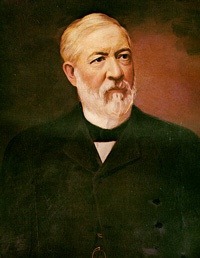 BLAINE, James Gillespie, (1830-1893) , a Representative and a Senator from Maine; born in West Brownsville, Washington County, Pa., January 31, 1830; was graduated from Washington College, Washington, Pa., in 1847; taught at the Western Military Institute, Blue Lick Springs, Ky.; returned to Pennsylvania; studied law; taught at the Pennsylvania Institution for the Blind in Philadelphia 1852-1854; moved in 1854 to Maine, where he edited the Portland Advertiser and the Kennebec Journal; member, State house of representatives 1859-1862, serving the last two years as speaker; elected as a Republican to the Thirty-eighth and to the six succeeding Congresses and served from March 4, 1863, to July 10, 1876, when he resigned; Speaker of the House of Representatives (Forty-first through Forty-third Congresses); chairman, Committee on Rules (Forty-third through Forty-fifth Congresses); unsuccessful candidate for nomination for President on the Republican ticket in 1876 and 1880; appointed and subsequently elected as a Republican to the United States Senate to fill the vacancy caused by the resignation of Lot M. Morrill; reelected and served from July 10, 1876, to March 5, 1881, when he resigned to become Secretary of State; chairman, Committee on Civil Service and Retrenchment (Forty-fifth Congress), Committee on Rules (Forty-fifth Congress); Secretary of State in the Cabinets of Presidents James Garfield and Chester Arthur from March 5 to December 12, 1881; unsuccessful Republican candidate for President of the United States in 1884; Secretary of State in the Cabinet of President Benjamin Harrison 1889-1892, when he resigned; aided in organizing and was the first president of the Pan American Congress; died in Washington, D.C., January 27, 1893; interment in Oak Hill Cemetery; re-interment at the request of the State of Maine in the Blaine Memorial Park, Augusta, Maine, in June 1920.
Comment: Known as “The Plumed Knight,” “Belshazzar Blaine” and “Magnetic Man,” his charismatic personality was a continuing focus of many in the Republican party following the Civil War until his death. Like James Garfield (Credit Mobilier), the assassinated president and also a close friend of William Walter Phelps, his reputation was tainted with allegations of taking railroad money while in the House (the Mulligan Letters), and this was perhaps the principal reason he never attained the presidency.
These political profiles are taken from the Biographical Directory of the United States Congress and the Political Graveyard (both online).
© Alex Phelps, 2006
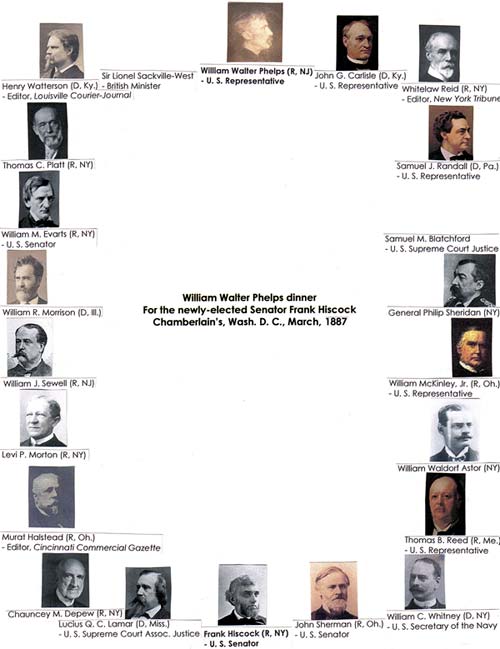
 The city is looking to preserve an important piece of Englewood and Teaneck history by developing a historical preservation plan for the Mackay Park Gatehouse, the last remaining structure of a mansion owned by a well-known Teaneck congressman.
A contract for the preservation plan was awarded to Connolly & Hickey Historical Architects, LLC during a Sept. 11 city council meeting. The city will pay approximately $22,000 to match a grant from the Bergen County Historical Preservation Trust Fund, which will be paying for half of the $44,000 contract.
The gatehouse is the last remaining piece of property from the William Walter Phelps estate from the 1880s, a massive mansion called “The Grange” that stretched throughout the area where Teaneck and Englewood are currently located.
Phelps, a congressman and ambassador to Germany, was an avid arborist who planted hundreds of thousands of trees on his property throughout his life.
According to a 1970 article from the Teaneck Shopper, roads to the local railroad stations in Teaneck and Englewood ran through the property, causing Phelps to have gatehouses built at intersections with public thoroughfares. The Grange eventually burned down in a fire in 1988 (sic ).
Documents to nominate the gatehouse for both the New Jersey and National Registers of Historic Properties will also be developed by Connolly & Hickey, which will allow the city to apply for construction grants to help fix up the gatehouse. The city has spent approximately $100,000 on repairs to the gatehouse in recent years, which included the addition of a new roof and a new boiler, said City Manager Timothy Dacey.
Not only will the restoration of the facility help preserve this final piece of Phelps’ estate, it will also provide improvements for the offices of the Englewood recreation department, which currently uses the gatehouse as its headquarters, said Dacey.
As part of the contract, Connolly & Hickey will research and develop floor plans for the building, conduct an inspection and structural assessment, and provide an analysis of heating, electricity, and plumbing needed to maintain the building, said Dacey. Work on the gatehouse is scheduled to start soon and will take place over a six month period.
Norman Davis, president of the Englewood Historical Society, was glad to see work was being done on the gatehouse, which he felt had been in “dreadful condition.”
Davis brought up the conditions of the gatehouse to the city council in March 2010, during the historical society’s 25th Annual Award Dinner. While the historical society presented the city with an award for preserving the gatehouse for many years, Davis also warned the council about the potential deterioration in the building, feeling that the Englewood Recreation Department was working in “substandard conditions.”
“I’m very glad the council is spending money to fix it up,” said Davis. “Most of the time when people see an old building, they build a new one. We don’t want to do that; [the gatehouse] has historical significance.”