
Township Managers 1930 to Present
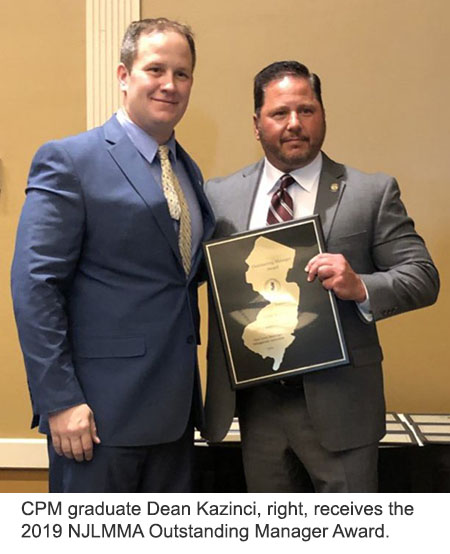 CPM Graduate Dean Kazinci Awarded 2019 NJMMA Outstanding Manager Award
by Rutgers School of Public Affairs and Administration, Newark, January 21, 2020
Dean Kazinci, Teaneck Township Manager and graduate of the New Jersey Certified Public Manager (CPM) Program at Rutgers SPAA, was awarded the 2019 Outstanding Manager Award by the New Jersey Municipal Management Association (NJMMA) during their annual conference in November. The award recognizes an administrator or manager who has successfully implemented a specific exemplary project or program within the last three years.
“I am humbled by the recognition and certain there were other hard working and dedicated managers deserving of the award,” said Kazinci. “The support and resources provided by the Teaneck Council allowed me to focus on, address, and implement new safety measures that serve to protect the community in the event of a critical railroad incident. Many thanks to Dr. Domenick R. Varricchio, Rutgers School of Public Affairs and Administration, and the entire CPM team for their guidance and support on my capstone project.”
Kazinci was nominated by Varricchio, an instructor in the CPM program and professor at Seton Hall University, for his CPM capstone project, “Municipal Preparedness for a Bakken Oil Critical Railroad Incident.” Kazinci’s project evaluated the readiness, preparedness, and resourcefulness of the Township of Teaneck as a municipality to handle a critical railroad incident involving the transportation of one to three million gallons of Bakken Crude Oil weekly on a three-mile stretch of the CSX River Line. He researched emergency procedures for critical railroad incidents, surveyed local first responders, interviewed senior staff, created a 2,500-foot buffer map to identify staging areas and evacuation routes, and developed shared services agreements with surrounding communities.
“Dean Kazinci’s capstone project not only received due recognition, but this critical information will be shared among the many municipalities potentially impacted by such an incident,” said Varricchio. “We all acknowledge Dean’s prestigious award and wish him a continued successful career in public service.”
 2019 NJ ASKEW Award Winner
From: American Academy – of – Certified Public Manager
(http://cpmconsortium.org/page-18188)
State of New Jersey CPM Graduate and George C. Askew Award Recipient
Dean B. Kazinci, Township Manager
Township of Teaneck, New Jersey
Capstone Title: Municipal Preparedness: Bakken Oil Critical Railroad Incident
Dean’s Capstone project assessed the readiness, preparedness, and resourcefulness of the Township of Teaneck as a municipality to handle a critical railroad incident involving the transportation of Bakken Crude Oil and other combustible materials on the CSX River Line. Through research and assessments, Dean was able to identify deficiencies and focus on the resources and training needed to ready Teaneck for a critical incident. Some of the topics of focus were, incident command, Emergency Management, identifying evacuation routes, mutual aid assistance, activating an audible alert warning system, opening an Emergency Operations Center, and the preservation of life and property. As a result of this Capstone Project, Dean was able to initiate, secure, and fund several assets that will better prepare Teaneck’s emergency services and provide the residents peace of mind by knowing that their families, property, and community are protected each time a freight train travels through Teaneck.
 Council Appoints New Township Manager
by Howard Prosnitz, Staff Writer
Teaneck Suburbanite, April, 22, 2009, p. 2.
Will Broughton, a Teaneck native and former captain on the municipal police, has been named the township’s sixth manager*.
Broughton, 47, who will begin his duties on May 13, will also become the first African-American to hold this position.
He will replace Gregory Fehrenbach, who has served as part-time interim manager since February. Fehrenbach was hired after the council removed Helene Fall in January.
At an April 13 council meeting, all six members present voted to appoint Broughton.
Broughton will resign from the Bergen County Sheriff’s Department where he has served as chief since 2005.
In an interview with Teaneck Suburbanite , Broughton said he was excited to be returning to Teaneck.
“I look forward leading the wonderful work force that we have there and to making Teaneck a model in efficiency and excellence,” he said.
The son of a New York City bus driver and a homemaker, Broughton was born and raised on Hubert Terrace. He attended Bryant and Whittier schools, Benjamin Franklin Middle School and graduated from Teaneck High School in 1980.
Although his ambition was always to become a police officer, Broughton worked for several years after high school at Ken’s Auto Repair on State Street and Teaneck Road.
In 1983 he joined the Teaneck Police Department as a patrolman.
He was promoted to sergeant in 1988 and detective lieutenant in charge of the youth bureau in 1991.
He also served as lieutenant incharge of the detective bureau.
In 2002 he was promoted to captain, serving as different times as administrative captain and patrol captain.
“I had a wonderful career in Teaneck,” Broughton said, describing his time in the youth bureau, where he worked alongside current Police Chief Robert Wilson, as one of the most enjoyable parts of this career.
In 2005 Sheriff Leo McGuire invited Broughton to come to Hackensack and join the sheriff’s department.
When the manager’s position became available in Teaneck, Broughton received numerous calls from people urging him to apply.
“I saw a void that I believe that I have the skills and ability to fill and to be instrumental in helping Teaneck grow,” said Broughton, who is a certified municipal manager and has also earned a bachelor’s degree in criminal justice from New Jersey City University and a master’s degree in administrative sciences from Fairleigh Dickinson University.
One of his first priorities is to put Teaneck in a firm financial position for 2010 and subsequent years.
“These are very challenging times financially. Everyone will have to pull together and make sacrifices. I want to have a good relationship with labor so that we can be more progressive and efficient.”
Other concerns including youth issues and the township’s aging infrastructure.
Broughton will seek to work with school officials to develop strategies so that Teaneck teenagers are not caught up in the gangs that are proliferating throughout the nation.
Concerning the infrastructure, he notes that many township-owned buildings are in need of repair. Employees in the municipal offices are cramped for space and space problems also exist at the DPW yard.
Broughton declined to comment on the successful lawsuits against the township by former Police Captain Diane Mancini and former Patrolman John Shouldis, both of whom he worked with.
He was also on the force in 1991 when Officer Patrolman Gary Spath shot and killed black teenager Phillip Pannell.
“It was a very troubling time, but Teaneck has come out of it a stronger and more united town,” Broughton said.
As chief in the sheriff’s department, Broughton’s duties have included heading the internal affairs division. He is espacially proud of leading a delegation of sheriffi’s and state police officers in New Orleans after Hurricane Katrina.
“We searched many homes and found bodies inside. We handed out food on the street. People did not have shelter. It was a very humbling experience.”
A resident today of Jackson, Broughton’s wife Sandy is an administrator at Ocean County College.
The couple has four children: Gabrielle, 5, Ariana, 3, Robert, 18 and Stephen, 23.
Mayor Kevie Feit noted that the council had received more than 30 applications for the position, interviewed eight candidates and called three back for a second interview.
“We are very excited about this choice,” said Feit. “He has experience managing budgets and experience with the civil service commission.
He is a product of Teaneck and understands the issues affecting us.”
In an e-mail, Councilman Elie Y. Katz concurred.
“I am proud to support Broughton. Brougthon has excelled in every position he has been in during his professional career. He will bring a much needed new direction and working environment to our municipal organization.”
* Should be the seventh manager. — corrected by Teaneck Public Library.
Teaneck Hires Ex-cop as First Black Manager
By Joseph Ax, Staff Writer
The Record, April 15, 2009, pL03.
The town has hired William Broughton, a former township police captain and an undersheriff in the Bergen County Sheriff’s Department, as its next municipal manager.
The decision came Monday at a workshop meeting of the Township Council. Broughton, 47, will be the town’s first black manager.
“I’m very thankful and very humbled by the opportunity that you’ve given me to serve as manager,” Broughton said.
“I look forward to coming back to Teaneck and leading this workforce and developing a harmonious relationship.”
The Jackson resident, a graduate of Teaneck High School, will begin work on May 18 at an annual salary of $157,000.
He arrives in the manager’s office during a tumultuous time for the town, with the specter of layoffs hanging over dozens of employees.
As he delivered a few remarks at Monday’s meeting, Broughton turned around to address the rows of employees sitting inside the council chambers, vowing to build mutual trust.
“This is a bold council,” he said. “They decided they wanted things managed in a different way. And that’s why I’m here. I’m here because the council has chosen a different path.”
The vote was 5-0. Deputy Mayor Lizette Parker, whose husband works for the sheriff’s department, abstained but said she supports Broughton.
Broughton replaces Helene Fall, who was fired from her position in January, three weeks after a $4.1 million jury verdict against the town in a harassment case.
Broughton, a 22-year veteran of the police force, said he thinks his career as a Teaneck employee would serve him well.
“I think I’m going to be able to develop relationships with the unions and the employees, which are our most valuable resource,” he said.
Broughton is no stranger to the political tensions in town. Fall rejected his request to go on leave when he left Teaneck for the sheriff’s department in 2005.
He sued the town and eventually dropped the lawsuit as part of a settlement in which he resigned.
Broughton said that as the first black manager of the town, he felt he was “standing on the shoulders of others” — including the late Frederick Greene Jr., Teaneck’s first black police officer.
Broughton and his wife have four children, ages 3 to 22.
 Fall Promoted to Township Manager
By Kate Brex
Teaneck Suburbanite, May 30, 2001, p. 1
After two years as deputy township manager and nearly five months as acting township manager, Helene Fall will become the first female top administrator in Teaneck history.
As expected the council, in closed session May 22, approved Fall’s appointment as township manager, taking effect through a June 12 public vote, but retroactive to June 1.
Fall has been action township manager since January, when Township Manager Gary Saage retired after serving the town as chief financial officer, deputy township manager and then manager since the mid-1960s.
“This has always been a dream of mine,” said Fall. “When I was 13 years-old, I wrote a report for school on the council-manager form of government. I have been interested in municipal government ever since. And being town manager of Teaneck is a dream come true for me. I have come home.
Teaneck is one of the best places to exercise her administrative muscles, said Fall, due to the truly dedicated elected officials, staff and volunteers. She doesn’t do it alone. With a town as complex as Teaneck, Fall’s feet are firmly planted on the ground she explained. She does the best she can.
“I’m honored to be working with and for the council and the residents of Teaneck”, she said.
The council did not consider any other applicants for the job because everyone, including council, employees and community leaders all agreed that Fall has done an exemplary job since rejoining the Teaneck in November 1998, Mayor Ostrow said.
“We have all watched Helene over the last year,” said Ostrow. “She is a highly motivated, highly principled, hardworking woman.”
Fall, 40, was born and raised in nearby Hackensack. She attended Douglas College, where she majored in political science and Italian literature and graduated in 1982. She earned her master’s degree in public administration from Fairleign Dickinson University.
In 1985 Fall joined the Teaneck team as former Town Manager Werner Schmid’s assistant. After Schmid’s retirement, she became administrator first in Bernards Township and then back to Bergen County in Montvale.
She resides in Teaneck with her husband, Fred, a former lieutenant in Teaneck’s Fire Department. She has two grown stepchildren.
Deputy Mayor Yitz Stern is very enthused that Fall has indicated Teaneck is where she would like to be for the rest of her career.
“She is in the frontlines,” said Stern. “I know from personal experience and from talking with residents that she is at the top of her class. She is responsive and responsible and with a responsive government she will help foster a good feeling within the community.”
Teaneck’s Acting Manager is Moving Up
By Adam Lisberg, Staff Writer
The Record, May 24, 2001, P. L3
Bergen County’s second-largest community is handing the reins to its first female manager.
The council Tuesday night named Helene Fall township manager, effective June 1. Fall spent two years being groomed for the position as deputy to Gary Saage; for the past five months, she has served as acting manager while Saage uses up his vacation time.
“Teaneck is definitely a dream come true for me,” Fall said Wednesday. “Teaneck represents the best of what municipal government can be.”
Fall said while female managers are few and far between in New Jersey municipal government, she doesn’t see her appointment as any sort of breakthrough for women.
“I don’t feel like I’m breaking a barrier,” she said. “I just feel like I’m capable of doing a lot for this community.”
The council did not consider other candidates for the job because employees, council members, and community leaders all said they were impressed with Fall’s performance since she joined Teaneck in November 1998, Mayor Paul Ostrow said.
“The council over the last year has been watching Helene very carefully,” Ostrow said. “She is a tremendously hardworking, highly motivated, highly principled woman.”
Fall, 40, was born and raised in Hackensack. She graduated from Douglass College in New Brunswick in 1982 with a double major in political science and Italian literature, then earned a master’s degree in public administration from Fairleigh Dickinson University.
Fall first worked in Teaneck from 1985 to 1989 as an assistant to Werner Schmid, township manager for 29 years.
She left Teaneck soon after Schmid retired, serving as an administrator in the Somerset County community of Bernards Township and then in Montvale.
“It’s a strange feeling for me,” she said. “When I started my career over 16 years ago … there was always a small hope in me that I would have the opportunity to come back to Teaneck.”
Fall, who will be paid $121,000 annually, lives on Monterey Avenue in Teaneck with her husband, Fred, whom she met during her first stint working in Teaneck, when he was a lieutenant in the Fire Department. She has two grown stepchildren.
“Teaneck is not a steppingstone for me,” she said. “Teaneck is where I really want to be for the rest of my career.”
Teaneck Hires Montvale Official to be Deputy Town Manager
By Don Stancavish, Staff Writer
The Record, September 24, 1998, p. L3
After six years without a deputy municipal manager, Teaneck has hired one.
Helene V. Fall, borough administrator of Montvale, is scheduled to become deputy manager on Nov. 16, Township Manager Gary Saage said Wednesday.
Fall, 38, will assist Saage in one of the largest municipalities in Bergen County, with 38,000 residents, 400 employees, and a $40 million annual budget for full-time police and fire protection, the Department of Public Works, the Health Department, and other services. She will be paid $85,000.
Fall is expected to assume a community- and public-relations role, responsibilities that Saage could not always undertake because of his other duties, said Mayor Paul Ostrow.
“She will be able to fill a gap that has been present in our administration for years,” he said. “With a town of our size, we should have more than one person in a managerial position to work with the public and with the work force.”
The mayor said Fall would seek to improve links between the township and residents, pointing out the possibility of a township newsletter, a community calendar, a 24-hour phone line for residents, and announcements via cable television and the Internet.
Fall is expected to succeed Saage when he retires, township officials said. Saage, 64, has talked with the township about retiring in two to four years.
Fall, a Hackensack native, has worked in Montvale for five years. Before that she was an assistant township administrator in Bernards Township. She worked with Saage in Teaneck when he was chief financial officer.
She holds a bachelor’s degree in political science from Douglass College of Rutgers University and a master’s degree in public administration from Fairleigh Dickinson University. She lives in Montvale but intends to move to Teaneck.
 Teaneck appoints familiar face as acting manager
By David Voreacos, Staff Writer
The Record, June 2, 1991
One day after firing Jack Hadge, Teaneck’s Township Council has agreed to bring back an old hand to run the township government.
In a closedd session Friday, the council appointed former Chief Financial Officer Gary S. Saage as acting manager until it finds a permanent replacement. Saage, who must be confirmed in a public vote Tuesday, will start immediately.
“I look forward to coming back and being with all my employees,” said Saage, a 57-year-old township resident. “I feel comfortable there. I spent 24 years of my life there. I bleed Teaneck blue, to paraphrase [Los Angeles Dodgers manager] Tommy Lasorda.”
Saage said he is interested in permanent appointment, but the council plans a search, which could take several months.
Thursday, the council voted, 5-2, to fire Hadge effective July 1, and to suspend him until then. Hadge can request a hearing in the next month.
Hadge, who had come under increasing fire, was criticized in a council resolution that cited his alienation of township employees, his poor relations with reporters and the public, and his withholding of information from the council.
The council apparently believe that such problems will not arise with Saage. He is regarded as an honest, tightfisted administrator who values integrity in government workers.
“I feel very positive because of Gary’s background in finance and his complete unterstanding of state law,” said Mayor Eleanor Kieliszek. “He understands what the council desires. The council makes policy and he expects to carry it out.”
Saage had worked for the township for 24 years when he began a terminal leave in November, citing pholosophical differences with Hadge. Saage also served as acting township manager from August 1988 to February 1989, when Hadge came to Teaneck from Niles, Ill.
Saage, who will make Hadge’s salary of 85,000, faces several immediate hurdles. The township has yet to pass its 1991 budget, the Police Department has been without a chief for six months, three municipal unions are working under expired contracts, and Hadge left many employees disspirited.
In addition, the township still is struggling to initiate solutions to social problems exposed by the fatal shooting of Philip C. Pannell, a black 16-year-old, by policie official Gary S. Spath, who is white. Spath is to be tried on a charge of reckless manslaughter.
Saage said he will first set his attention to studying the $29.1 million budget proposal. He said he probably will change the way the township finances capital improvements and will appoint one of the three police captains as chief within the next month.
Restoring a free flow of information to the Township Clerk’s office — which often feuded with Hadge — also is a priority for Saage.
“I absolutely believe in open government,” said Saage, who added that he will follow the example of former Manager Werner Schmid, who retired in 1988 after more than 30 years in township government.
“Werner Schmid set the standard for me as a model of a well-run goverment in New Jersey,” Saage said. “we had a team spirit under him, and I just want to reestablish that as best I can. I want to restore a sense for employees that they’re working in a professional environment and they’re feeling good about their work.”
After fireing Hadge, the council also appointed his deputy, Henry Ross, as interim manager until an acting or permanent replacement was found. But on Friday the council decided that Ross will continue in his role as deputy, Kieliszek said.
Teaneck manager prepares to retire; Council plans for transition
By Don Stancavish, Staff Writer
The Record, October 10, 1997, p. L1
Township Manager Gary Saage, a fixture in Teaneck’s municipal government since Lyndon Johnson was president, is expected to announce his retirement Tuesday night.
Saage, 63, has been privately discussing his departure with the Township Council and with department heads in Teaneck since June, sources said. This week, Saage acknowledged that he broached the topic recently with municipal officials.
“I felt it was time to bring it up,” he said. “I care very deeply about this community, and I didn’t want to leave it in the lurch. …I wanted to tell them that I had seen the light at the end of the tunnel.”
At this point, Saage and municipal officials say details of his retirement are not in place yet — including the date when Saage is expected to leave. But Saage has provided Teaneck with a “window,” meaning he could step down any time from six months to two years after Jan. 1, 1998.
Sources say the township is considering hiring a deputy manager while Saage is still working to provide a transition between the old and new managers.
The council this year appropriated $50,000 to hire a deputy manager to handle public and community relations in Teaneck. so far the township has not taken action on the matter.
Saage is Teaneck’s most important and powerful non-elected official, presiding over a payroll of 400 municipal employees and a 33.4 million government that is one of Bergen county’s largest.
Teaneck’s government includes full-time police and fire departments, a library, a health department, and a recreation department.
Saage, a Teaneck resident since 1967, is paid about $106,000 a year and is due soon for an annual raise that would bring his pay to $108,000, officials said.
Teaneck Mayor Paul Ostrow would not comment in detail on Saage’s retirement, but he said Saage “is looking to participate in a transition that will maintain the high caliber of Teaneck’s government.”
Ostrow said the township is seeking “a smooth and careful transition” in hiring Saage’s sucessor. Of Saage, he said: “Gary is a gentleman of high integrity whose primary interest is the wellbeing of Teaneck.
“In 20 categories, he gets high marks in 15 to 18 of them,” Ostrow said. “He’s not perfect. But nobody is, and neither will his successor.”
“Saage’s supporter credit him with coming up with ways to cut costs and keep municipal taxes relatively low. But Saage has been publicly criticized recently by some council members, who say the manager is not responsive to residents’ problems and has created addversarial relations between Teaneck’s government and its employees.
“The town desperately needs a manager who is adept at community relations and at conflict resolution,” said Councilman Leo Wielkocz, one of Saage’s critics.
Saage began working in Teaneck in 1966 as a finance officer, and after rising to chief financial officer he announced his retirement in 1990.
But just a few months after he left Teaneck, Saage was appointed acting manager in June 1991 when the council fired Township Manager Jack Hadge. Hadge had been criticized by township officials for uneasy relations with the council and the public. Saage later was appointed permanent manager.
“This is a big job,” Ostrow said of the manager’s post. “Teaneck is a vibrant, exciting, and complicated town.”
Teaneck Manager Likely to Step Down
Deputy Would Take Over Temporarily
By Adam Lisberg, Staff Writer
The Record, December 19, 2000, p. L3
Township Manager Gary Saage is expected to announce tonight that he is closing the book on more than three decades of watching over the business of Teaneck.
Saage, a 66-year-old Teaneck resident, declined to discuss his plans before tonight’s Township Council meeting. His last day of work will be Jan. 12, but he will stay on the payroll until June 1 by virtue of unused vacation time.
Helene Fall, who was hired as Saage’s deputy two years ago, has been groomed to succeed him and is expected to be named acting manager when Saage leaves. She has already taken over some of the position’s major responsibilities, such as preparing next year’s budget and negotiating new contracts with Teaneck’s labor unions.
Saage is the chief executive officer of Bergen County’s most populous municipality (38,345 in 1998), overseeing a $40 million budget and a staff of 400; the heads of every municipal department report to him.
“I have a lot of praise for Gary. He’s done a lot of good for this town,” said Mayor Paul Ostrow. “He’s firm but fair to employees, and he runs the town like a business.”
Saage started working for the town in 1967 as a fiscal officer, and is known as a sharp-eyed guardian of Teaneck’s funds. He resigned from the township in 1990 after a conflict with the manager at the time, but when council members fired that manager less than a year later, they asked Saage to take the post.
In addition to his $121,637 salary, Saage receives five weeks of vacation and three weeks of sick time each year. When his resignation takes effect June 1, he will be compensated for half his unused sick time.
He still works with a calculator and a ledger book. There is no computer in his office.
Under his leadership, Teaneck became one of the first self-insured communities in New Jersey, saving millions in insurance premiums; the township also carries no long-term debt. However, Saage has been criticized as an autocratic manager who created adversarial relations between municipal managers and employees.
“He’s opinionated and he’s stubborn, but he’s willing to listen,” Ostrow said.
Day in the Spotlight for Teaneck Manager
Saage Honored on Eve of Retirement
By Adam Lisberg, Staff Writer
The Record, December 20, 2000, p. L3
After 34 years of service to the township he calls home, Gary Saage is finally getting some time to himself – and a day of his own.
Today is “Gary Saage Day” in Bergen County, in honor of the Teaneck township manager’s impending retirement.
Bergen County Executive William “Pat” Schuber surprised Saage with the honor Tuesday night at the start of the Township Council meeting, where Saage formally announced his retirement.
“This township has progressed immensely with Gary’s help,” Schuber said. “He’s a unique treasure, and I want to wish him well in his retirement.”
Saage, 66, will put in his last day of work Jan. 12, though he will stay on the payroll through May 31 using vacation time. He will begin his time off with a monthlong trip to Florida.
“It is time to be realistic and think about winters in the sun,” Saage said, “with a great wife who has endured living in a fishbowl as the spouse of a public official instead of the accountant she met and married 41 1/2 years ago.”
Saage recommended that Deputy Manager Helene Fall, who came to Teaneck two years ago and has been learning the ropes under Saage, be named acting manager when he leaves. She has already taken charge of negotiating union contracts and preparing next year’s budget.
Saage became a master of township finances during his first 23 years as a Teaneck employee, when he worked his way up to chief financial officer. He left that job in 1990 to work in the Hackensack treasurer’s office, but Teaneck’s council asked him to return the next year.
Saage took over a troubled town when he was hired as manager in 1991. The previous manager had left under a cloud of bitter relations with the council and the public; the budget, labor contracts, and hiring all were months behind schedule; and the town was being criticized for white Police Officer Gary Spath’s fatal shooting of a fleeing black teenager, Phillip C. Pannell. Spath was acquitted of reckless manslaughter.
“We were going through very difficult, tumultuous times,” said Mayor Paul Ostrow. “He did a wonderful job in helping bring the town back together after the turmoil of 1990.”
Nine years later, things are quieter in Teaneck. Council meetings don’t dissolve into post-midnight bickering, police officers operate out of a modern building, and officials say the town’s finances are in fine shape.
However, the same take-charge style and strong will that helped bring order to a fractious town has earned Saage some detractors.
In two recent lawsuits, firefighters claimed they were singled out for unwarranted discipline after complaining about working conditions or grievances; they also went three years without raises during a protracted contract battle.
Saage, who metes out some employee discipline and negotiates contracts, was personally named in at least three lawsuits. One suit was dismissed, another is pending, and Saage was found liable for $150,000 in punitive damages in the third claim – a ruling that is likely to be appealed.
Some town officials, when granted anonymity, acknowledge that Saage’s hard-nosed approach to labor negotiations was at times counterproductive. Still, there was nothing but praise for Saage on Tuesday night, as council members thanked him for his service to Teaneck.
Meet Manager Jack Hadge
By Beverly O’Shea, Staff Writer
The Suburbanite, Wednesday, February 15, 1989. p. 5
Jack Hadge received some bad news during his first week as the new township manager.
A letter from Trenton informed Hadge that the townsip will not receive an expected $250,000 in state aid — which amounts to almost another tax point that will have to be collected to pay for the nearly $25 million proposed township budget.
Council members were hoping to keep the tax increase to six or seven cents despite already mandated large increase for the Bergen County Utility Authority sewer operations and health insurance coverage.
During an intervew last week, Hadge faulted Gov. Thomas Kean for coming in with a state budget showing a very slight increase while municipalities are left to pick up the expense of drastically reduced aid.
“I believe that it bacome an important priority of the state of New Jersey to recognize that the local property tax cannot constantly be relied upon to provide the revenue base to provide services,” Hadge said.
Hadge said the cuts in state assistance, added to the state-mandated services that have to be paid for by local taxes, really hit municipalities like Teaneck that are primarily residential communities. The Township, which was planned to be mostly homes, has no commercial base to generate revenues other than the property tax, the manager pointed out.
Teaneck was told a few months ago to expect aid of $250,000, Hadge said. The township received a letter Feb. 7 about the cut. “We were depending on it,” he said.
The new manager had started off the week by arriving early Monday morning. Asked what he would do first. Hadge said, “I want to hear and listen. That’s the best way to start.”
By the time of his interview with The Suburbanite, the new manager had spent hours listening and learning. He had been through his first council meeting, talked with dozens of people, visited most Teaneck departments, including the main firehouse, and appeared at a police roll call to talk with the officers.
During his first week, Hadge had even offered to remain in his town hall office to meet with a resident who has a problem, but couldn’t make it back to town from work until 6:30 p.m.
Hadge said his initial observations have led to a big concern about what he called Teaneck’s infrastructure, especially the age and condition of the equipment and buildings used by the township government agencies. He cited the recreation department offices in the old Town House as “a classic example of my concern.”
The department staff, he said, has outdated equipment and needs an “improved working environment.”
Safe working conditions are high on his list of priorities. On his first day he made his way through the various departments in the town hall, introducing himself to those who work for the township.
When asked Friday what he thought of Teaneck, Hadge said that in his short time here he found the township most appealing aesthetically. He especially likes the diversity of the community’s residents, he added.
As to why he accepted the job when he knew of the council dissension about the financial arrangements for his appointment, Hadge answered: “I enjoy professional challenges.”
During the pre-employment interviews, he added, the council members presented a series of concerns. “I believe I’m the man to meet those concerns and challenges.”
Hadge said he also like change, as evidenced in his record of serving in about seven different types of government operations. Incidentally, he added, in the position he just left as manager of Niles, IL, he also succeeded a manager with a long history of service. He was referring to his predecessor in Teaneck, Werner Schmid, who served the township for 33 years before retiring Jan. 1.
The new manager also likes New Jersey. “If Teaneck were in Maryland or in New Hampshire, I wouldn’t have applied,” he said.
Hadge explained that he did not think the situation with his not-yet-completed contract would have an affect on his performance for the township.
Although he had only been here a week, Hadge agreed to talk about his first impressions. He said he does not allow reporters to use tape recorders, though, because of personal preference.
Asked about the similarities with his situaiton in Illinois, Hadge said Niles was “looking for organizational change” when he went there five years ago. “Similar needs exist here,” he said.
“MY style of administration is to listen,” he declared, adding “After a vast amount of experiences, large and small, I can arrive at conclusions and recommendations.”
When explaining his recent stop at the police roll call, Hadge said, “You might even see me riding in a police cruiser. That’s the type of manager I enjoy being.”
The council has a big list of concerns it planned to discuss with Hadge at the Feb. 14 meeting, where the members also expected to set priorities they want the manager to follow.
“My general goal, ” stated the new manager, “is serving the community.”
Hadge said public information involving situations in the township, such as the details of the fire-protection problems at Teaneck Nursing Center, will be disclosed to the newspapers and the public.
Before Hadge arrived, Acting Township Manager Gary Saage declined to release the information about fire department charges against the nursing home.
Penalty fines against the nursing home had mounted to more than $200,000 before the information was available at a hearing. Hadge agreed the department activities are public information . He added that personnel information has to be judged differently and by individual case.
The manager added, “One of the characteristics of any government should be its responsiveness to its citizens.”
Hadge concluded by saying he wants to instill that philosophy among all employees, starting with department heads.
 Vital Statistics: Jack Hadge
The Suburbanite, Wednesday, February 15, 1988, p. 5
Name: Jace Hadge
Age: 44
Education: University of California, Berkeley – B. A., M. B. A.
University of Hartford – M. P. A.
Employment: Teaneck township manager, Feb. 6, 1989.
Viliage manager, Niles, IL. 1983-1989
Treasurer and finance director, Ocean City, NJ. 1979-1983.
Executive director, management and budget, Newark (NJ) Board of Education, 1977-1979.
Budget administrator, Howard County, MD, 1976-1977.
Finance director, chief administrative assistant to town manager, Chapel HIll, NC, 1974-1976.
Principal administrative analyst in city manager’s office, Hartford, CT. 1972-1974.
Visiting lecturer on administration and finance at the University of Hartford, 1973-1974.
Schmid Made Town Manager: 29-Year-old Youngest for Teaneck
Sunday Sun, March 27, 1959
Werner H. Schmid of 96 Ayers Ct., a 29-year-old husband and father, has reason today to celebrate and meditate.
He has become Teaneck’s youngest Township Manager.
His salary has jumped overnight to $9,500, an increase of $3,230.
And he faces the challenge of administering affairs for Bergen County’s larest municipality.
However, for a few minutes during Tuesday night’s Council meeting, Mr. Schmid’s future was in doubt. councilman Milton G. Votee had mislaid the formal resolution naming him to his new post.
Vainly searching through his notes, Mr. Votee admitted the appointment was the most important business of the night, declared in apologetic tones that he had asked for the privilege of announcing it.
Township Attornery Leland F. Ferry stepped forward with a copy of the resolution, and Mr. Votee, settling back, read Mr. Schmid into the post vacated Jan. 31 by James T. Welsh. The former manager left Teaneck to take a $15,000 a year job as Deputy Director of Ohio’s Highway Department.
The appointment received the unanimous approval of Councilmen and a strong round of applause from some 25 residents attending the meeting.
Councilman Thomas J. Costa told the audience that 140 applications were carefully considered before the council made its choice. “We know the type of man Mr. Schmid is,” he said. “The others are good, but we don’t know them like we do Werner.”
Mr . Votee said he had long been convinced that Mr. Schmid was the best man for the job. “He will prove to be the best Township manager Teaneck has ever had,” said the veteran Councilman. “He has been more of a student of municipal government than even our first manager, Paul A. Volcker.”
Councilman S. Bradford Menkes noted that the appointment “was not hastily conceived,” and said he feels that “Township employees will enjoy working with Mr. Schmid as much as we will.”
In a prepared statement, Mayor Matthew Feldman pointed out that the 140 applications for the post were a “flattering” indication that many men in the city management profession feel Teaneck would be a good place to work.
“After much study and discussion,” the Mayor said, “we came to the conclusion that none of the candidates had better qualifications than Mr. Schmid, although I hasten to add that many of them had excellent professional backgrounds. Mr. Schmid, however, offers the unique advantage of several years of experience in our town as assistant to the former Township Manager.
“This means he will be able to step into his new post smoothly and without the necessity of a period of indoctrination. He is familiar with the Township’s problems and has demonstrated good administrative ability.”
Outlining Mr. Schmid’s activities since he became administrative assistant to Mr. Welsh in December of 1955, the Mayor noted that the young official “assisted in the preparation of the budget and the annual report, performed administrative research, prepared ordinances and assisted in personnel management.
“He was responsible for the supervision of the maintenance of public buildings and grounds, directed the street lighting program, acted as a purchasing agent and investigated residents’ complaints.”
“As for his scholastic background,” the Major added, “he was graduated from Rutgers University with a bachelor of arts degree in political science, economics and history in 1951. He attended Rutgers on a four-year State scholarship and achieved scholastic distinction as a member of Phi Beta Kappa and other honerary societies. He was seventh from the top in a graduating class of 561.”
The Mayor noted also that Mr. Schmid holds a master’s degree awarded in 1952 by the Maxwell School of Public Affairs, Syracuse University. In 1956, Mr. Schmid completed an eight-week course in “Principles of Local Planning” at the extension division of Rutgers, and in 1957 he was graduated from a correspondence course in “Techniques of Municipal Administration” by the International City Managers’ Association.
From August, 1952, to November, 1955, as a lieutenant in the U. S. Air Force, Mr. Schmid served as an administrative supply and personnel officer.
Responding to the applause which greeted his appointment, the new Manager acknowledged the responsibilities for his job and thanked Councilman for their confidence. “I will do my upmost to serve the Township,” he said.
Councilman extended formal thanks to Township Clerk Miss Clara Christensen, who has acted as Township Manager since Mr. Welsh’s departure Jan. 31.
 The man who runs Teaneck
By John Koster, Staff Writer
The Record, November 4, 1977
If you can imagine a computer with a mind and will of its own, you’ll understand how many Teaneck residents feel about Township Manager Werner Schmid.
Joseph J. Squillace, Schmid’s fellow manager in Hackensack, has called Schmid one of the finest and most brilliant professional managers he’s ever met. Others have called him indispensible. Some have called him sinister.
But he remains something of an enigma to most of the 42,000 residents of Bergen County’s largest community.
Schmid veers away from any issue that could be construed as partisan politics. He keeps a low profile — except when he feels Teaneck’s welfare is involved.
Recently he took on Conrail for what he called the routing of trains carrying dangerous chemicals through Teaneck. Schmid dashed off letters to Washington and to Conrail and is trying to enlist the support of local authorities in getting advance warning of dangerous cargoes.
Dispite this furor, the quiet, empirical manager tries not to seek publicity.
It is about 10 in the morning when Schmid arrives at the Municipal Building to take command of his staff of about 300 township employees.
For about an hour before he arrives, Schmid’s been driving around, taking notes on potholes, illegally parked vehicles, fallen tree limbs, and spilled garbage. Shortly after he gets to work, the staff will get a multipage memo about the infractions.
“He’s a detail man, very much so,” says Township Clerk Roz Endick. “The one thing you cannot do around here is to submit a report that’s one bit less than complete. “no way is he going to accept less than a complete report, on anything.”
Through Schmid’s drive for perfection is relentless, he doesn’t alienate his staff. Most of the senior municipal employes who work with him not only are supportive. but protect Schmid and his reputation.
“This township has a reputation as one of the cleanest in the state — in every respect,” Mr. Endick says. “There’s no corruption here, and there’s efficiency.”
Some lower-lever employes — the ones Schmid has to negotiate with on salaries — tend to be negative however. While the police generally praise Schmid for doing a hard job well, some of the fire fighters, who have just started their third year of talks on the 1976 contract, say they’d like to strangle him.
The Department of Public Works men hung him in effigy during their brief strike last autumn. And occasional crank phone callers who blame him for almost anything call him up to scream obscenities.
“Show me any other $10-million business where the man in charge answers his own phone,” Mrs. Endick says. “We’ve tried to convince him to have his calls screened, buy he won’t do it.
The townspeople are of two minds about Schmid. No one who knows anything about him seriously suspects him of any fiscal wrongdoing or malfeasance. The worse thing he is accused of is arrogance.
This impression probably comes from the twice-monthly Township Committee meetings. Depending on the issue and the hour, the council meeting can resemble anything from a bland college seminar to the mad hatter’s tea party.
The unflappable Schmid never seems to lose his cool and strikes onlookers as a sinister figure among the ebullient council members. Some residents seem to think Schmid is the one who pulls the strings behind anything that happens in Teaneck — a sort of Bismarck presiding over a rebberstamp Reichstag. The people who really hate him lika to pronounce his name with a mock German accent.
“some people who come to council meetings get mad at Werner bacause they don’t understand his function,” says Mayor Eleanor Kieliszek. “Usually, in the long run, they wind up respecting him. Unexpected things don’t usually happen to Werner, because he comes well prepared.”
Schmid’s role is not so much the man behind the throne as the man divorced from all politics. This policy originated in 1930, when the strong manager form of government was adopted in Teaneck, which is nonpartisan.
The Township’s population had risen 300 per cent between 1920 and 1930, from about 5,000 to 16,000. Expenses staggered the taxpayers, while council meetings became incredibly windy as many residents repeatedly spoke on the same subject.
In 1930, the Teaneck Taxpayer’s League stumped successfully for a nonpartisan form of government in which a full-time manager would run the business affairs, while candidates ran for office as individuals rather than members of parties or slates.
Paul Volcker, a civic engineer hired as the first manager, showed his devotion by serving as township engineer at $1 a year.
James T. Walsh succeeded Volcker in 1950. In 1955, Schmid, then a recent graduate of the Maxwell School in Syracuse, after serving in Korea and a summa cum laude diploma from Rutgers, came to Teaneck as Welch’s assistant. When Welsh retired in 1959, Schmid, said by some to be too young for the job at 29, beat out 140 applicants for the job.
Under Teaneck’s government, Schmid hires, fires, and promotes employes, supervises the preparation of the municipal budget, handles salary negotiations, and provides direct supervision of the police, fire, DPW and engineering departments. he cannot be removed from office except for proven misconduct. He owes political allegiance to no one.
At one time, veteran Councilman Max A. Hasse was regarded as the head of an anti-Schmid faction on the council. He claimed in 1974 that Schmid, then making $37,500, was overpaid, and that he didn’t need two assistant managers. Hasse is gone – he retired in January – and there’s an anti-Schmid faction on the council now, the members don’t identify themselves. Schmid’s present salary is $41,000, and nobody says he’s overpaid.
Schmid’s workweek is unpredictable. The only sure fact is that he usually puts in a good deal more than 40 hours. Twice-monthly council meetings, and the twice-monthly council work sessions the night before are usually good for five hour each, and at budget time Schmid often uses the office nights and weekends for the quiet environment necessary to calculate the budget.
The big issue for Schmid this year has been Conrail. On July 4, a Conrail train stalled on the tracks behind the Volunteer Ambulance Corps headquarters on Windsor Road and leaked anhydrous ammonia fumes. The irritating gasified fertilizer alarmed the ambulance corpsmen. The corpsmen evacuated about 29 homes. There were no injuries.
Schmid then took up the cudgel, asking the state Public Utilities Commission to demand that the railroad provide advance notification when they ship hazardous materials through Teaneck.
The PUC said that the realroads felt this was unnecessary. Schmid wrote back, questioning if the PUC supervised the railroad, or the other way around.
He also wrote to the Federal Transportation Commission in Washington to press his case, and discovered a way that computerized date could be delivered instantly to local police in case of chemical spills.
The matter isn’t settled, but nobody who knows Werner Schmid is betting on the railroad.
Township Manager Schmid – He keeps Teaneck ticking
By Peg Shaw
The Record, April 14, 1975, p. L1
Under Werner H. Schmid, the Township of Teaneck runs like a Rolls Royce engine, says a longtime observer.
The loud knocks and political sputterings that accompany routine government decisions in many other Bergen County towns hardly can be heard in Teaneck.
Those decisions are made without the Township Council’s lifting a finger — except to rubber stamp items in Township Manager Schmid’s calculated-to-the-penny budget.
Under Teaneck’s strong manager charter, Schmid is the chief executive, directing the day-to-day operation of government.
He is given many of the powers that mayors possess in most other municipalities — and he can be removed from office only on proof of misconduct.
 No favors owed
He — not the council — hires, fires and promotes employes. Schmid’s cabinet mambers owe no loyalty to any elected official.
For 16 years, Schmid has exercised his authority with an attitude that a longtime Town Hall watcher says is one degree below arrogance.
Schmid calls it professionalism.
Roads don’t fall into disrepair in Schmid’s domain. He regards chronic potholes as unprofessional.
No other Bergen County town inspects eating places as thoroughly or brings building code violators to court with such speed.
Store owners are regularly reminded that Teaneck employees don’t accept as much as a free cup of coffee.
Prompt and courteous
When residents call Town Hall with complaints, Schmid’s employes generally give the problem prompt, courteous treatment.
Their style is Schmid’s own: He runs his town with a blend of a firm hand and charm.
“He carries his straight arrow attitude into everything he does,” said one township employe who asked that his name not be used.
The employe said,”The emphasis in this town is to be fair to people, whether we like them or not.”
Joseph J. Squillace, neighboring Hackensack’s manager under an identical charter, says, “He’s one of the finest and most brilliant professional managers I’ve ever met.”
Squillace says Schmid has the reputation among other managers as a student of government second to none. Schmid — who recently served a term as vice president of the International City management Association — has said he cares more about the opinions of his professional peers than the views of the residents who pay his $41,000 salary.
According to Squillace, Schmid has proved over the years that he is willing to stand up for what is right, rather than do what is popular.
Nearly everyone who has been in close contact with Schmid can tell a personal story of how the manager refused to grant a small favor on grounds of principle or how he intervened when a council member or outsider threatened to meddle with one of his employes.
Schmid continually pleads with the council members to think about long range implications of their actions. Says Schmid: “After all, I have to live with all the consequences of all the decisions. This town isn’t only the place where I live. It is also my profession. So in a sense, I have a bigger stake in Teaneck than anyone else.”
A sharp eye can spot the anger beneath his usual facade of polite interest when residents press him to do what he considers mere political acts.
The anger surfaced, though, during a recent meeting of the council with parents who wanted a uniformed guard to watch their schoolchildren cross a railroad track.
“It’s misleading the public to do something just to say you responded, when you know it won’t do any good,” he lectured the council.
Problem no problem
The council, which treatens to reject Schmid’s advice about once each meeting, asked Schmid to hire a guard.
His reaction was characteristic. He ordered anon-duty fireman in the station next to the tracks to watch the children. The service will cost the township nothing.
“Once the council comes to a decision,” he says, “I carry it out — enthusiastically! But,” he adds, “I wouldn’t let my council do anything illegal. That would be very unprofessional.
I’m out to make the council look as good as possible.”
Most managers would regard Schmid’s regular lectures to his theoretical bosses as unheard of conduct during meetings open to public view. Nearly all the county’s municipal administrators and managers avoid taking controversial stands on policy — at least in the open.
But Schmid seems to glory in it — at least he has during the past few months since a new council began doing more of its business in public.
Deputy Mayor Max A. Hasse Jr. says he sometimes thinks the council is skillfully manipulated by Schmid. “Maybe he takes a little too much on himself. The council should have more say-so,” he said.
“Not to be ignored”
Mayor Eleanor M. Kieliszek disagrees. “We pay him for his advice. He’s not to be ignored.
Several Schmid supporters attribute Schmid’s recent increasing outspokenness in public to what they call a budding anti-Schmid majority on the council.
They say the coalition information includes Hasse and council members John F. Dougherty, Martin R. Cramer, and Dorothy Silverstein.
During the last few months, councilman Francis E. Hall several times has said in public that he believes the new council deliberately is trying to undercut Schmid’s powers. But the rest of the council says that’s not true.
Schmid stays out of the debate on whether his new council is deliberately ignoring his advice at an unprecedented rate or whether it is simply taking longer than usual to seduce the new members into silence with smoothly functioning government.
On every issue, Schmid provides council members with a flow of arguments why they should heed his professional advice. Almost daily he sends them envelopes stuffed with information. There is seldom any need for the council to seek information from outside sources.
“I almost overkill in keeping the council informed,” he says.
“He went out of his way to make us as comfortable as possible,” said Councilwoman Silverstein about her first months in office. “Werner was perfectly charming. That’s the way he works.”
Schmid’s background
Schmid hosts the council’s executive meetings in his office.
On a recent afternoon there, he leaned back in his favorite padded chair, stretched his long fingers toward the everpresent cup of black coffee on his desk, and explained with a smile that 20 years ago he had never even heard of Teaneck.
But in 1955, Teaneck’s manager was looking for an assistant, and Schmid decided he wanted to use his public administration training in municipal government.
Most of his fellow graduates of the Maxwell School in Syracuse went to work for the federal government. That didn’s appeal to Schmid.
“They were little fish in a big pond,” he said of his former classmates who went to Washington. “They never saw the end results of what they did.”
“And I could see the tremendous need for professionalism at the local level. I felt that’s where the future would be – the frontier.”
Schmid was 29 when Manager James T. Welsh quit and the council began screening 140 applicants to replace him. Despite doubts that he was too young, they hired Schmid to be the town’s thrid manager since Teaneck’s Depression-born nonpartisan, strong-manager charter was adopted.
Still a challence
That was 16 years ago. Since then he says he’s devoted his life to the job and he continues to be challenged by Teaneck.
He says he has no interest in directing a larger government — through some observers say he’d enjoy a chance to streamline the Bergen County government were it to adopt a manager system.
Schmid says only his wife, Irene, and five school-age children are allowed to compete for his attention with the town he loves. They live in a $70,000 two-story frame house at 350 Ogden Ave.
When asked what he has accomplished in 16 years as manager, the deeply etched lines in his face pull tight.
He says he’s created a full-time professional government which operates without patronage or meddling from political forces.
He says he has attracted — and kept — a cabinet so competent that its members could find work anywhere. Through they are among the best-paid municipal employes in the county, he contends that the kind of talent he has collected cannot be bought. He believes his staff is the envy of Bergen County.
James T. Welsh
Teaneck Report, v.1, #1. Sept. 1953, p. 6.
 Township Manager James T. Welsh has been a resident of Teaneck for five-and-a-half years. he moved here from Steubenville, Ohio, after accepting the position of Deputy to Township Manager Paul Volcker. Municipal governmetn was far from new to him for he had been a Councilman and Mayor of his former home community. During service in World War II, he was a Military Governor for the U. S. Navy.
Mr. Welsh attended Colgate University and Centenary College. At the latter institution he received his Bachelor of Science Degree. He was awarded his Master’s degree by the University of Pittsburgh and went on to Columbia University where he completed graduate work in Public Law and Government.
Mr. and Mrs. Welsh live at 161 Pinewood Place. They have two sons, Jim, now in the Mrine Corps, and Tim.
 Who’s Who In New JerseyJames T. Welsh, Municipal Manager, Teaneck
Source: N. J. Municipalities. Feb. 1957.
James T. Walsh, a native of Ohio, has his Master’s Degree from the University of Pittsburgh and has taken graduate courses in Public Administration at Columbia University. He served as Naval Military Governor of an occupied area in the South Pacific during World War II. After the war, he was elected to the City Council of Steubenville, Ohio, as a Councilman at large and served two terms as Mayor of that city. A sports enthusiast, Mr. Welsh taught and coached athletics at different high schools before being elected Mayor.
In March 1948 he was appointed Deputy Manager of Teaneck and Manager two years later in 1950. Mr. Welsh is active in community and professional organizations, holding membership in the International City Managers’ Assoication, American Public Works Association, American Society of Public Administrators, V. F. W. and the American Legion. He is currently serving as Vice-President of the Teaneck Rotary Club.
Mr. Welsh has served in many League committees, including the Advisory Committee, Conference Program Planning Committee, League Legislative Committee, League Traffic Safety Committee and the Resolutions Committee. He is President of the New Jersey Municipal Managers’ and Administrators’ Assoication.
Various documents on Paul. A. Volcker Became the Municipal Manager of Teaneck – 1926-1931
Hear New Council Will Name Volcker Municipal Manager
Teaneck Times Review, Nov. 10, 1930. p. 8
Former Cape May Head Slated to Get Post — Confirmation Due at Inauguration — Place Salary at $7,500 — Has Brilliant Record
 Little doubt remains about the identity of Teaneck’s new township manager. All sorts of remors have been flying in the township for many weeks about who the man would be to fill the job. The new manager, according to information obtained from a reliable source through not officially confirmed, is Paul A. Volcker, who has been the city manager of Cape May since 1925.
It is reported that Volcker was selected last week by the incoming councilmen after much deliberation.
The official confirmation of Volcker is expected to be known tomorrow after the councilmen have assumed their new offices. It is said that the salary to be paid the new executive will be $7,500. Though this might seem high, it is also a pretty well established fact that his service may only cost Teaneck $2,500 a year. The mathematical procedure by which this is arrived at is from another unofficial report that there will be no specially appointed executive to run the affairs of the township engineering department. Volcker is an engineer himself and as such there is a big possibility that he may take over the actual supervision and production of the engineering works of the township, thus eliminating the $6,000 salary paid annually to the township engineers in Teaneck heretofore.
Darby Gives Praise
Assuming that the information obtained on the new city manager of Teaneck is correct, it is timely to quote an excerpt from a letter written by Walter R. Darby, state commissioner of municipal accounts in 1926, which reads as follows:
“If what has been accomplished in Cape May is a proper indication of what city manager government can accomplish, I would like to see more of our municipalities operating under this form of municipal government.”
The letter was written to Volcker by Darby on Sept. 8 1926, and was dug out of an application filed with the council-elect some time ago.
Volcker is a true native of the state. He was born here, is forth years old, is married, has four children and is an Episcopalian.
Volcker is a graduate civil engineer of the class of 1911 Rennselaer Polytechic Institute, Troy, N. Y. He is a registered professional engineer in Pennsylvania and a member of the honorary society of Sigma XI.
From July 1911 to April 1914 Volcker served with the New York state engineer’s department on large canal construction work as rodman, leveller and assistant engineer. Volcker was in responsible charge of construction of bridge abutments and superstructures, locks, diam and power house; hydraulic and dipper dredgings; foundations from rock to thirty feet piles, steel sheet piling and crib cofferdams.
From April 1914 to January 1916 Volcker was with the New York State Highway commission working as an assistant engineer on road construction.
Was City Engineer.
From January 1916 to November 1922 Volcker was employed as city engineer with the city of Lebanon, Pa., a commission governed community with a population of 26,000. He inaugurated and completed about a million and a half dollars worth of public improvements while in the post without getting into any legal entanglements. The work he did at the time included sewage disposal plant, sanitary sewers, flood prevention project including storm sewers, paving, reinforced concrete culverts and bridges and a new water supply.
Volcker was next employed as general manager of the Lebanon Chamber of Commerce from November 1923 to May 1925, during which time he built up the membership and finances of the organization, carried through a varied program of constructive work, one phase of which was commented upon editorially by the Saturday Evening Post. Volcker made an industrial survey, assisted in agricultural survey, community campaigns, worked with merchants on retail problems and did many other things to bring the Lebanon chamber to the front rank of the entire state group.
Volcker started as city manager of Cape May in May 1925. During this period Cape May has been brought out of financial chaos and rehabilitated physically through the construction of new boardwalk, water plant, beach protection structures and strengthening, rebuilding and adding to other public structures. Entertainment features were improved and many additional comforts and conveniences provided. Volcker acts as advertising manager and publicity director for Cape May and has supervision of the police, fire, street and water departments, lifeguards, assessments, tax collections, engineering and other features of the city government. He revised Cape May’s office procedure and clerical work and the yearly budget is about $325,000 with additional yearly capital expenditures of $100,000.
“The Public Dollar,” published by the U. S. Chamber of Commerce last year is quoted as follows: “The four year transition of Cape May, N. J., is an epic in small city management.”
Volcker has made thousands of friends in every connection he has been in. His sterling and outstanding record is spoken of in the highest of terms by his former employers who also prophesied great future success for him in his undertakings.
The people of Teaneck have placed their faith in the new form of government and have been, if Volcker is the man hired, unusually fortunate in obtaining a manager of such high type, a native of the state familiar with the problems here and eager to make good.
Why Teaneck Is Sitting Pretty – Everybody’s Weekly, October 19, 1941, The Philadelphia Inquirer.
There is No Crime in Teaneck – Speech by Paul A. Volcker at the New York City Federation of Women’s Club (invitation letter ) on Friday, 2/1/1946. In response to the article “There’s No Crime in Teaneck ” by Edward D. Radin, From: Saturday Evening Post , July 28, 1945.
Ist City Manager in Jersey to Quit
The New York Times, July 26, 1948, p. 19
Paul A. Volcker, who became New Jersey’s first city manager in 1925 when Cape May pioneered the way by adopting the manager plan of government and who has been township manager here since Teaneck adopted the plan in 1930, has announced his intention to retire in two years.
However, true to his principles opposing “political appointments,” Mr. Volcker has hired a deputy whom he hopes to groom as his successor.
“Government is a science,” Mr. Volcker ways, “and I am happy that the officials and the people of this community agree that the man who is to manage it should be thoroughly trained in the science of government. Under the manager plan it is possible to do things like this.”
Mr. Volcker’s deputy is James T. Welch, who was the mayor of Steubenville, Ohio, and who in the war was military governor in the Marshall Islands. He has been hired at a salary of $5,000. Mr. Volcker receives $9,500 as manager and an additional $1,000 for serving as township engineer.
When Mr. Volcker took over the administration in Teaneck after five years as manager of Cape May, the township had a population of 16,000 and a bonded indebtedness of $5,000,000. Today the population is 33,000, and the bonded indebtedness has been cut to $1,800,000.
“We were suffering in those days from the devastating results of the real estate boom that had gone bust, with the consequent overdevelopment of streets and sewers,” he explains.
In 1930 there were no park lands; today there are ninety five acres of developed parks; the per capita debt was $301, today it is $56.85.
“We have had our growing pains, and our battles,” Mr. Volcker recalls, “but the township has never lost faith in the manager form of government.”
Despite Teaneck’s success with manager government, not many municipalities in New Jersey have embraced it, although many have voted on the question.
“There are seven manager municipalities in the state now: Clifton, Hackensack, Keansburg, Teaneck, Medford Lakes, Teterboro and Fairlawn, which just adopted it,” Mr. Volcker points out.
One of Mr. Volcker’s most bitter battles for the clear-cut rights of the city manager occurred in 1938 when the Township council challenged his right to appoint a police captain. He took his claim to the New Jersey State Supreme Court and was upheld.
Before becoming city manager to Cape May, Mr. Volcker was city engineer in Lebanon, Pa., and later State Highway Department. He is a graduate of Rensselaer Polytechnic Institute.
Upon retirement on pension when he becomes 60 years old, Mr. Volcker intends either to teach engineering or becomes consulting engineer.”
It is a friendly joke locally to point out that Mr. Volcker, Mrs. Volcker, and their three children are all well over six feet in height and reside on Longfellow Avenue.
Dinner in honor of Paul A. Volcker, Municipal Manager, Teaneck, N. J. — Sponsored by Teaneck Taxpayers League, Casa Mana, Saturday evening, February 18, 1950.
Teaneck Pays Tribute to its Town Manager – 12-page Special Edition, The Sunday Sun, February 19, 1950, S1-S12
750 In Tribute To Town Manager At Dinner Marking Anniversary – Bergen Evening Record, Monday, February 20, 1950, p. 11.
Program of Courses and Research on Municipal Government at Stevens Institute of Technology – Spring 1951
Presentation: A Program for the Improvement of Municipal Administration in New Jersey – Stevens Institute of Technology, Hoboken, NJ
The Importance of the Municipality – by Paul A. Volcker, Former Township Manager, Teaneck, NJ, Former Associate Professor, Municipal Government Program at Stevens Institute of Technology
Paul A. Volcker, 70, Ex-Aide Of Teaneck – The New York Times, Sunday, February, 14, 1960
Teaneck Eulogizes Volcker
By Mary Carves
The Sunday Sun, February 21, 1960
Dozens of tributes were paid this week to the late Paul A. Volcker, retired Township manager, who died at his home in Lyons, N. Y., last Saturday.
The Rev. Lyman B. Greaves, pastor of Christ Episcopal Church, has set April 24 for a memorial service for Mr. Volcker pending arrangements with the immediate family. Mr. Volcker was a past warden of the church and active in all church programs.
Speaking at the Township Council meeting Tuesday night, Mayor Matthew Feldman stated: “Undoubtedly most of your know that Paul A. Volcker, Teaneck’s first Township manager, passed away at his home Saturday. Mr. Volcker became manager in November, 1930, after the voters chose the township-manager form of government, and he filled the post with distinction for 20 years until his retirement on Sept. 1, 1950.”
“I speak for all the people of Teaneck when I extend my sincere sympathies to his family on their profound loss.”
Suggests Memorial
William Brett asked that councilmen discuss setting a memorial as tangible recognition of Mr. Volcker’s work in establishing a model town under the manager form of government and for bringing national recognition through his personal study of government matters.
Suggested memorials were a bronze bust in the municipal building and naming of a public park, school or building. The matter will be discussed in executive council session.
Mr. Brett suggested formation of a citizens’ committee to further the idea.
Mr. Volcker was the first municipal manager in Bergen County and claimed to be the first in the state. Prior to his position here he served with the New York State Highway Department as an engineer and was municipal manager of Lebonan, Pa., and Cape May.
Following his retirement, he continued as an independent consultant on municipal matters on which he was considered one of the nation’s leading authorities. He aided in selecting a manager for Fair Lawn.
Varied Activities
During World War II, Mr. Volcker was active in Red Cross War Relief Committee works in Teaneck. In 1948 he was named chairman of the New Jersey State Housing Council by Gov. Alfred E. Driscoli.
During his 20 years of service here, he served on many community projects and civic activities. he was past president of the Teaneck Rotary Club.
Private funeral services were conducted at Lyons, home town of his wife, Tuesday.
Besides his wife, Alma Klippel Volcker, he is survived by three daughters, Miss Ruth and Miss Louise Volcker and Mrs. Virginia Streitfeld.
Teaneck Eulogizes Volcker — The Sunday Sun, February, 21, 1960.
Scene Here and There
By Bob Henderson
The Sunday Sun, March 20, 1960
If an institution is the lengthened shadow of a man, the tall shades of Paul Valcker, will pervade both the official and private life of Teaneck for a long time to come.
What are the qualities that make a man outstanding among others of equal position; that cause him to be remembered with respect and affection and that raise his municipality to a position of prestige and influence among neighboring towns and the entire state?
First, although he was figuratively and actually the head man in a large official organization and could have thrown a lot of weight around, Paul always kept in mind that he was dealing with people — all kinds of people with their faults, their idiosynerasies, but also their innate decency.
Paul seldom if ever, made snap judgements. If any one went to him with a suggestion, an idea or a complaint, he’d most likely take a long puff on his pipe, remark that he hadn’t thought of it that way, but if the caller would come back on Thursday at 2 p.m., he’d have an answer. And he’d have the answer and a cracking good reason for his decision.
Perhaps his most endearing quality was that he always believed in the spirit as well as the letter of the laws and ordinances. There were many times when he did not make his decisions by the book.
A “for instance.” When men by the scores were being mustered out of service, the housing situation in many cases was desperate. People were installing sinks and baths in one-family residences and Paul knew it. He told a group of reporters that he certainly wasn’t going to tell people that they could make such installations and openly flout the law, but in such a dire emergency, neither was he going to tell them they couldn’t.
He kept his weather eye on the situation and as soon as the house situation had eased, he quietly ordered every one of those houses restored to one-family status. It was done with neither fanfare or objections and his whole handdling of the situation left a sweet taste in everyone’s mouth.
On the rare occasions when he was irked or angry, his emotion never took the form of arm waving or shouting. Few people ever heard him raise his voice. Rather, you sometimes had to cup your ear to hear what he was saying.
Most men of wisdom are guided to some extent by the precepts of their forebears. This one from George Washington, still hangs in the office of Township Manager Schmidt, next to Paul’s picture:
“Do not suffer your good nature when application is made to say Yes when you ought so say No. Remember that it is a public, not a private cause that is to be injured or benefited by your choice.”
A memorial to Paul Volcker is among the musts for Teaneck. It might be possible to coldly appropriate a sum of money from Township funds and erect a tablet in the library or Town Hall or dedicate a tree in his name. This would be no memorial at all to the man who raised Teaneck to the position of respect and prestige it enjoys, but above all, who made it the nice place it is in which to live.
A committee of his close friends and associates will be appointed shortly to decide what form the memorial shall take. all the people of Teaneck who knew him and remember him with affection, willhave an opportunity to make their donations to some living and lasting form of memorial.
Acknowledging the tributes paid to Paul after his recent death, Mrs. Volcker wrote to Mayor Matthew Feldman:
“In a very special way Mr. Volcker loved Teaneck. For 20 years he watched it grow and mature into an outstanding community, gaving it his best always. His interest did not lessen when he retired nor when he moved away…”
Yes, Mrs. Volcker, that’s just how the people of Teaneck felt about him.
I, for one, will always be glad I knew him.
Speech by Clarence W. Brett at the Dedication of Paul A. Volcker Municipal Green – December 4, 1960
Volcker Municipal Green Marks Teaneck’s 30-Year Manager Era: Sundial Monument Is Dedicated By Town – The Bergen Evening Record, Monday, December 5, 1960