
The Pictorial History of Fairleigh Dickinson University
 FAIRLEIGH DICKINSON UNIVERSITY:
A PICTORIAL HISTORY
1942-1967
Welcome! You are about to view a pictorial history of the Teaneck Campus of Fairleigh Dickinson University.
All pictures and captions are taken from “Fairleigh Dickinson University: A Pictorial History, 1942-1967,” by Helen L. Warren and Richard W, Holub, pages 48-55.
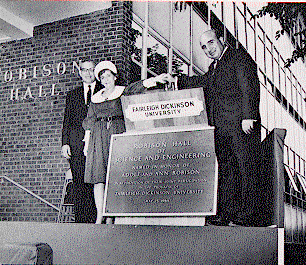 The dedicating of Tobison Hall named on May 23, 1964 in honor of Adolf and Ann Robison who are shown here with Dr. Sammartino, then president. Dr. Robison was chairman of the University’s Board of Fellows.
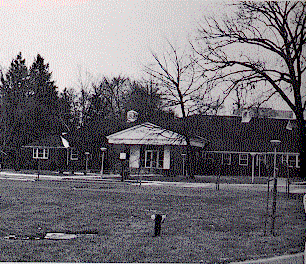
When the Teaneck campus was acquired, the first step was to create a library because nothing had been done in the minuscule Bergen Junior College library for ten years. Mrs. Althea Herald, the new librarian, worked miracles in creating a library from scratch in four months. Within a year, it required a whole new addition and within a few years, the campus needed an entirely new building, the Weiner Library. In the meantime, Mrs. Herald, got the Dental Library on its way and the library fro the Edward Williams College-five libraries in a ten-year period. It was a herculean task, but it was this type of loyal service that built the University.
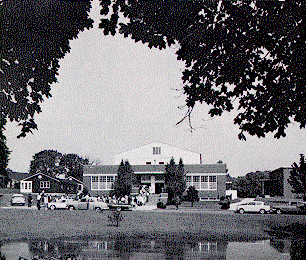 The gymnasium in Teaneck which dates to Bergen Junior College days. It was a surplus property acquisition from the old Camp Shanks. Just as plans were under way to build a new gymnasium, the Twombly estate in Madison was bought in 1957 and all available funds had to be diverted to the new campus.
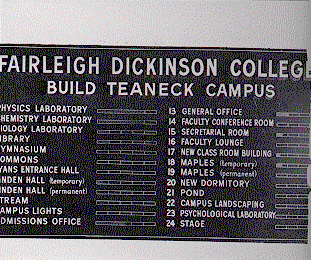
Immediately upon the acquisition of the Teaneck campus in 1954,Dr. Sammartino had a large sign made so that faculty, students and visitors could see what progress was being made. Red marking denoted the progress each week. Twenty-four building and renovation projects were set up. Rutherford faculty members rolled up their sleeves and went to work to bring the Teaneck campus up to standards-and all at no extra pay.
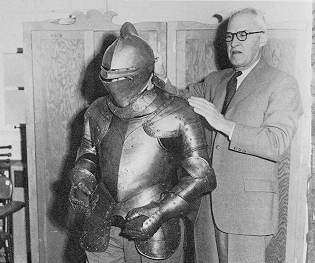 When we took over Teaneck, not all students were happy with the new order of things. Dr. Sammartino, with the help of Dr. Harry Sprague, then dean of the Graduate School, donned one of his suits of armor, appeared before the dissident students and said “I expect some brickbats; I’m all set for you.” It soon began to dawn upon the students that Fairleigh Dickinson College was really their savior and that in 1953 when they had paid their tuition to Bergen Junior College, it was really to a bankrupt institution.
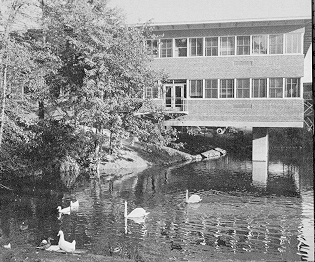 The first building to be built on the Teaneck campus by Fairleigh Dickinson College was William Hall named in honor of Edward T. T. Williams, first chairman of the Board of Trustees. Dr. Sammartino took a chance and rushed it through even before all the “i’s” had been dotted in the merger agreement because there was no classroom building in Bergen Junior College as such. The few classrooms where were makeshift affairs around the gymnasium. He had a pond created and a member of the Board of Fellows, Richard Poor, of Standard Bleachery donated the swans. The swan was used as a motif in the coat-of-arms to denote Teaneck.
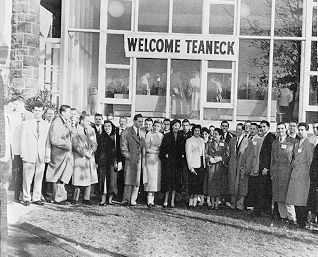 When Bergen Junior College in Teaneck was dissolved, and Fairleigh Dickinson College assumed its assets and liabilities, Dr Sammartino moved quickly to bring the two campuses together. Of the 300 old Bergen students, half had to be let go because of unsatisfactory entrance requirements or poor records. Most of those remains were put on probation. The Teaneck students were invited to Rutherford to meet with the students of that campus and the process of merging went along more or less amicably.
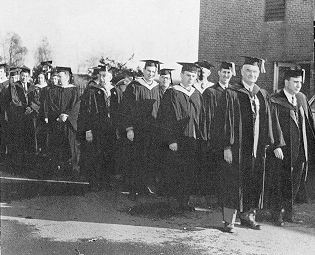
When Bergen Junior College in Teaneck became the Teaneck campus of Fairleigh Dickinson College, a solemn function was held to mark the acquisition. Leading are Dr. Walkter Head, who had been president of Bergen Junior College and who became the dean of the new admissions campus, and Dr. Sammartino. Following were the two deans: Dr. Albert Carpenter for Teaneck, Dr. Ray A. Miller dean at Rutherford. The basis was quickly established for each campus to be co-equal
From: New York Time, June 24, 1948, p. 25
Col. Dickinson, 84, College Founder
Head of Surgical Instrument Firm in Rutherford Dies, Set Up School in 1942
Special to The New York Times
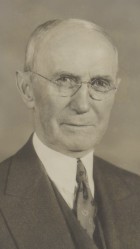 RUTHERFORD, N. J., June 23 — Col. Fairleigh S. Dickinson, president and founder of Becton, Dickinson & Co., one of the country’s largest surgical instrument manufacturing concerns, died here today at his home, 185 Ridge Road, after a year’s illness. His age was 84.
Colonel Dickinson also was the founder of the Fairleigh Dickinson College here, a career college for vocations such business administration, merchandising, accounting and industrial management. The school was established in 1942 with Colonel Dickinson as the largest contributor to its endowment fund.
Born in Beaufort, N. C., colonel Dickinson was the son of David Owen and Margaret Ann Tillman Dickinson. As a young man he was a sailor on a square rigger for two years, before moving to Elizabeth, N. J., where he worked for the Singer Sewing Machine Co. while attending night high school.
After being associated with the Saugerties (N. Y.) Manufacturing Company, Colonel Dickinson and Maxwell W. Becton founded their surgical firm in New York in 1897, and moved it to Rutherford several years later.
During the first World War, he was inducted into the United States Army Reserve as a lieutenant colonel, working with the Army Medical corps on supplying surgical instruments. In 1926 he was appointed a member of the War Department’s business council with the rank of colonel.
Colonel Dickinson was names chairman of the medical and surgical committees for the medical departments of both the Army and Navy in 1940 and was reappointed to the post in 1944. The previous year, Under-Secretary of War. Robert Patterson named him to attend a conference of industrial leaders as the representative of the surgical instrument industry.
Since 1927 he had been president of the Rutherford National Bank. He also was director of the American Surgical Trade Association for nineteen years and president of the Manufacturers Surgical Trade Association from 1919 to 1944. He was a charter member and past president of the Rutherford Rotary Club, a member of the Masons and the Knights Templar and a member of the executive committees of the national and regional councils of the Boy Scouts of America since 1941.
In 1938 he returned to his home town to build the Core Creek Community Church and Social Center Community Clubhouse.
Surviving are his widow, Mrs. Grace Smith Dickinson, whom he married in 1916; a son, Fairleigh S. Dickinson Jr., of Rutherford, and a sister, Miss Lulu Dickinson of Plainfield, N. J.