
The History of Holy Name Hospital

 Holy Name Hospital, as it looked in 1964, after the two-story addition to the Marian Building. Since then, the Breslin/Kennedy addition, a medical/surgical unit, was added in 1980, the rehabilitation center was added in 1991, and a $50 million, 100,000 square foot, five-story addition was opened in Nov. 1, 1992. The new addition has a 25-bed maternity unit, a cardiographic suite, a 22-bed same-day surgery suite, facilities for bronchoscopy and endoscopy suite, and a new kitchen and dining pavilion. Today, Holy Name Hospital serves 18,000 inpatients annually.
Holy Name HospitalTeaneck, New Jersey, 1925
Foreword
The Holy Name Hospital, now in course of construction, is, day by day, becoming a reality and the time limit for completion estimated by Architect and Contractor will be May, 1925.
The erection of the present structure was the out growth of a motion on the part of physicians for greater hospital accommodation to meet the demands of the rapidly increasing population of Bergen County.
In our service t those whose care shall be intrusted to the Holy Name Hospital, we shall always appreciate the splendid work being accomplished by our neighboring institutions through which they also give honor and glory to the Holy Name of Christ our Lord.
Ladies of the different Townships in Bergen County have expressed their desire to be of service along any of the lines which may be suggested.
Hope is entertained that in the near future Auxiliaries will be formed either in the various parishes or as a single center, which will direct all these activities.

Like the hospital, the Auxiliary will be non-sectarian in character.
As the care of the sick poor, and those whose financial condition will make it impossible to pay the regular hospital rates, will always form a devoted part of the hospital’s service, an appeal is here made to those whom Providence has blessed with a greater abundance of this world’s goods, to be mindful of this special charity by establishing a fund, making an endowment or other financial gift.
It will be the purpose of the hospital to care for all medical, surgical and maternity cases irrespective of race or creed. Exception, however, is made of pulmonary tuberculosis, contagious diseases, insanity, drug addicts, incurables.
To begin the undertaking, a loan at a very low rate of interest was obtained, but now that the work of the building may be carried through, a further loan at a higher rate of interest is needed.
The object in presenting the above statement is for the benefit of friends and patrons who wish to help in this noble cause by substantially contributing to the initial operating cost of the new hospital and in lightening the burden of its indebtedness.
Furnishings of patients’ rooms and other departments are important items.
For the information of societies, clubs or other organizations and individuals who wish to establish permanent mementos to which suitable bronze tablets will be attached to designate the donors, the following schedule may be helpful:
| 43 private rooms, $400 each. | Nursery, $750; or $25 a crib. |
| 8 semi-private rooms, $800 each | Emergency room, $500. |
| 2 – 3 Bedrooms, $600 each. | 4 utility rooms, $750 each. |
| 3 operating rooms, $1000 each. | Waiting room, $750. |
| Anesthetic room, $600. | Office, $1000. |
| Recovery room, $400. | 2 surgical dressing rooms, $500 each. |
| Sterilization room, $1000. | 3 diet kitchens, $750. |
| Duty room, $750 | 4 solariums, $500 each. |
| Nurses’ dining room $1500 | 2 airing balconies, $250 each. |
| Doctors’ dining room, $750 | Dispensary $750. |
| Chaplain’s dining room, %500 | Pharmacy, $1000. |
| Maternity service rooms, $1750. | Passenger elevator, $5000 |
| X-ray suite, $4500 | Laboratory, $1000 |
| 3 – 8 bed wards, $800; or $100 a bed. | Ambulance, $2500. |
| Children’s ward, $700; or $50 a bed. |
Memorial Endowments
A gift of $25,000 at one time shall entitle the donor and his successors to nominate a patient to a room free of charge in perpetuity.
A gift of $15,000 at one time shall entitle the donor during life to nominate a patient to a room free of charge.
A gift of $10,000 shall entitle the donor and his successors to nominate a patient to a free bed in a semi-private room.
A gift of $7,500 shall entitle the donor and his successors to nominate an adult patient to a free bed in perpetuity in a ward.
A gift of $5,000 shall entitle the donor and his successors to nominate a child to a free bed in the children’s ward in perpetuity.
A gift of $5,000 shall entitle the donor during life to nominate an adult patient for a free bed.
A gift of $4,000 shall entitle the donor during life to nominate a child to a free bed in the children’s ward.
A gift of $600 at one time entitles any person or society to endow a bed in the hospital and to designate a patient to occupy same for a period not exceeding twelve months following the date of such gift.
Patients entitled to the use of endowed rooms or beds shall be subject to the regulations governing the admission, treatment and discharge of patients.
Certificates of the right to nominate patients to occupy rooms or beds free of charge shall be issued in such form as the Board of Managers may prescribe and shall be signed by the President and the Treasurer who shall also affix the seal of the Corporation.
If on the death of the donor, no successor shall have been designated, the right of nomination shall then have lapsed.
Location
The hospital is located on the Southwest corner of Cedar lane and Teaneck Road in the Township of Tenaeck, New Jersey; about five hundred feet west of Teaneck Road and the same distance south of Cedar Lane, in the center of a beautiful plot of rising ground measuring ten acres, formerly the homestead of the Phelps family of New Jersey.
One should visit the grounds to appreciate thoroughly this ideal situation; the charm of scenery in all directions adding attractiveness to the site. To day the premises present an uninviting appearance as a result of the work of construction, but it is intended as soon as possible to have the once velvety lawns, trees and shrubbery restored to their former beauty.
The Building
In design the building is three stories with a fourth floor over the central portion, a ground floor and basement; the entire length is 228 feet by 58 and 36 feet in width. The structural parts are of steel, concrete and hollow block; the exterior is faced with tapestry red brick and stone trimmings. The floors are litosilo and in several departments the walls are tile. Every modern sanitary convenience is provided; the water supply is taken from the main line of the Township. Both in the exterior and interior of the building the Architect has endeavored to present a pleasing appearance in his arrangement of details, creating a cheerful, homelike atmosphere, thus promoting with maximum efficiency the welfare of the patient and the convenience of physicians and nurse staff. The hospital has a capacity of one hundred and seventy beds.
Diagrams are prepared to show the number of private and semi-private rooms and wards on the different floors as well as the particular sections and units on these floors. The heating plant supplies steam sterilization on all floors. A refrigerating plant supplies a constant temperature in the ice boxes and other places throughout the building. There are three cold storage rooms, a hygienic ice making plant with storage compartment.
Besides the main kitchen on the ground floor, there is a separate diet kitchen where special foods are prepared and conveyed to the diet kitchens on each of the other floors by an electric dumb-waiter. The dish pantry is equipped with an electric dishwasher of the latest improved type.

On this floor also is a large dispensary and waiting room for out-patients; a room for filing patients’ charts, histories and clinical records; a large modernly equipped laundry with a disinfecting plant; an incinerator for the disposal of refuse and garbage.
First Floor
On the first floor is the chapel with a seating capacity of seventy, two wards, private and semi-private rooms, an x-ray suite, an emergency operating room connected directly with ambulance entrance, a separation room for newly admitted cases, a waiting room for visitors, general administration office, and a student nurses’ lecture and study room.

Second Floor
the maternity section located on this floor comprises two special service rooms with sound proof walls and doors; a sterilizing room and scrub-up rooms for doctors and nurses. On this floor also a nursery and children’s ward, the latter being located in a wing of the building, having an airing balcony for babies and children.

Third Floor
The general operating section is situated in the north wing of the third floor and is equipped with every necessary facility for patients, doctors and nurses.
This floor also contains twenty-six private rooms, with two three-bed semi-private rooms, also four airing balconies.

Fourth Floor
 In the center of the building on the fourth floor are the nurses’ quarters, these rooms are larger than the average private room and are amply supplied with every accommodation.
Solariums are provided on each floor where convalescent patients may enjoy sunlight and air as an aid to complete recovery in the minimum of time.
Fire escapes are accessible from all parts of the building.
Equipment
Some of the special features of equipment are the Telephone system, by which inquiries about a patient and reports on his condition may come directly to and from each floor. There is also a telephone service in private rooms which may be used from the bedside; a silent electric call system throughout, an automatic electric passenger elevator reaching all floors, an electric vacuum cleaner, a dust chute, a clothes chute, all leading to the basement.
The preceding description gives a fair idea of the hospital building. In its construction and equipment the aim has been for economical administration, as well as to provide the best obtainable appliances for the one great consideration-the welfare of the patient. In our efforts to accomplish this, we have assumed an expenditure of over $350,000-which sum represents the cost of construction and constructive equipment exclusive of furnishing.
Training School
the training school for nurses will be established according to the rulings of the New Jersey Educational Department, the American Hospital Association, New Jersey State Board of Nursing and the New York State Department Regents. all the requirements of above Departments will be complied with, thereby permitting the hospital to become registered in these states and the graduates to receive the degree of R. N. Black forms for admission to the training school will be furnished to applicants.
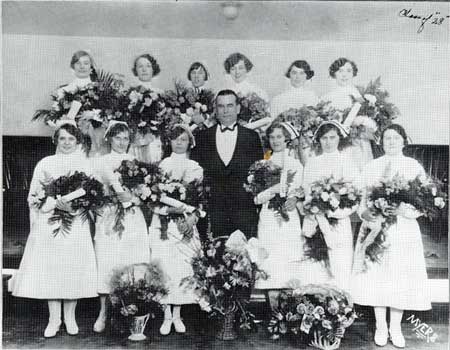
The first graduating class at Holy Name included the following: Marion
Appleby, Elizabeth Clare, Constance Farinella, Alice Grievison, Kathryn
Gomez, Jennie Jerman, E. Bertha Maillous, Constance Nelson, Mary
O’Brisn, Mary Quirk, Anna Spence, Janet Wiley. Dr. F. C. McCormack
in center.
First Alumnae President, Marion Johnson (Appleby) 1928.
In 1920 and the following three years, the population of Bergen County increase so rapidly that the general hospital of the County, namely Englewood and Hackensack Hospitals, where frequently filled beyond their normal capacity. The possible recurrence of an experience similar to the so-called “Flu Epidemic” of 1918 and 1919, meant that either both hospitals would have to greatly increase their bed capacity or the construction of a new hospital in the County would be a necessary undertaking. Encouraged by the enthusiastic agreement of many citizens and physicians that an urgent need for a their hospital existed, Dr. F. C. McCormack of Englewood, New Jersey who had been associated professionally for many years with the Sisters of St. Joseph, as attending physician to St. Michael’s Orphanage and Novitiate, of Englewood Cliffs, and Villa Marie Clare, of Hohokus, and Dr. George Pitkin of Bergenfield, New jersey, consulted many times with the Reverend Mother General Agatha and the Counselor Board of the Sisters of St. Joseph of Newark, with reference to the establishment of a general hospital in Bergen County. After carefully investigating the apparent need and future possibilities of a general hospital in this location, the final decision was made in 1924 by the Mother General and the Counselor Board, to build a general, non-sectarian hospital, to be called the “Holy Name Hospital,” on the site of the Colonel Phelps estate in Teaneck.
Mr. William Conklin, of Englewood, New Jersey, at that time Chairman of the Bergen County Board of Taxation, was named Chairman of the General Advisory Board, and Mr. Conklin, of Englewood still retains that Chairmanship.
Dr. Frank C. McCormack was appointed Medical Director. Ground was broken for the erection of the new hospital in June, 1924, and the hospital was ready for the reception of patients on October 12, 1925. During the building of the hospital, Dr. McCormack was authorized to organize a county wide representative Medical Advisory Committee. The following physicians from different parts of the County accepted an invitation to serve on that Committee; Dr. Frank C. McCormack, Englewood, New Jersey, Chairman; Dr. George P. Pitkin, Bergenfield; Dr. Frank Freeland, Hackensack; Dr. George L. Edwards, Bogota; Dr. G. H. Ward, Englewood; Dr. Fred Fin, Jersey City; and Dr. E. P. Essertier, Hackensack, The duty of the medical Advisory Committee was to recommend the necessary hospital plans and equipment, and to establish standards of medical practice that would meet with requirements of the Catholic Hospital Association, the American College of Surgeons, the American Medical Association and the American Hospital Association. The Hospital passed the inspections of each and was approved and accepted by these organizations in 1926, one year after the opening of the hospital.
The School of Nursing was established 1926. The first class of Graduates was in 1928. The first internes, appointed in 1925 at the opening of the Hospital, were Dr. Maurice M. Lynch, of Winchester, Virginia, now located in Hackensack, New Jersey, and Dr. John Hillsman, also of Winchester, Virginia, now located in Calgary, Manitoba Providence, Canada. The Nurses’ Home Building was completed and dedicated in February, 1928. Governor A. Harry Moore was the principal speaker, and Right Reverend Monsignor Duffy, Chancellor of Newark Diocese, now Bishop of Buffalo, dedicated the building. During the years 1928 and 1929 the demand for extra beds was so great that in 1930 a new wing was added to the main building, increasing the capacity by seventy-five beds. A complete Out-patient Clinic and a new Department of Pathology was provided. A central heating plant was also constructed in 1930. The new building was dedicated in May, 1931, by the Most Right Reverend Monsignor Duffy, now Bishop of Buffalo, and Mr. William Conklin who were the speakers of the day.
It will be of historical interest to mention the following events that happened during the early years of the Hospital. Shortly after the Hospital opened, Dr. George Pitkin started the internationally known work on controllable spinal anesthesia. As a result of his arduous research, numerous experiments, demonstrations, talks and papers on that topic, spinal anesthesia was popularized throughout the surgical world. The Holy Name Hospital became widely known throughout the United States. As an epic event in 1928, the Medical Director, Dr. Frank C. McCormack, planned a joint Round-Table Conference and Dinner for the Staffs of the Hackensack, Englewood and Holy Name Hospitals. The conference was held in the Auditorium of the Nurses’ home. The staff had as its guest of honor, the Reverend Father Molinier, President of the Catholic Hospital Association, Dr. Malcolm McEachern, Director General of the American College of Surgeons, and Dr. Edward Cowell, Executive Secretary of the American Hospital Association.
During the first five years of its organization, the Executive Committee established with no little difficulty, a number of precedent staff regulations in hospital practice in Bergen County.
- The regular committee secured reciprocal surgical privileges among the three general hospitals of the County.
- Mandatory consultations in all major obstetrical procedures were instituted in 1930.
- A standardized Orthopedic and Fracture Service, a genito-Urinary Surgical Service, a Specialized Closed Anesthetic Service, and a Closed Department of Otolaryngology were formed and headed by a fully qualified specialist in that particular branch of surgery.
- A full time Pathologist, Dr. L. A. Markley, was added to the staff in 1929.
- After proper and prescribed training, the Attending Obstetrical Staff were full qualified for performing Caesarean Sections. Dr. Maurice H. Lynch, Attending Surgeon, is the youngest surgeon, and Dr. Henry D’Agostin, Attending in Obstetrics, was the first Obstetrician in the County to be admitted to the American College of Surgeons.
At the present time, construction is underway to greatly enlarge the hospital’s capacity with a new wing.
*Source unknown, a pamphlet published by Bergen County Medical Society.
By F. G. Dilger, M. D.
The Town Manager, March 1932, p. 18-19
 One of the most important properties of life is growth. But growth in itself is not necessarily something to be desired. There are several kinds of growth. There is the sturdy growth of the oak from its humble beginning, to its fruition as a majestic tree; and there is the sordid growth of a fungus. There is the orderly growth of a child, from babyhood to manhood; and there is the disorderly growth of a malignant cancer. There has always seemed to me to be something puerile in the blatant self-advertisement of many small towns as expressed on roadside bill-boards: “This is Hickville; watch us grow”! Who cares for growth, per se? Who cares for the fungoid growth of an artificially induced boom? What is there attractive about the disorderly growth of a “gold rush”? Growth that is sturdy, that is orderly, growth that proceeds according to plan, this indeed is to be desired. Such a growth has been Teaneck’s, to a large degree, in the past. It is hoped that, to an even larger degree, in the future, a sturdy, orderly, planned growth will occur.
Progress Rapid
One of the most interesting, as well as outstanding aspects of Teaneck’s growth is seen in the progress of the modern hospital which we are so fortunate as to have within its borders. The hospital serves not only Teaneck but surrounding towns in the county, and owes its existence to the foresight and the zealous persistence of Dr. Frank C. McCormack, who has been the Medical Director of the institution since its inception. Through his efforts the Sisters of St. Joseph, well experienced in hospital management and nursing, were persuaded to add to their already considerable debt, by building, financing and operating the Holy Name Hospital of Teaneck.
 The spot selected as a location for the hospital was an ideal one for this purpose. The beautiful, well-wooded plot of ground, measuring ten acres, was formerly the site of the homestead of the Phelps family. Certainly, the sadness which one would feel at the dissolution of a fine old estate is considerably modified when we view the beauty of the buildings which have replaced the old mansion, and consider their beneficent purpose. It was on June 19, 1924, that work was started on the main building, and it was formally opened on October 4, 1925. The structural parts are of steel, concrete and hollow block, the exterior being faced with tapestry red brick and stone trimmings. This original building had a capacity of one hundred and seventy beds.
Outside Aid
The original plans did not provide for an “Out Patient Department.” It was considered that the hospital was situated so far “out in the country” that any kind of an active Out Patient service would not be required. In fact, many predictions were made that very few of the hospital’s original one hundred and seventy beds would be occupied. However, it was not long before the pessimists were found to be in error. First, temporary provisions had to be made for a Clinic; and shortly thereafter additional buildings had to be erected. The first of these, a handsome Nurses’ Home, one of the finest in the State, was opened on Sunday, February 12, 1928. A central power plant was put into service at the same time. Only one month later, that is two years and four months after the first opening of the hospital, it became evident that a further building program must be undertaken immediately. At that time, the first public appeal for help was made. Let us remember, the original buildings, comprising a modern hospital and Nurses’ Home, had been erected at a cost of $1,000,000 without any general appeal to the public. Accordingly, on April 26, 1928, a drive was started for funds to finance a new addition. This drive realized $351,060. The addition was placed in the rear of the original building, the whole taking the form of the letter “H”, and bringing the capacity of the hospital up to 250 beds. All the buildings are in architectural harmony and provide a complete and compact unit.
Every Convenience

The interior of the hospital fulfills the promise of its exterior. Every possible convenience and aid for the diagnosis and treatment of medical and surgical conditions have been installed, and the hospital has been approved by, and has received the highest rating of the American College of Surgeons. In addition to the excellence of its technical equipment, the hospital possesses a quality seldom found in such institutions. There is a cheerful, homelike atmosphere about it that is apparent to patients and visitors alike. This must be experienced to be appreciated.
A detailed description of the various departments of the hospital is not possible in the brief space available. Only a few of the more important details will be given here. On the main floor of the hospital are the reception room and offices, the X-Ray laboratories, the Emergency Room, some wards and rooms for mail patients, and in the new section clinic rooms and pathological laboratories. The eastern half of the second floor is devoted to the maternity department, which is entirely self-contained, and the western half to the children’s wards and rooms, on the third floor, are the suite of operating rooms, and also some private and semi-private rooms, and wards for female patients. The fourth floor contains additional private rooms and the Interns’ quarters. There is a large and attractive roof-garden, and each floor is well provided with solaria and balconies.
The Chapel
On the ground floor, at the extreme southern end, is an artistic and devotional chapel, with a seating capacity of seventy. The hospital is, and always has been, non-sectarian; “as non-sectarian as appendicitis”, in the word of Mr. William Conklin. Up to May, 1931, over 16,000 bed patients had been treated regardless of race or creed. The nursing staff, and the medical staff of the hospital include those professing various creeds. But the motive power that lies behind those responsible for the establishment and management of this undertaking cannot be understood except in the light of that little chapel where they worship the same God who is the Father of all of us. Self-sacrificing devotion to the cause of sick humanity, without earthly recompense, fame or glory, can be explained on no other basis.


PROGRESS IN HEALING THE SICK
 In this age of constantly changing principles and feverish unrest there is little time for reflection or retrospection; the accent is rather on
progress, still greater efficiency and service, and Holy Name Hospital cannot be an exception.
But to its pioneers it is extremely gratifying to stop and look back to the day when in spite of numerous obstacles, they set forth upon a special labor of faith and love. The general belief at the time was that Bergen County did not need another hospital, but the challenge was not of a material nature; it was to something nobler and higher, reaching out to the soul as well as to the body of the suffering neighbor.
And so, at the earnest request of Doctors Frank C. McCormack and George P. Pitkin, our Sisters assumed the responsibility of building and organizing what became a joyful reality on October 4, 1925. On that day Holy Name Hospital, thoroughly equipped and scientifically complete, was opened to the public.
Its achievements and rapid development surpassed all expectation. From its very beginning, the ladies from the adjoining communities, through the influence of the above-mentioned doctors, pledged their allegiance and formed auxiliaries that have worked hand in hand with the Sisters. Their unflagging interest and loyalty have earned for them the admiration of those in the hospital field, even outside of New Jersey State.
The increase of nurse applicants rose so constantly and rapidly that in a few years a nurses’ residence became a necessity. The building of the new, far-famed George Washington Bridge had its effect upon the hospital also, when Teaneck became one of the fastest growing towns in the United States. This influx of population brought so many additional patients to Holy Name, that a new seventy-bed wing had to be built and put into operation in 1931. And now, ten years later, crowded conditions demand still further physical expansion. Besides, the modern and hospital-minded public is today looking for hospitalization at the hands of trained, educated and skilled personnel. Advances in medicine and science proceeding from higher educational levels make inevitable the need of special preparation for every phase of hospital service.
While the Sisters must keep in step with the trends and standards of the age, they can never permit themselves to stray from the sight of the good Samaritan. Whether the Sisters’ hospital is to be a “business or not a business”–as questioned at the annual hospital conventions–will depend upon the motives and spirit of its staff. If they are guided by the primary objective with which they entered upon the work, namely, to serve God’s poor, whether sick in mind or in body; to serve them with Him Who spent Himself in a gentle, tireless ministration to all mankind and to serve for that Divine Physician, Who alone can give success to all “business,” they will prove that their hospital is something beyond the realm of any business.
SISTER M. EVANGELISTA, Superior.
ORTHOPEDIC SURGERY
ORTHOPEDIC Surgery is the youngest of the surgical specialties; but at Holy Name Hospital it is a thriving infant indeed. As the staff was originally organized, there was no such department, and no provision for an orthopedic clinic. It was considered that the hospital was so “deep in the woods,” so far off the beaten track, that the crippled and the lame would certainly not seek treatment here. How inaccurate was that prediction can be seen in the throngs, both of children and of adults, who now crowd the orthopedic clinic.
Among causes of this continued growth are the use of the latest methods of treatment, where these have passed the experimental stage, and the installation of the most advanced equipment both in the oper- ating rooms and in the physical therapy department. An example of this is seen in the fact that, in less than fifteen years, no less than three fracture-orthopedic operating tables have been purchased, the one now in use representing the last word in such equipment.
Perhaps the most outstanding feature of the department is the extensive use of bone-grafting technique in place of metal plates and screws of steel and alloys which have heretofore been so widely used. An original operation, involving the transplantation of bone, has even been devised.
Recognition of the standing of the department was indicated during the past year by the Governor’s appointment of its director as the medical member of the Crippled Children’s Commission for the State of New Jersey.
THE YEAR’S WORK
DEMANDS for care in 1940 continued to increase as they have done in almost every year since the hospital was opened.
During the year 5,278 patients received 60,100 patient days of care, as compared with 5,107 patients and 56,027 days in the previous year.
These yearly increases cannot continue in the present buildings, for the service in most departments has now reached a ceiling beyond which it cannot go. We have a waiting list which gradually grows longer, and we are worried by the growing number of patients whose admission we must put off until suitable beds are available. We ask forbearance from all our friends when they hear of patients whom we are unable to admit, or when they themselves have such an experience. The reason is simply that we cannot crowd more beds or more patients into space already filled beyond proper capacity. Another reason is that whenever we have empty beds in some departments, they may not be suitable for some patients requiring care, as illustrated on a later page.
| WORK DONE IN THE HOSPITAL | ||
|---|---|---|
| 1940 | 15 YEARS (1935-1940) | |
| Patients Admitted | 5,273 | 56,837 |
| Patient Days of Care | 60,160 | 655,645 |
| Babies Born | 1,025 | 9,552 |
| Surgical Operations | 2,398 | 26,481 |
| Laboratory Tests | 42,912 | 336,363 |
| X-Ray Examinations | 8,379 | 77,665 |
| Out Patient Visits | 13,152 | 147,374 |
| Admissions and Patient Days include Newborn. In 1940 Newborn were: 1,025 Patients, 10,276 Days. |
||
Our hospital is a community institution and our wish is to familiarize the community as fully as possible with the work that we are doing. For that purpose we have issued our annual report for 1940 in a new form which we hope will present the main features of our hospital’s service in an interesting way. Instead of confining ourselves to departmental reports we have included brief special articles on subjects of current interest to the general public.
Again we wish to extend our thanks to the many friends whose kindly thoughts and deeds have so greatly aided us in our work. To the Staff, the Auxiliaries, the County Board of Freeholders, contributing municipalities, individual contributors and the general public, whose interest in the hospital is so often shown, we express our appreciation in behalf of the ill and injured who come to us for care.
We are particularly grateful for the friendly labors of those about to carry through our building fund campaign. Our prayers go with them, and our most earnest hope that through their efforts the new building may soon rise, for indeed we need it most urgently.
SISTER M. ALPHONSUS, Administrator.
BERGEN COUNTY’S HEALTH
THE epidemic of influenza in 1918, with its high mortality, was largely aggravated by its complete unexpectedness and by a lack of hospital preparation for it under the stress of war, with thousands of men living under unusual conditions in the nation’s training cantonments. That epidemic, not to speak of others more frightful in the long past, demonstrated how helpless even skilled doctors can find themselves when they are faced with a lack of ordinary hospital facilities for acute victims.
Thus today, with the trend of our thinking more and more toward preventive medicine and with the recent flu scare to put us on guard, the responsibility for the health of a hugely populated section such as Bergen County cannot but lie heavily on the consciences of its three great general hospitals. Bergen County is woefully under-hospitalized. In that regard cold facts and figures speak for themselves, for the county is the third largest in New Jersey as to population, and yet there are fifteen counties in the state far ahead of it in hospital facilities.
Beyond this, to aggravate the county’s shortage of hospital beds, we are faced with a public which is growing more and more hospital- minded. The public has learned of preventive medicine, and now it flocks to our hospital laboratories for investigative tests, as witness the more than 42,000 laboratory tests made by Holy Name Hospital last year. At the same time, more and more expectant mothers are demanding hospitalization.
This growing hospital-mindedness should be a pleasant fact for contemplation by those who are interested in preserving a high standard of public health. Hospitals have, to a degree, stimulated it by their own missionary work in making the public realize the dangers of disease and its spread, as well as the perils of childbirth-its perfect naturalness as a function of womanhood, but also its extreme seriousness, requiring the best of care for mother and child during the pre-natal and post- natal periods.
But now that we have attained this result, we in Bergen County can very logically be accused of an inconsistency. We cannot supply a requirement which we have stimulated ourselves. Now that the public is on the alert, pathologically speaking–now that it demands hospitalization, we are unable fully to meet the demand.
This situation is not one of embarrassment alone, however. It contains an element of danger. A major disaster or an epidemic in this area would present a simple but unsolvable problem of lack of bed capacity for accident victims or acute cases. Even in the normal course of affairs, being over-crowded as we are now, the danger of greater over-crowding is for the individual patient just as serious. It is ever present as long as accident and disease continue to operate on an invisible schedule If chance and probability.
All this is why Holy Name Hospital plans an expansion of its plant in the coming year. Bergen County having described a phenomenal growth in the last five years, there is nothing to indicate that this growth will not continue, though perhaps at a more moderate speed.
Bergen County’s hospitals today, as always, stand as guardians of the county’s health. They cannot, however, as voluntary hospitals, expand to meet the county’s growth unless the public comes forward with definite financial assistance. We believe in this near-crisis the public will not fail us, nor any other Bergen County hospital, when a sincere appeal, founded on logic and good sense, is made.
FRANK C. MCCORMACK, M.D., Medical Director.
PROGRESS IN ANESTHESIA
FROM the time Holy Name Hospital became outstanding as a pioneer in the use of spinal anesthesia under the leadership of Dr. Pitkin, the Anesthetic Department has continued to investigate and put into practical service new methods of alleviating pain.
During recent years the use of spinal anesthesia has continued at the hospital. Rapid strides being made by the science of anesthesiology, however, have contributed several other new anesthetic methods which are in considerable use. More and more the hospital is resorting to intravenous anesthesia. Many authorities believe this to be the anesthetic method of the future. They are using it with increasing frequency as fast as new phases of intravenous application are deemed safe and practical.
In the last two or three years, the Anesthetic Department has employed cyclopropane increasingly as an inhalant. In this regard, Holy Name Hospital has developed to a very high degree modem safeguards in handling volatile gases.
In the last year in a wide variety of operative problems, the hospital has successfully used nitrous oxide, ether and ethylene among the inhalants, and novocaine, nupercaine, pontocaine, spinocaine, and neospinocaine in spinal anesthesia and nerve blocking. Spinocaine and neospinocaine have been created by Dr. Pitkin in his experiments with this anesthetic group.
The hospital is tending more and more in its use of inhaled gases to the technic known as the “closed method” of application. By this method, the patient, as far as his respiratory function is concerned, is completely secluded from the air of the operating room. His oxygen supply is furnished in mixture with the anesthetic, his carbon dioxide is absorbed by soda lime and his breathing is under the complete control of the anesthetist from beginning to end of the operative period.
THE SCHOOL OF NURSING
 HOLY NAME Hospital’s School of Nursing was established in 1925. The hospital is accredited by the American Medical Association and the American College of Surgeons. The various courses of study offered in the School of Nursing are approved by the Department of Nursing of the State of New Jersey. Its aims and purposes are:
1. To prepare young women spiritually, intellectually, physically, socially, and esthetically to give skilled nursing care to the whole individual patient.
2. To prepare nurses for community health service in the hospital, school, home and industry.
3. To prepare women to meet the responsibilities of life in the profession and in the family.
4. To prepare young women to live wholesome, Christian lives and to contribute to the welfare of church, family and state.
A certificate of graduation from an accredited high school is required. To be eligible for a qualifying certificate to admit the candidate to the profesional study of registered nursing, the course in high school must include: English, four years; Science, three years, including Gen- eral Science, Biology and Chemistry; Social Studies, two years; Mathematics, one year.
The school is desirous of not only promoting educational interests, but also of fostering, to the fullest extent, the spiritual welfare of its students.
Courses in Ethics, Psychology and Religion are given by the Chaplain of the Hospital. Credit for these courses will be accorded by Seton Hall College to students who are desirous of pursuing the course of study leading to the Bachelor’s Degree.
An annual health examination is included for all students during their course of study.
In case of illness, the hospital extends full privileges of medical care to the students.
The dietary program of the school is under the supervision of the dietary department of the Hospital.
Individual rooms are provided for students in residence. A vacation period of one month is granted annually.
Courses for Fall Semester, 1940, were as follows: Anatomy and Physiology, Case Study, Chemistry, Contagious Diseases, Ethics, Eye, Ear, Nose and Throat biseases, First Aid, Materia Medica II, Medicine Applied to Nursing, Nursing Arts, Operating Room Technique, Professional Adjustments I, Psychology, Public Health Nursing, Religion I, II, III, Surgery Applied to Nursing.
Courses for Spring Semester, 1941, are as follows: Dental Surgery, Dietetics, Elementary Materia Medica, Ethics, First Aid, Gynecology, History of Nursing, Microbiology, Nursing Arts, Obstetrics, Operating Room Technique, Orthopedics, Pediatrics, Psychiatry, Psychology, Religion I, II, III, Sociology.
MATERNITY SERVICE
DESPITE the present apparently commodious quarters, continually increasing demands for service necessitate the doubling of space and equipment in the Maternity Department.
This is evidenced by the tripling of the birth record of the hospital in the fifteen years of its existence. In 1926 a total of 366 babies was born here. In 1940 there were 1,025 births, without a maternal death.
The 1940 record also showed that twenty-two Caesarian births took place, including a pair of Caesarian twins. Ten other sets of twins were born in the hospital during the year.
The present equipment of the Maternity Department includes a nursery of 42 bassinets–often crowded–and 42 beds for mothers.
Temperature and humidity of the nursery are regulated mechanically. The most modem spray shower equipment is used in bathing the babies. All bedding and clothing are “Autoclaved” (sterilized under steam pressure) after being returned from the laundry.
In the isolation ward each baby has a separate unit–a cabinet in which his clothing is kept and upon which he is bathed and dressed, and a bassinet–with which no other child comes in contact.
Great importance is attached by the Maternity Department to the care of its new-born babies. For this reason more graduate nurses are employed in the new-born section than in any other department.
Individual formulas, special attention to incubator babies, administration of oxygen, individual instructions to the mother as to the care of the baby at home–these are but a few of the many services which, although routine to the hospital, may mean life itself to these most delicate little patients.
| COMMUNITY SERVICE Resident of Patients Admitted in 1940 |
|||||||||
|---|---|---|---|---|---|---|---|---|---|
| Communities in Bergen County: | 1940 Population | Patient Admitted | Patient Days | *Service Ratio | Communities in Bergen County: | 1940 Population | Patient Admitted | Patient Day | *Service Ratio |
| Allendale | 2,058 | 1 | 11 | .5 | Oakland | 932 | 1 | 11 | 1 |
| Alpine | 626 | 1 | 6 | .9 | Old Tappan | 609 | 13 | 139 | 21 |
| Bergenfield | 10,275 | 401 | 4,040 | 39 | Oradell | 2,802 | 33 | 345 | 12 |
| Bogota | 7,346 | 208 | 2,476 | 34 | Palisades Park | 8,141 | 201 | 2,369 | 29 |
| Carlstadt | 5,644 | 10 | 80 | 1 | Paramus | 3,688 | 47 | 468 | 13 |
| Cliffside Park | 16,892 | 136 | 1,747 | 10 | Park Ridge | 2,519 | 25 | 355 | 14 |
| Closter | 2,603 | 11 | 147 | 6 | Ramsey | 3,566 | 2 | 22 | .6 |
| Cresskill | 2,246 | 20 | 262 | 12 | Ridgefield | 5,271 | 102 | 1,189 | 22 |
| Demarest | 1,165 | 15 | 169 | 14 | Ridgefield Park | 11,277 | 286 | 3,316 | 29 |
| Dumont | 7,556 | 273 | 3,165 | 42 | Ridgewood | 14,948 | 22 | 314 | 2 |
| * Number of patient days per 100 population. | |||||||||
A VOLUNTARY HOSPITAL
 HOLY NAME HoSPITAL is one of nearly 3,000 voluntary hospitals in the United States. Do you know what a “voluntary” hospital is? The term will be easier to understand if you will consider the three broad types of hospitals.
VOLUNTARY: non-governmental, non-pront hospitals conducted by independent groups of citizens for the public welfare. They consist mostly of “general” hospitals, supplying general medical and surgical care.
GOVERNMENTAL: Federal–mostly for members of the armed forces and their dependents; State–mostly for mental patients; County–mostly for tubercular patients; City–mostly for general or communicable-disease patients.
PROPRIETARY: relatively small in size and often owned by doctors; conducted without legal restriction as to profit.
The total number of all types of registered hospitals in the United States is more than 6,000, and they admit about 10,000,000 patients every year. Nearly two-thirds of those patients–about 6,000,000–are treated in hospitals of the voluntary type.
It is important to understand that a voluntary hospital does not receive automatic support through taxation, as in the case of Government hospitals, but must stand on its own feet and justify its continued existence by the character of service it supplies to paying patients as well as to non-paying patients.
Most voluntary hospitals, like those in Bergen County, receive some auxiliary support out of tax funds. However, in Bergen County and in many other localities, such support amounts to much less than the free and below cost care given by these hospitals to patients who are unable to pay in full or at all.
While Federal, State, County and City hospitals have provided the most practical and satisfactory means of caring for certain special types of patients, the voluntary hospital has supplied the most satisfactory answer to the need of local communities for general medical and surgical care.
The voluntary hospital is a successful expression of the American tradition of free enterprise, local responsibility and community cooperation.
MESSAGE FROM THE CHAPLAIN
THE present day trend of philosophy translated into action, as evidenced by the spectacle of the modem world of chaos and tunnoil, seems to indicate quite clearly that men and nations have lost the idea of the dignity of the individual and the marvelous influence for good one can wield in his own small sphere.
True Christian philosophy has ever taught the dignity of the individual, the nobility of his calling, the individual influence each one can and must wield for good.
Conscious of the individual’s dignity and his power for good in his allotted sphere, Holy Name Hospital has throughout the fifteen years of its existence striven to minister to man in his individual needs so that relieved from infirmity he can be returned a useful member of the community.
In all the various fields of work in the world to which man applies himself, there is no more noble task than that with which men rightly surround the aureole of glory: the sublimity of motherhood. The hospital has prided itself on keeping abreast with modem progress in meeting the requirements at this crucial moment in human life, but the ever rapid growth of our communities has compelled the Sister governing body to secure more room in the proposed erection of the new wing.
Holy Name plans to make every adequate convenience possible to the expectant mother and the world’s most priceless possession, her baby. It is because like the Church, of which the hospital is a unit, Holy Name regards the individual’s needs that she proposes the new addition. No greater contribution can come to the community of Bergen County than this center which will provide a worthy advent for its citizenry into the world.
REV. LEO. J. MARTIN Chaplain.
| HOW IS THE SERVICE PAID FOR? | ||
|---|---|---|
 |
PATIENTS: All are treated alike. Most pay conscientiously. Many are treated below costs. Some can pay little or nothing. | $253,282.30 |
 |
GOVERNMENTAL AID: Bergen County and some municipalities help carry part of the cost of free and below-cost care. | $54,900.00 |
 |
COMMUNITY CHEST: There is no Community Chest in the central part of the County, and no Chest support is received | 0 |
 |
CONTRIBUTIONS: Many friends contribute through activities of the Women’s Auxiliaries, and directly to the Hospital. | $7,609.60 |
| MISCELLANEOUS: Nursing school, old accounts, etc. | $14,309.12 | |
 |
EXCESS OF EXPENSE OVER RECEIPTS: Total expense exceeded total receipts from all sources, leaving a net loss for the year | $8,950.57 |
SUMMARY OF FINANCIAL STATEMENT
| OPERATING EXPENSES | |||
|---|---|---|---|
| ADMINISTRATION: Office expense, salaries, supplies, telephone, Sisters’ allowances for expenses, etc. | $30,084.84 | ||
| DIETARY: Cost of food, preparation and serving for 338,264 meals to patients and personnel | 97,700.94 | ||
| HOUSE AND PROPERTY: Heat, light, power, laundry, housekeeping, maintenance of buildings and grounds | 90,582.61 | ||
| PROFESSIONAL CARE OF PATIENTS: Nursing care, nursing instruction, medical and surgical supplies, operating room, delivery room, anesthesia, pharmacy, laboratory, X-Ray, Out-patients, etc. | 120,683.20 | ||
| $339,051.59 | |||
| RECEIPTS FROM PATIENTS | |||
| IN-PATIENTS: | |||
| Private | $65,366.05 | ||
| Semi-private | 74,896.70 | ||
| Ward — Full Pay | 8,162.77 | ||
| Ward — Part Pay | 4,299.23 | ||
| Special Services | 83,047.14 | $235,771.89 | |
| OUT-PATIENTS: | 17,510.41 | ||
| 253,282.30 | |||
| Excess of expense over receipts from patients (exclusive of depreciation–see note): THIS IS THE NEW VALUE OF THE HOSPITAL’S FREE AND BELOW COST CARE TO THE PUBLIC |
$85,769.29 | ||
| OTHER RECEIPTS | |||
| GOVERNMENT AID: Bergen County | *$53,400.00 | ||
| Municipal Contributions | 1,500.00 | $54,900.00 | |
| CONTRIBUTIONS: | |||
| Received from auxiliaries | $5,430.35 | ||
| General Contributions | 2,179.25 | 7,609.60 | |
| MISCELLANEOUS: | |||
| School of Nursing — tuition fees | $6,418.15 | ||
| Collection of old overdue accounts | 6,016.41 | ||
| Other small items | 1,874.56 | 14,309.12 | |
| $76,818.72 | |||
| NET LOSS FOR YEAR | $8,950.57 | ||
| *Actual allotment was $48,000, but there was a carry-over of $5,400 from the previous year. | |||
| NOTE: Depreciation of buildings, equipment and furnishings valued at approximately $1,5000.00 was not included in this statement. On a conservative basis it would be $37,000 and would increase the Net Lost by that amount. | |||
This financial summary is intended to present a clear and understandable statement of interest to the general public.
Practically all executive, supervisory and technical positions in the hospital are held by Sisters, who receive no compensation beyond their maintenance and small allowances for such items as clothing and educational charges. To afford a true picture of the cost of running and hospital, therefore, the value of the Sisters’ unpaid services to the extent of approximately $31,000 has been include as an operating expense.
This is a conservative figure based on less than prevailing salaries for the positions held. While it was not actually paid by the hospital, on the other hand a considerably larger sum was not charged for depreciation. Most of the capital cost of the hospital as it stands today was provided without cost to the people of Bergen County.
ACTIVITIES OF CENTRAL AUXILIARY
THE original obligation assumed by Central Auxiliary of Holy Name Hospital was the furnishing of all gauze by the hospital. But the auxiliaries steadily increased their activities every year, until now each of the twenty-two auxiliaries annually fulfills four major Central obligations. If the efforts of the individual auxiliary more than support these obligations, they then use their surplus moneys to supply some major gift to the hospital.
The first of these activities is the Linen Shower which is held annually, the Second Sunday in May. At this time the hospital linen supply is completely replenished. Each auxiliary arranges and decorates its own booth in the auditorium of the nurses’ home, carrying out the blue and white colors of Central Auxiliary.
In June Central Auxiliary entertains the graduating class of nurses at a tea during class week and each member of the class is presented with a gift. On the last Sunday in October all of the auxiliaries participate in the Harvest Festival. Booths in the nurses’ auditorium are decorated in the seasonal colors of orange and yellow. The booths display the gifts of canned goods, fruit, fruits juices, yearly supply of ice cream mix, jellies, jams and beverages. We again entertain the friends of the hospital, who are invited to visit the various departments in the hospital.
Then the season of Christmas is with us. Each auxiliary is represented on the committee of women who decorate the hospital, chapel and nurses’ home. The entire staff, personnel and all the patients at the hospital are our guests at Christmas dinner. Holy Name Hospital greets the Christmastide in a beautiful blue and silver dress and the visitors are filled with the joys of the Holy Season.
The Central Auxiliary of Holy Name Hospital was organized on March 12, 1925 at Trinity Lyceum, Hackensack, New Jersey, under the direction of Mrs. Howard Kohl.
The object of this organization is to direct the local auxiliaries established in the various municipalities of Bergen County and vicinity in their activities of work and play in the interests of Holy Name Hospital.
Any woman in Bergen County or vicinity in sympathy with the object of this organization is eligible for membership in any of the twenty-one auxiliaries.
Excerpt from Constitution and By-Laws.
| THE AUXILIARIES | |||
|---|---|---|---|
| PAST PRESIDENTS OF CENTRAL AUXILIARY | |||
| Mrs. Howard Kohl | 1925-1927 | Mrs. Everet Carter | 1932-1934 |
| Mrs. john R. McConville | 1927-1929 | Mrs. P. Ralph McFeely | 1934-1936 |
| Mrs. Francis A. Banville | 1929-1932 | Mrs. Charles S. McHugh | 1936-1938 |
| Mrs. Edward A. Martin | 1938-1940 | ||
| OFFICERS OF CENTRAL AUXILIARY FOR 1941 | |||
| Dr. Irene D. Pindar | President | ||
| Mrs. James A. Lynch | First Vice President | Mrs. Frank S. Leonard | Record Secretary |
| Mrs. Charles J. Greene | Second Vice President | Mrs. Arthur Albert | Corresponding Secretary |
| Mrs. George Kelley | Third Vice President | Mrs. Theodore W. Kloman | Treasurer |
| Staking Committees | |||
| Publicity | Hospitality | Historian | |
| Mrs. William P Ahearn | Miss Ann McGinnis | Mrs. James P. Boughton | |
| Mrs. Edward Gaston | Mrs. John A. Kraus | Mrs. James B. Franklin | |
| Mrs. Louis a. Nessi | Mrs. Arthur W. Kopp | ||
| PRESIDENTS OF LOCAL AUXILIARIES | |||
| BERGENFIELD | Mrs. Louis C. Jabelsnik | HASBROUCK HEIGHTS | Mrs. C. Springrose |
| BOGOTA | Mrs. Harry J. Campa | LEONIA | Mrs. William H. Bovers |
| CLIFFSIDE-FAIRVIEW, JRS. | Mrs. Alice Naedler | NEW MILFORD | Mrs. Catherine Schaberg |
| CLIFFSIDE-FAIRVIEW, SRS. | Mrs. Charles Sturm | PALISADES PARK | Mrs. james Fordyce |
| CRESSKILL | Mrs. John Beach | RIDGEFIELD | Mrs. Charles J. Greene |
| CHILDREN’S WARD | Mrs. Edward V. Sexton | RIDGEFIELD PARK | Mrs. John McCann |
| EDGEWATER | Mrs. James Bain | LOWER TEANECK | Mrs. Ashley Walker |
| ENGLEWOOD | Mrs. Charles A. Emise | UPPER TEANECK | Mrs. John R. Flannery |
| FORT LEE | Mrs. Oresti C. Cassi | TENAFLY | Mrs. F. S. Leonard, Jr. |
| GRANTWOOD | Mrs. William P. Ahearn | THE CHARITY GUILD | Mrs. Arthur Albert |
| HACKENSACK | Miss Ann McGinnis | WESTWOOD | Mrs. Thomas J. Bromilow |
This year, in addition to our usual activies we are cooperating with the building fund campaign in every possible manner to insure the success of the campaign for the new hospital wing.
Throughout the year our director Sister St. Jude is ever our guide and inspiration.
Central Auxiliary holds two benefit parties during the year. We are deeply grateful to our many friends whose generous assistance is not only encouraging, but makes possible the extended scope of our auxiliary work.
Our newest obligation is the complete X-Ray equipment for the new wing.
Our affiliated auxiliaries welcome new members and WE extend our invitation to YOU to join with us and assis the Sisters of St. Joseph of Holy Name Hospital in furthering their widespread charity.
Irene D. Pindar, M. D., President of Central Auxiliary
ACTIVITIES OF THE LOCAL AUXILIARIES
ONCE A YEAR a joint all-day surgical dressings meeting is held by all auxiliaries. In 1925 the quantity of gauze used by the hospital was 10,000 yards. In 1940 the yarclage was 90,000. Each auxiliary also has its own surgical dressings meeting. The types of dressings made are appendectomy sponges, ear sponges, laparatomy sponges, tape sponges and 2 x 2 and 4 x 4 dressings.
Each auxiliary has its own Sewing Chairman under the direction of the Central Sewing Chairman. The hospital is kept supplied with various size sheets, towels, tray covers, sterile wraps, gowns, glove cases, bassinet lining, clysis cases, hot water bottle covers, bed pan covers, drum covers, points, surgical stockings, caps, gowns, masks, mitts, sleeves, binders and pillow cases.
| MAJOR GIFTS BY THE AUXILIARIES FOR 1940 | |
|---|---|
| Bronchoscope | Nurses’ Home: |
| Children’s Floor Maintenance | Cafeteria |
| Clinic: | Hot Plate Service |
| Furnishings for four rooms | Furnishing of three rooms |
| Equipment of Dental and Orthopedic Clinics | Physiotheraphy Equipment |
| Convalescent Porch, Fourth Floor | Portable X-Ray Equipment |
| Maternity: | Resuscitator and Inhalator |
| Furnishing of Hospital Rooms Nos. 113, 406 and 411 | |
| Linoleum Floor covering for Labor Room, Ward No. 1, Ward No. 2, Diet Kitchen and nineteen Bed Room. | Suction Machine |
| Furnishings for Main Floor Waiting Room | |
| MEDICAL STAFF | |
|---|---|
| CONSULTING STAFF | |
| Department of Surgery | Dr. E. R. Cuniffe, New York |
| Dr. H. Dawson Furniss, New York | |
| Dr. Allen O. Whipple, New York | |
| Department of Medicine | Dr. Authur Chace, New York |
| Dr. John Keating, New York | |
| Dr. Joseph Morrow, Ridgewood | |
| Department of Obstetrics | Dr. Samuel Cosgrove, Jersey City |
| Department of Pediatrics | Dr. Joseph Regan, Brooklyn |
| Department of Orthopedics | Dr. Fred Albee, New York |
| Department of Neurology | Dr. Edwin Zabriskie, New York |
| Department of Otolaryngology and Opthalmology | Dr. J. D. Kelly, New York |
| Dr. Olin Farley, New York | |
| Dr. James McGrath, Bronchoscopy, New York | |
| Department of Urology | Dr. George Cahill, New York |
| Department of Dermatology | Dr. George McKee, New York |
| Department of Pathology | Dr. L. C. Knox, New York |
| Dr, James Ewing, New York | |
| Department of Radiology | Dr. Francis C. Wood, New York |
| Department of Dental Surgery | Dr. Louis Hayes, New York |
| Dr. Charles Gallagher, Hackensack | |
| ACTIVE STAFF | |
|---|---|
| Medical Director | Frank C. McCormack, M. D., F.A.C.S. |
| Department of Surgery | George P. Kitkin, M.D., F.A.C.S., Chief Surgeon |
| Frank C. McCormack, M.D., F.A.C.S., Asspocate Chief Surgeon | |
| Sidney F. Johnston, M. D. | |
| Luke a. Mulligan, M.D., F.A.C.S. | |
| Maurice M. Lynch, M.D., F.A.C.S. | |
| Charles G. Prather, M.D. | |
| Arthur A. Scullion, M.D. | |
| Department of Medicine | Paul A. Kennedy, M.D.,F.A.C.P., Chief |
| John F. Baldwin, M.D. | |
| John D. Dickson, M.D. | |
| Robert R. Grimes, M.D. | |
| Johesh R. Helff, M.D. | |
| Winfield Kilts, M.D. | |
| Joseph R. Pedevill, M.D. | |
| Frank J. Vita, M.D. | |
| Department of Pediatrics | Edward P. Essertier, M.D., F.A.C.P., Chief |
| Frank S. White, M.D., Associate Chief | |
| Victor A. Blenkle, M.D. | |
| Ralph D. Denig, M.D. | |
| Frederick S. Leonard, Jr., M.D. | |
| William B. Prout, M.D. | |
| Joseph A. Rowe, M.D. | |
| J. L. York, M.D. | |
| Department of Obstetrics | Charles A.Knox, M.D., Chief |
| Thomas R. Carroll, M.D. | |
| Henry D’Agostin, M.D., F.A.C.S. | |
| John J. Danielson, M.D. | |
| Joseph F. Duffy, M.D. | |
| Francis A. Macaulay, M.D. | |
| Lorenz C. Nicol, M.D. | |
| John W.Prather, M.D., F.A.C.S. | |
| Department of Orthopedics | Frederick D. Dilger, M.D., F.A.C.S., Chief |
| Robert Neville, M.D. | |
| Dept. of Otorhinology & Ophthalmology | Charles N. Dezer, M.D., F.A.C.S., Chief |
| William C. Giordano, M.D. | |
| Edward F.Grueninger, M.D. | |
| Samuel T. Hubbard, M.D., F.A.C.S. | |
| Department of URology | John J. O’Connor, M.D., F.A.C.S., Chief |
| Donald J. Kissinger, M.D. | |
| Department of Anesthesia | Leo J. Fitzpatrick, M.D., F.A.C.A., Chief |
| D’Arcy C. Clarie, M.D. | |
| Department of Pathology | Luther A. Markley, M.D. |
| Department of Roentgenology | Arthur M. Hambright, M.D. |
| Department of Dental Surgery | Alfred W. Nelson, D.D.S., Chief |
| Calvin A. Barnes, D.D.S. | |
| R. W. Drews, D.D.S. | |
| Robert B. Fear, D.D.S. | |
| Henry W. Mustermann, D.D.S. | |
| L. R. Schilling, D.D.S. | |
| Transfusionist | Edward V. Sexton, M.D. |
| Cardiologist | Paul A. Kennedy, M.D., F.A.C.P. |
| Radiologist | Conde Pallen, M.D. |
| Neurologist | Paul J. Buckley, M.D., Chief |
| Richard E. H. Duisberg, M.D. | |
| Physiotherapy | Clarence W. Byers, M.D. |
| Frederick D. Dilger, M.D., F.A.C.S. | |
| CLINIC STAFF | |
|---|---|
| Chief of Clinic | Clarence B. Byers, M.D. |
| Surgery | Joseph coughlin, M.D. |
| Joseph D. Gatti, M.D. | |
| R. Bryan Hillsman, M.D. | |
| Frank A. Patti, M.D. | |
| Arthur W. Pindar, M.D. | |
| Medicine | Philip J. McLaren, M. D. |
| Edward R. Neary, M.D. | |
| Edward E. Wolfe, M.D. | |
| Pediatrics | Osborne Christensen, M.D. |
| Henry E. Prall, M.D. | |
| James L. York, M.D. | |
| Obstetrical | Paul Angellillis, M.D. |
| John J. Danielson, M.D. | |
| Frank L. Lombardi, M.D. | |
| Diabetic | Edward E. Wolfe, M.D. |
| Dermatology | Alfred T. V. Brennan, M.D. |
| F. J. Marx, M.D. | |
| Ear, Eye, Nose and Throat | Edward F. Grueninger, M.D. |
| Orthopedic | George D. Appold, M.D. |
| (NAMES ARE LISTED ALPHABETICALLY IN EACH DEPARTMENT) | |
COMBINED STAFF (Comprising Active and courtesy Staffs)
* Member of Active Staff
| COMMUNITY | MEDICAL STAFF |
|---|---|
| BERGENFIELD | George D. Appold, M.D. |
| *Frank L. Lombardi, M.D. | |
| *George P. Kitkin, M.D. | |
| *Lloyd B. Whitman, M.D. | |
| BOGOTA | *Paul J. Buckley, M.D. |
| *John D. Dickson, M.D. | |
| *P. R. McFeely, M.D. | |
| L. C. Nicol, M.D. | |
| A. F. Padden, M. D. | |
| CLIFFSIDE | *Henry D’Agostin, M.D. |
| W. W. Schmidt, M.D. | |
| *Arthur Scullion, M.D. | |
| CLIFFSIDE PARK | J. L. Brown, M.D |
| J. M. Coppoletta, M.D. | |
| W. W. Mockett, M.D. | |
| *Frank J. Vita, M.D. | |
| CLOSTER | C. D. Cochran, M.D. |
| COTESVILLE | R. Carbone, M. D. |
| CRESKILL | S. G. Loman, M.D. |
| DUMONT | J. R. Grimes, M.D. |
| J. O. Halpern, M.D. | |
| *Donald J. Kissinger, M.D. | |
| *John W. Prather, M.D. | |
| George O. Rowvilt, M.D. | |
| EDGEWATER | A. Brogman, M.D. |
| C. F. Buckley, M.D. | |
| ENGLEWOOD | G. Barton Barlow, M.D. |
| *Alfred T.V. Brennan, M.D. | |
| Lyman Burnham, M.D. | |
| P. Busico, M.D. | |
| *R. W. Drews, D.D.S. | |
| FAIRVIEW | J. A. Villegas, M.D. |
| Joseph F. Videtti, M.D. | |
| FORT LEE | John Crandall, M.D. |
| M. Sandler, M.D. | |
| GRANTWOOD | *T. R. Carroll, M.D. |
| *William Fessler, M.D. | |
| HACKENSACK | R. M. Anderson, M.D. |
| *P. Angellillis, M.D. | |
| NORTH BERGEN | Peter J. Bonanno, M.D. |
| *John J. Danielson, M.D. | |
| ORADELL | William T. Knight, M.D. |
| S. B. Reich, M.D. | |
| PALISADES PARK | Joseph C. Baun, M.D |
| L. Kosminsky, M.D. | |
| RIDGEFIELD | *D’Arcy C. Clarie, M.D. |
| William C. Giordano, M.D. | |
| RIDGEWOOD | Ward Denison, M.D. |
| *Joseph A. Rowe, M.D. | |
| TEANECK | J. F. Baldwin, M.D. |
| *Calvin A. Barnes, D.D.S. | |
| WESTWOOD | *Joseph F. Duffy, M.D. |
| Davic Goldberg, M.D. | |
| WOOD RIDGE | *Louis C. Cartnick, M.D. |
| HUDSON HEIGHTS | Walter F. Modrys, M.D. |
| ADMINISTRATIVE STAFF | |
|---|---|
| Sister M. Evangelista, Superior | Sister M. Alphonsus, Administrator |
| Department Heads | |
| Sister M. Aloysia, Laboratory | Sister M. Justina, Laundry |
| Sister M. Annette, Pediatrics | Sister M. Kevin, Operating Room |
| Sister M. Bellermine, Night Supervisor | Sister M. Pulcheria, Delivery Room |
| Sister M. Catherine, Out Patient Department | Sister M. Raymond, Record Room |
| Sister M. Dolores, Superintendent of School of Nursing | Sister M. Rosalie, Dietician |
| Sister M. Fidelis, X-Ray Department | Sister M. St. Jude, Housekeeper |
| Sister M. James, Bookeeper | Sister M. Vincent, Surgical Floor Supervisor |
HOLY NAME HOSPITAL TEANECK, NEW JERSEY
A voluntary general hospital serving all of Bergen County and portions of adjoiningcounties.
Approved by the American College of Surgeons.
Registered by the American Medical Association. Approved for the training of internes.
Member of the American Hospital Association, the Catholic Hospital Association, the New Jersey Hospital Association and the Newark Diocesan Hospital Council of New Jersey.
Member of the Associated Hospital Service of New York and the Hospital Service Plan of New Jersey.
School of Nursing Approved by the New Jersey State Board of Nurse Examiners.
Source: The Record, Monday, April 10, 1972
Holy Name Hospital Honors Pioneer Leader
By Time Noble, Staff Writer
How do you keep a perceptive, strong-minded woman in the dark about a dinner in her honor when you know she’d boycott it if she knew?
 When she’s Sister M. St. Jude, C.S.J., director of the auxiliary at Holy Name Hospital, Teaneck, for 44 years, you:
Let her supervise “all arrangements for the events, including seating, and make her think the only purpose is to honor past auxiliary presidents.
Lure her to the dais on the big night to assist in honoring the post-presidents.
Then and only then, you pass out the programs filled with tributes and let the speeches begin.
That was the scenario Saturday night, before 200 patrons at the annual dinner-dance of the hospital’s Central Auxiliary.
And it worked.
“I was just about speechless,” says Sister S. Jude. “I’m very keen. I don’t know how they did it.”
The auxiliary has grown from five chapters and 70 members in 1928–when Sister St. Jude came to the then three-year-old hospital as a novice of the Sisters of St. Joseph of Peace–to 27 chapters and 1,500 volunteer women today. Its efforts have provided the hospital with more than $835,000 and nearly four million folded bandages since 1960.
For the past two years, all auxiliary proceeds have gone into the hospital’s building fund. “we’ve got to build,” says Sister St. Jude who has seen Holy Name grow from one building to five, plus additions.
Sister St. Jude was born Louise Scholl in Newark “over 60 years ago,” as she puts it. Her age is the subject of much conjectural banter between auxiliary members and herself, but one member says 74 has been certified by reliable sources.
Sister St. Jude is proud of her women, and her success with them apparently is part inspiration, part therapy, and part carrot-and-stick. Her cohorts call her tireless and indefatigable, and–since St. Jude is the patron of lost causes–they consider her well names.
“She’s demanding,” says Mrs. Thomas K. Biggar of River Edge, another past president. “She scolds us. You can get angry at her, but you’ll always go back to her. We’ll do anything the world for her.”
And she for them, apparently. There is a story that when auxiliary members’ cars were ticketed some years back for parking in the wrong area behind the hospital’s Marian Hall, Sister St. Jude marched out and tore up each ticket. Last night, chuckling, she denied it ever happed but allow that she probably would have done just that.
The year’s major social and fund-raising event for Holy Name Hospital will be its 50th anniversary Charity Ball Saturday evening, Nov. 22, at the Hilton Hotel in New York City. Honorees will be Sister Evelyn, Administrator, and John J. Breslin Jr., Chairman of the Board.
A Capacity attendance of 900 guests is anticipated, according to Dr. William P. Magee, general chairman.
Sister Evelyn began her hospital career at Holy Name Hospital. After studying hospital administration at St. Louis University, she returned to Holy Name Hospital as director of Medical Records. She served on many committees of the New Jersey Council of Catholic Hospitals and in 1967 began intensive studies with hospital administrations in New York. She earned a master of Hospital Administration and on Jan. 1, 1975, became Bergen County’s first women hospital administrator.
Under her administration Holy name Hospital has led in eradicating of Rh factor at birth and has pioneered in total hip surgery; before others in New Jersey. Holy Name Hospital provided hemodialysis treatment for kidney patients and a self-care center. The hospital’s Poison Control Center and Birth Defect Center have received national acclaim.
Sister Evelyn has served as President of the New Jersey Council of Catholic Hospitals, Chairmen of the Bergen-Passaic Council of Hospital Administrators; and as Secretary and Director of the Comprehensive Health Planning Council of North Jersey.
Breslin has been a member of the Hospital Board of Trustees for more than a quarter century. A resident of Paramus, he was Bergen County Prosecutor from 1933 to 1944. A leading Catholic layman, Breslin is President of the Board of Trustees of Felician College, Lodi, and has been honored by the national Conference of Christians and Jews; and in 1962 was named a Knight of St. Gregory by the late Pope John XXIII. He is a founding director for the United Fund of Bergen County.
Holy Name Hospital was built when Teaneck was mainly farmland. it was the brainchild of two Teaneck surgeon, who suggested the idea of the hospital to the Sisters of St. Joseph of Peace.
First patient in 1925 was admitted for an appendectomy and the surgical branch of medicine always has played an important part in the Holy Name story. last year more than half the patient admissions were for surgery. There were 7,794 operations compared to 6,100 in 1970.
The present Chief of Surgery is the son of one of the two doctors who originally suggested the hospital idea to the Sisters. he is Thomas C. McCormack, whose father, Dr. Frank c. McCormack, was Chief of Surgery and Chief of Staff. Dr. Francis Gilroy is Chief of Medicine and Dr. William P. Magee is President of the Medical Staff, which includes 250 physicians.
During Holy name Hospital’s half century, some 70,000 babies were born there. Last Year, there were 1,289 births. One Saturday in February Holy Name Hospital had twins and triplets born within half an hour of each other. Holy name Hospital’s Pediatrics Department has been a leader in developing and continuing unique techniques to promote more scientific care, greater safety and more happiness in the miracle of both.
Last years there were 14,905 admissions, the highest ever. The 1969 figure was 12,606. There were 26,847 visits to the Emergency Room; and the 1969 figure was 17,321. There were 7.794 surgical cases last year compared to 6,840 six years ago. last year there were 9,325 hemodialysis treatments at Holy Name Hospital; in 1969 there were 684.
Holy Name Hospital School of Nursing is the largest hospital school in the state with a present enrollment of more than 200. More than 1,700 nurses have been graduated from Holy Name in the last 50 years.
Holy Name also trains Nurses Aides and Licensed Practical Nurses and offers hospital facilities for others studying for nursing and technical careers.
The Dietary Department is geared to provide more than 100 different forms of diet. Fifty percent of the meals of the meals are special diets prescribed in treatment of medical problems.
Sister Evelyn made this statement in connection with the observance:
“We must use every effort at our command to provide the most complete program of preventicaid, health education, modern care and treatment, and expanding service to all. We do this with the same devoted, humanitarian approach that we have in the past and with the sophisticated and businesslike economy of the ’70s.
Source: Teaneck News, June 23, 1976, p. 1
Ground was broken Wednesday, June 16th for a $16,000.00 modernization program at Holy Name Hospital, Teaneck Road at Cedar Lane, Teaneck.
John J. Breslin, Jr., Chair of the Board of Trustees, interrupted the meeting of the Board of Trustees at 8:45 a.m. to lead that group and all the Sisters affiliated with the Hospital and department heads to view the arrival of earth moving equipment and symbolic groundbreaking. Mr. Breslin announce that financing is being provided by two Bergen County institutions, The national Community Bank and the United Jersey Bank.
He said the new construction will involve replacement of a fifty year old section of the building and extensive renovation and modernization. The new portion of the building will be three stories high, amounting to 150,00 square fee. There is to be a substantial increase of on-site parking.

Through new construction is required, Breslin said the total bed count of 370 will remain the same. The building program was brought about by the increasingly stringent safety rules of regulatory agencies which require the hospital to vacate patient areas erected in 1925 and 1931.
Mr. Breslin said the construction will take place in two phases, the first phase to be completed by January 1978. It will include the structure in front of the hospital. The second phase will involve removal of a portion of the old hospital and will make room for an interconnection between the existing and new structures. It is scheduled for completion by early 1979. The plans are by the New Jersey architectural firm of Rouse, Dubin and Ventura of Tenafly in conjunction with Ferrenz and Taylor, Inc., of New York City, nationally known architects and hospital consultants. London, Kantor, Umland and Associates of Elmwood Park, are the mechanical and electrical engineers. Lawrence Tencza of Little Falls is developing and landscaping plans.
The concept will present a low silhouette providing an unobstructed view from existing rooms. By taking advantage of the sloping topography toward Teaneck Road, the building height will correspond the second floor of existing buildings. The facade will be of brick, to blend with original construction.
The first stage will contain the relocated beds, intensive and coronary care units, visitors’ entrance with coffee and gift shops, employee entrance and mechanical equipment rooms. Visitors and employees will enter from expanded from parking facilities.
All rear parking areas and parking for the School of Nursing as presently provided will be retained. The new parking facilities will be generously augmented with tree plantings and a park-like setting. The hospital tennis courts will be preserved.
The second stage will begin when beds have been relocated in the newly constructed building. The center portion of the original 1925 building will be demolished and replaced with three stories and a partial basement. A complete new emergency room, outpatient facility, surgical suite with nine operating rooms and a new radiology department will be included in this area.
Improvements will be made in existing laboratory, physical therapy, hemodialysis departments and cafeteria. A new 34 bassinette nursery will be constructed during the renovation. Four additional elevators will supplement the present vertical transportation system, providing rapid transfer to patients and visitors. On-site parking will be provided for construction workers.
Construction will be supervised by Joseph L. Muscarelle, Inc. of Maywood, N. J. as Construction Manager. Work will be sequenced to maintain patient care without interruption or interference. Arthur Fellner is Director of Construction Management for Joseph L. Muscarelle, Inc. A fast-track construction technique will be applied to reduce overall time.
Holy Name Hospital opened 50 years ago in October 1925 on the hill once part of the vast William Walter Phelps Estate. Sister Evelyn, Holy Name Hospital Administrator for the past seven years said 1975 saw 15,000 patients treated there.
Source: The Record, October 21, 1993, p. A-1
By Lindy Washburn, Staff Writer
 Hillary Rodham Clinton, the architect of the administration’s national health-care reform plan, challenged nurses and doctors at Teaneck’s Holy name Hospital on Wednesday to move beyond America’s broken system of delivering medical care and “think new” about health care in this country.
“Change may be hard, Risks may be frightening,” the first lady said in a 35-minute reprise of President Clinton’s address to Congress last month. “But the statue quo is unacceptable.”
Flanked by Governor Florio and his wife, Lucinda, Clinton stumped for her husband’s health-care reform proposals at this Catholic community hospital in the afternoon after campaigning in Cherry Hill for Florio’s reelection earlier in the day.
Clinton praised New Jersey for leading the nation in its insurance reforms.
“Unlike New York, most states have never passed a law making it illegal to eliminate from insurance coverage whose who need it the most,” she said, referring to new laws governing health insurance for small businesses and individuals.
And she sought to ally herself with the huge network of Catholic-sponsored health-care facilities in this country. “My own father was in a Catholic hospital,” she told a group of nursing students in the hospital’s library before her address. Hugh Rodham died April 7 at St. Vincent Infirmary Medical Center in Little Rock, Ark.
Although Florio used the opportunity to spotlight his own record on health care, he clearly was upstaged by “Our Hillary,” as some in the audience of 300 referred to the chairwoman of the White House Task Force on Health Care Reform.
Hospital employees crowded the corridors where Clinton was to pass, whispering to each other as they caught a distant glimpse of the first lady’s bright red jacket. She visited the hospital’s maternity area, where each mother spends her entire stay, form labor to postpartum care, in one room.
Sister Patricia Lynch, the hospital’s president, said word of the first lady’s visit spread quickly on Tuesday, and “the phones never stopped ringing.”
 The governor used the occasion to sign an order creating a women’s health commission in New Jersey. The panel’s 22 members will have a year to recommend ways to cut costs and improve access to basic preventive and primary care for women. Such a commission had been requested by experts and advocates at New Jersey’s Women’s Health Summit this fall.
New Jersey’s health-care reforms are similar to those the president has proposed, Florio said, “but we’ve come to understand that no one state’s plan can solve the health dilemma we have in this nation. We need a notional plan.”
With that, the first lady outlined the basic principles – security, simplicity, prevention, quality, choice, and responsibility — that she said should structure any plan for reforming the nation’s health-care system.
President Clinton’s reform proposals “mirror” many recommendations of the Catholic Health Association, whose work Hillary Clinton studied when she began work with the White House task force, she said.
In particular, she was inspired by the Catholic group’s adherence to a “higher moral and ethical imperative of health care.” Once those principles are in place, the technical details can be debated, she said.
Her remarks seemed directed to the health-care workers in the audience and the students at the school of nursing. “We have taken the most highly trained professionals we have,” she said, “and turned them into bookkeepers and accountants.” Too much time is spent in non-patient-related paperwork.
Such professionals need more autonomy in their decisions, Clinton said. They should not be micromanaged by insurance company overseers, or base their decisions about patient care on “insurance plan fine print,” she said.
The role of nurses must also be expanded, she said. “We need a greater partnership between primary-care doctors and primary-care nurses — and we don’t have enough of either,” she said. Earlier she had encouraged 11 students in the hospital’s nursing school to do well in their studies.
Ultimately, she said, “this health-care reform debate is not about finance.
“It’s not about hospitals, or doctors or nurses….It’s about what kind of country we’re going to be, what kind of people we are. It’s about whether we care about each other, and can solve the problems other countries have solved.”
Source: The Record, Friday, October 20, 1995
 When Holy Name Hospital was founded, Teaneck was little more than a rural village and Bergen County had only 250,000 inhabitants. Holy Name Hospital became a reality through the concern and dedication of two Teaneck surgeons, Dr. Frank McCormack and Dr. George Pitkin, and the leadership of Mother General Agatha Brown of the Sisters of St. Joseph of Peace.
Recognizing the need to serve the sick and indigent of the community, the doctors appealed to Mother Agatha for help in finding a site and providing capable and caring Sisters for the administrative and nursing staff. The Hospital was erected on the estate of the late William Walter Phelps, which was purchased by the Sisters of St. Joseph of Peace. Ground was broken in June 1924 and the hospital opened October 4, 1925.
Dr. McCormick became the medical director and Dr. Pitkin became the chief surgeon at Holy Name. Dr. Pitkin helped to put Holy Name Hospital on the medical map through his development of Spinocain, a method of spinal anesthesia. Spinal anesthesia had been practiced earlier but Dr. Pitkin brought it to a greater degree of safety by his formula, syringe, and technique. In his method was perfected.
In June 1926 a three-day fair was held by Governor A. Harry Moore to raise funds for the new hospital. It was the most successful event of its kind at that time in New Jersey.
With the completion of the George Washington Bridge in 1931, the cornfields and apple orchards that were once a familiar part of the landscape began to disappear. There was another surge in development at the end of World War II and the area soon became a thriving residential and business community.
Holy Name thrived as well. Two major additions, a 50-bed wing in 1930 and the Marian Pavilion, a 110-bed wing, completed in 1954, became taxed to capacity because of the growth and expansion of Bergen County.
The hospital has continued to expand over the years to meet constantly growing and changing needs of the community it serves. Today, Holy name has 361 beds serving 18,000 inpatients annually. Holy Name’s medical staff is made up of 450 dedicated physicians with an administrative and support staff of 1,900 persons. Holy name’s most recent large-scale expansion incorporated a new five-story building and renovation to a number of programs and services that enables Holy Name to continue to provide residents of Bergen County and beyond with the most advanced medical care in a contemporary health care setting.
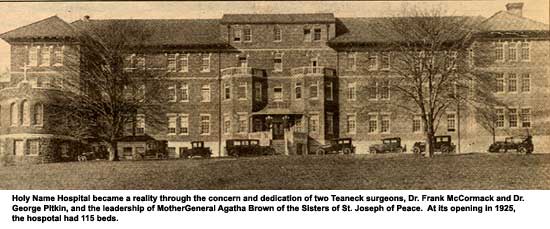
The importance of women’s health issues marks a new era in health care. The Women’s Health Source at Holy Name Hospital is made up of two core service area. The BirthPlace, Northern new Jersey’s first single-room maternity care unit, offer families the convenience and safety of experiencing all phases of the birthing process – labor, delivery, recovery, and postpartum- in private suites. The Stella C. Van Houten outpatient center offers a wide range of educational, support and diagnostic services, including a comprehensive breast health program.
With surgical techniques continuously advancing, many procedures that once required long hospital stays can now be performed on a same-day basis. Holy Name’s 22-bed Same Day Surgery unit allows patients to undergo procedures and return to their homes later that day.
The technology used to treat acute and chronic kidney failure has greatly improved in the last two decades. Holy Name’s regional Dialysis Center, with 41 licensed stations, currently treats more than 350 individuals with kidney failure. The Dialysis Center is one of the largest community hospital-based programs in the nation.
Holy Name was the first hospital in this area to develop a cardiac rehabilitation program for patients who have undergone cardiac surgery or angioplasty. Since then, the program has earned a notable status that has led to a new cardiac fitness program. It emphasizes wellness by focusing on exercise, education, nutrition counseling, and emotional support through personalized plans.
When capabilities change because of illness of injury, patients can receive therapy at Holy Name’s Rehabilitation Medicine Center to help them function at their highest capacity. To Rehabilitation medicine team also works closely with the staff of the Bernard W. Gimbel Multiple Sclerosis Comprehensive Care Center, the only hospital-based facility in the state that specializes in the treatment of MS. What separates Holy Name from other hospitals is the variety of specialty services and programs that are offered to the community. These programs include: the Headache Center; the Eighth Nerve Hearing and Balance Center; DayAway, and adult medical day-care program; The Sniffles Club, a day-care program for mildly ill children; the Pain Management Center; Occupational Health Services; MedCall 24-hour free physician referral service; Chest Pain Emergency Room; and Home Care. In today’s changing world, it is prudent for individuals to strive to prevent illness and disease. Holy Name’s Community Health Services Department offers educational lectures, seminars, and workshops to educate the community and promote a healthy lifestyle.
Community Health Services’ award-winning Health Check Program provides medical services for abused and homeless women and children in Bergen County’s shelter system.
Holy Name Hospital’s Outpatient Department provides clinical services to patients unable to afford the services of a private physician and the full cost of medical treatments. These clinics meet on a weekly basis and range from allergy treatment to cardiology care to infectious diseases and urology care, to name just a few.
As medical techniques advance, so does the role of a nurse. Holy Name Hospital’s School of Nursing has educated and graduated thousands of nurses since 1925. The school operates one of the largest hospital-based nursing programs in New Jersey for the education of registered and licensed practical nurses.
Source: Teaneck Suburbanite, Wednesday, September 3, 2008
By Howard Prosnitz, Staff Writer
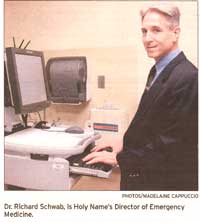 Gleaming hardwood floors, open areas with abundant light and expanded patient care rooms are some of the improvements in the $22 million expansion of Holy Name Hospital’s Emergency Care Center. The new emergency room addition opened on Aug. 25 and admitted its first patient at 5 a.m. that day.
The expansion increases the number of beds from 17 to 41.
“We are bigger and better,” said Dr. Richard Schwab. Holy Name’s Director of Emergency Medicine, who estimates that a patient entering with a minor injury should be discharged within an hour.
 “The emergency room has been designed for improving our efficiency so that there is minimal wait. As soon as you arrive, you are triaged and moved into one of our treatment areas,” said Schwab, who expects to add a meter-greeter who will be stationed outside and will determine whether the incoming patient should be triaged or moved into one of the rapid treatment areas.
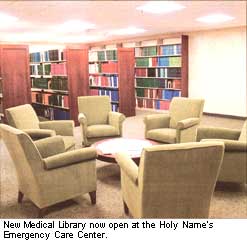 While Schwab did not address the issue of competition among hospitals, he noted that the Holy Name’s catchment area overlaps with that of Hackensack University Medical Center and Englewood Hospital.
“We are doing the best we can for our catchment area,” he said.
The new emergency room is built around a central station and includes four pods of treatment areas.
One pod always remains open and the others are opened as needed. “The central station is the brain of the emergency room where they have the computers with the information about every patient in every room,” said former Teaneck Mayor Jacqueline Kates, who, with former Mayor Paul Ostrow, is employed by Holy Name’s public relations department.
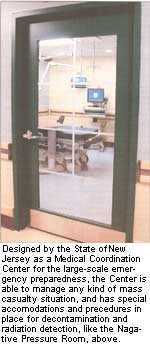 The ER also includes a separate pediatrics department, a room equipped for dental emergencies, gynecological examining rooms equipped with showers and a screen area for psychiatric patients, which can double as a private place for families who are grieving over bad news.
The new ER also includes a new ambulance entrance with an adjacent lounge supplied with food and beverages where EMTs can write up their reports. Decontamination showers for Hazmat emergencies are nearby.
Instead of cramped cubicles, patient rooms are spacious and most are equipped for single patient occupancy.
A computer with online access and a telephone are available at each patient’s bedside.
At the basement level below the ER, Holy Name has added an auditorium with three smaller rooms that will be used for both hospital and community events.
Kates noted that despite its growth, Holy Name remains committed to its community hospital origin.
“The community approach is related to the compassionate care approach and is taken by all staff members and will continue no matter how big the hospital grows,” said Kates, who added that many people have told her that they were happy to be in Holy Name.
“The really feel that compassionate, caring approach,” she said. “It is my hope that all hospitals will enhance their ability to serve the community.”
By Howard Prosnitz, Staff Writer
Teaneck Suburbanite, November 12, 2009. p. 3
 Dying from an incurable disease is a lonely and painful ordeal. As victims of intractable cancers grew sicker, they become burdensome to their families, compounding the pain of their final days with feelings of guilt.
There comes a time when the dying patient may recognize that the battle against the disease cannot be won.
But life is no over. The patient may live for weeks or months. Maximizing the quality of the time remaining is the goal of hospice care.
In the spring of 2010, Holy Name Hospital will open a free-standing hospice at the Villa Marie Claire, a 27-acre Saddle River estate. With 20 rooms for patients and 17 for their families, the hospice is believed to be the first in the country with living facilities for family members.
“Our interest is in prolonging life and preserving the quality of life but not in postponing death,” said Dr. Charles Vialotti, chief of Holy Name’s radiation oncology department, who will become the hospice’s director.
“There is nothing more frightening than a terminal illness,” Vialotti continued. “Patients receive hospice care will have a better quality of life, and probably a longer life, than those who continue fruitless treatments.” He noted that New Jersey leads the nation in the number of days patients spend in Intensive Care Units. Many patients are admitted to ICUs, he said, because of the toxic effects of futile chemotherapy.
The hospice will provide a full range of palliative medicine, including analgesics, sedatives and antidepressants, as required. But there will be no chemotherapy, radiation, respirators or dialysis.
Instead, the Villa Marie Claire will focus on natural and holistic activities that bring spiritual healing to patients and families. Healing gardens will be planted and nature trails will slope to the Saddle River. The estate already has an Olympic-size outdoor swimming pool. Concerts, performances and art exhibits will be presented in a large central atrium. The performances will be broadcast to patients’ rooms for those too weak to attend them.
“What is unique about the villa is that we will be focusing on offering patients and families life with dignity, not death with dignity,” said Vialotti. “Even though someone has a terminal illness, that person can still enjoy nature and the performing and visual arts and can still contribute to the integrity, unity and productivity of his or her family.”
The focus will be on the person and not on the disease, he said. “People do not want to die alone, they don’t want to suffer pain and they want their families to remain intact. We believe that we be able to give patients the affirmation that their families will survive.”
Family members can come and go to the hospice as they please. They can cook for the patient so the family can eat together, as all were at home. Patients will also be free to leave for dinner in a restaurant, a weekend, or longer. Patients may also decide to leave the hospice and resume treatments. If that case, patients are welcome back, if they decide to return.
A large interfaith chapel will serve patients of various religious faiths. The hospice will also include a kosher kitchen and Sabbath elevators. No one will be turned away, said Vialotti, noting that most insurances cover hospice care and an endowment is being established for the uninsured.
The Villa was built around 1900 as the summer home for Thomas and Marie Claire Mahoney. In 1916, on her 50th birthday, Marie Claire obtained her husband’s permission and turned the Villa over to the Sisters of St. Joseph of Peace, the founding order of Holy Name Hospital. In the 1930s the Mahoney’s made a substantial cash contribution, allowing the sisters to enlarge the Villa. Over the decades, the Villa has served a variety of functions including a summer camp for orphan boys, a novitiate, a Catholic elementary school, a home for unwed mothers, and a graduate school for nuns earning advanced degrees. In most recent use, it was a combination retirement home for nuns and residence for laypersons. In June 2007 the sisters turned the property over to Holy Name with the stipulation that it be converted into a hospice.
The hospital is requiring the hospice to raise $5 million prior to its opening. Half the money is for renovations to the building and half for the endowment.
HNH staff has been actively involved in fundraising for the hospice, and on Oct. 29 the hospital held a tricky tray fundraiser organized in Linda Giordano, an operating room nurse. The event took in $30,000.
I came up with the idea in April of how we could all come together and help the hospice,” said Giordano, who was assisted by two other HNH nurses, Mary Canciani and Johanna Marto.
The fundraiser was also a memorial to Linda Carta, a Holy Name nurse who died of ovarian cancer in 2008. While Carta was sick, HNH staff organized a tricky tray that raised $24,000 for her husband and children.
Beginning with a zero budget, Giordano sent letters to 400 businesses in Bergen and Rockland counties asking for gifts and donations for the hospice fundraiser. She received 100 responses.
Holy Name physicians also made cash donations, which Giordano used to purchase more expensive prizes, including a laptop, iPods, HGTV televisions and a GPS device. The major prize was a weeklong time share vacation for two in St. Martin’s with a $500 bonus for airfare.
“There is no wonderful way to end your life,” Giordano said. “But I would rather die in a cozy room with my family around me and holistic things, like healing gardens, than on a respirator. Hospice care is about making those last weeks or days of your life more meaningful.”
Hospital officially changes over to Medical Center
Teaneck Surburbanite, March 18, 2010, p. 19
Holy Name Hospital became Holy Name Medical Center last week during an event that focused on the themes of spirituality, selflessness and plurality, and addressed how those values relate to Holy Name’s mission and its expression both inside the organization and out into the world at-large. Soledad O’Brien, CNN Anchor and Special Correspondent, provided the keynote address.
The event and re-naming, which coincides with Holy Name’s 85th anniversary, was attended by about 300 dignitaries and community leaders, including municipal administrators, emergency first-responders, mayors and other elected officials from surrounding towns, as well as other friends of the Medical Center.
In her opening prayer, Sister Terry Donahue, CSJP, spoke of the unique spiritual personality of Holy Name, from which ‘no visitor leaves without a gift, no guest leaves without a blessing.” Sr. Donahue is the assistant leader of the Congregation of the Sisters of St. Joseph of Peace, Holy Name’s founding and sponsoring organization.
Michael Maron, President/CEO announced that Holy Name made the official change from “Hospital” to “Medical Center” to more accurately reflect the organization and its capabilities. “We’re much, much more than a hospital,” he said. “Holy Name has evolved in so many ways, that the term ‘hospital’, which connotes a common, traditional facility, no longer represents who we are and what we do.”
Maron cited the increasingly wide scope of services offered by Holy Name; leading-edge technology; multiple off-site locations, including care centers throughout Bergen and into Passaic and Hudson counties; culturally-focused medical care; and significant growth in the medical staff.
Maron and Holy Name anesthesiologist Alan Gwertzman, M.D. and Timonthy Finley, M. D. flew to Haiti last week to oversee the delivery and installation of the life-saving oxygen processor donated to Hôpital Sacre Coeur in Milot by Holy Name Hospital, its employees and Bergen Anesthesia Associates. The cooperative effort includes manufacturer Oxygen Generating System International (OGSI), Burn Advocates and Royal Caribbean Cruise Lines.
O’Brien noted that Holy Name “values the things that I value in my own life.” O’Brien observed that Holy Name combines the two essential “kinds of care: great medical care and great care of the community.”
O’Brien lauded the Medical Center’s long-term commitment to Haiti and spoke of the universality of the human spirit. “Everyone wants the same things: security, happiness, health, they want their children to have better opportunities…”
O’Brien alluded to her own international travels as a representative of the media, and acknowledged that even those in the audience who will never visit Haite can support the humanitarian effort in their own way, “making a difference in the lives of people you’ll never meet.”
Toware the end of the program, Maron accepted civic proclamations from N. J. Sen. Loretta Weinberg and N.J. Assemblyman Gordon Johnson; County Executive Dennis McNerney, and Township of Teaneck Municipal Manager William Broughton.
The proclamations endorsed Holy Name’s use of the term “Medical Center” and celebrated the orgainzational evolution that inspired that change.