
Teaneck’s Historic Red Oak Tree


By Mildred Taylor
The Sunday Sun, September 1, 1957, p. 6
 Under the shade of one of the oldest oak trees in Teaneck stands a brown shingled house that goes far back into the history of this community. The house and the tree which is estimated at between 175 and 200 years old are located at Cedar Lane and Palisade Avenue, one of the busiest corners in town. Also on the property stands the Teaneck Post Office.
Julius P. Richter, who has his plumbing business in part of the rambling house, has owned the property since 1921. It was there long before he came here as a boy in 1907. In the wing to the east live Mr. and Mrs. R. J. Abernethy. It is their love for flowers that makes the corner next to the postoffice a pretty sight at this season of the year. For many years they have planted the terrace with plants that make a gay spot there all summer long – verbena, Heliotrope, lemon and gold dwarf marigolds, Belgian clover, pink petunias geranium and salvia.
There are lilac bushes pruned low, in keeping with the height of the annual plants. The roots of the old lilac keep the soil of the terrace from washing. There is never a weed in that garden. When a tiny blade of grass appears, the Abernethys uproot it. It would seem they use tweezers.
Old timers do not know who built the house that has stood there since Teaneck was a farming community. It was there, a title search showed a hundred years before Mr. Richter’s parents arrived in Teaneck in 1907 and moved into a house built on stilts down on Front Street where they got all their water from the brook. Judging from the red sandstone foundation, the thick walls, the deep fireplaces and the hand hewn beams, the building at Cedar Lane and Palisade Avenue is really old. Before the brown shingles were put on, the house was covered with red clapboards.
Below what is today the plumbing shop is a room that was used as a kitchen by earlier tenants. There is a deep fireplace with a Dutch oven. It was customary for the Dutch farmers to spend much of the time in the kitchen. A narrow stairway led to the parlor above which was used only on special occasions, The family slept in the loft above which is lighted by dormer windows. The quarters to the east were probably added at a later date. Today the Abernethys live in that trim apartment which is all spic and span decorated in excellent taste.
All the back of the house in earlier times was a well covered by picturesque housing. You’d never guess the well is still there when you look up the double driveway between they house and the postoffice, but it is. A stone the size of a soft ball in the middle of the driveway is the only clue. Mr. Richter lifts the stone to let visitors look far down to the water of the well.
Among the long-time residents of Teaneck who are familiar with the old house are Charles Clausen, whose parents came here with William Walter Phelps shortly after the Civil War and Jimmy Limone, the genial citizen who still tends a truck farm across from the postoffice and sells his produce at a little stand. He has lived there for 50 years. Retired Lt. Jesson Witham of the Teaneck Police Dept. also recalls the old home.
Mrs. Gertrude Howe of 320 Hemlock Ter., Teaneck, lived in the apartment now occupied by the Abernethys. At that time she was Mrs. Kraus. She worked in the office of the Teaneck Tax Collector during the twenties and recalls how she and Mrs. Richter used to pick wild strawberries over on Frances Street. She also recalls the clop-clop of the milkman’s horses as they went up and down the cobble stones on Cedar Lane at 4 a.m. One morning she heard a terrible clatter and looked out to see the wagon limping on three wheels. The fourth wheel was careening down toward the railroad tracks. There was no bridge across them then.
Mr. Richter remembers the days when there was a grade crossing on Cedar Lane. There were frequent train accidents and victims were sometimes brought to the house for treatment.
“I remember once a freight train jumped the track,” he said. “The cars that broke open were loaded with sauerkraut, pig’s knuckles and corned beef. What a feast. Hardly anybody around bought coat. The kids would climb into coal cars, push the coal out with their feet and after the train had moved on go back and gather the coal up off the tracks. Horses used to get on the tracks, too. A lot of them got killed that way.
“The station was down at Cherry Lane – got its name because Phelps planted lots of fine Oxford cherry trees there.”
Mr. Clausen recalls that the station agent, George Barnes lived at one time or another in a house near the tracks which was recently torn down, on Cherry Lane and in another house just across from Jimmy Limone.
The Richter home at one time was a part of the Phelps Estate which included about half of present day Teaneck. In the early days Palisade Avenue was a farm road. Later it was called Heasley Avenue. The southern extension of the farm road ran through property owned by the Vandelindas which extended from the Hackensack River to Teaneck Road. The Vandelindas settled in what is now Teaneck when they arrived from Holland around the year 1700.
“Cedar Lane looked a lot different 50 years ago than it does now,” said Mr. Richter. “There used to be bridle paths all around this area. Phelps built them because his daughter, Marion, like to ride. There’d be four rows of trees and then a path about 15 feet wide, then another row of trees and another path. New Yorkers used to love to come out here and drink the water out of our well.”
Many of the meetings that resulted in the adoption by Teaneck of the council-manager form of government were held in the building, Mr. Richter says. Capt. John J. Wilkins, one of the original members of the Taxpayers League, had a real estate office there. League members felt a manager who could devote full time to government was needed. It was a close political fight, but the slate favoring the council-manager plan won with a great deal of help from Capt. Wilkins.
Mr. Richter, who went to the Main Street Grammar School in Bogota, to Hackensack High School and then to the Copper Union in New York to study engineering, has seen Teaneck grow from a population of little more than 800 to its present size of approximately 40,000.
By Howard Prosnitz, Staff Writer
Teaneck Suburbanite, May 11, 2011
 TEANECK – The great red oak that has grown for more than 350 years at what is today the intersection of Cedar Lane and Palisade Avenue will be allowed to die a natural death.
Through the efforts of community volunteers, including the Puffin Foundation, which provided an undisclosed amount of funding, a semi-circular conservation easement has been established in the area of the tree. The Bergen County Department of Parks will provide maintenance of the tree for the duration of its life.
At a ceremony on Saturday, May 6, attended by more than 40 residents, a plaque was installed facing Cedar Lane dedicating the tree to Irwin Weinberg, the late husband of Sen. Loretta Weinberg, a resident of Teaneck. The senator, who hosted the ceremony, recalled how 30 years ago her husband led the first of several battles to save the tree from destruction by developers, appearing before the council and planning board and, at one point, threatening to handcuff himself to the tree.
“This is a great occasion for the community to celebrate the coming together of citizens, activists and one of our houses of worship,” said Weinberg.
 The tree, which is the fourth largest red oak in New Jersey, according to the New Jersey Department of Forestry, has weathered several threats to its existence. Weinberg recalled that when her husband became involved, United Jersey Bank, which was then located across the street on Cedar Lane, had proposed buying the property and turning it into a parking lot.
In the late 1990s, a Jewish organization, Union for Traditional Judaism, bought the lot and the adjacent building at 811 Palisade Avenue. Officials from the seminary appeared at council meetings and promised to spare the tree. But in 2010 the organization was in bankruptcy court and attempted to cut down the tree to increase the value of the property to a buyer. Work crews had assembled on Cedar Lane and were about to begin the unauthorized cutting when Wally Cowan, a member and former chair of the Parks Recreation and Advisory Board, happen to pass by and observed them. Cowan called 911 and Mayor Mohammed Hameeduddin.
Through a series of negotiations involving the Congregation, which had been renting 811 Palisade Ave., the county and the bankruptcy court, Congregation Netivot Shalom bought the property and the Puffin Foundation donated money for the preservation of the tree in perpetuity.
Although Puffin Foundation Executive Director Perry Rosenstein would not reveal how much money the foundation donated toward the project, he said it was “a substantial amount.”
Hameeduddin recalled that the call from Cowan came just days after he became mayor.
“Wally Cowan got everybody on the phone and the tree got a stay of execution, and then we all got involved and we saved the tree,” the mayor said.
Bob McGrath, of Sesame Street fame, who has lived on Frances Street, just north of the property, for the past 32 years, led the group in a recitation of Joyce Kilmer’s poem “Trees.”
“I’m a real tree hugger and have loved the tree all my life. Saving it means a great deal to me,” McGrath said.
Weinberg described Perry Rosenstein and his wife Gladys as “the catalysts who provided the necessary money to establish the easement.”
Rosenstein spoke about some of the remarkable events that the great oak has quietly witnessed.
“It has been here since the Revolutionary War when George Washington retreated on this route,” he said. “It was here during the Civil War when the Emancipation Proclamation gave freedom to African-American slaves and when hundreds of young men and women from Teaneck who went off to fight fascism in WWII.”
Martin Sarver, lawyer for the Puffin Foundation, noted that when he drove past the property several weeks ago, the tree was bare but that now it is green.
“This is an absolutely unbelievable act of nature to which we are all recipients,” he said. “Every year this tree loses its leaves in the fall, and they grow back again in the spring, and this has happened 350 times and will continue to happen.”
E-mail: [email protected]
By DENISA R. SUPERVILLE, Staff Writer
Monday, April 16, 2012
 TEANECK — The township’s most famous tree — a hulking, centuries-old red oak that towers over Cedar Lane — has been called “majestic,” a seemingly fitting adjective, and “big,” an obvious understatement.
The tree’s admirers, including residents who have fought over the years to rescue it from many close shaves with chain saws, may soon be able to call the tree “historic.”
On April 25, the township’s Historic Preservation Commission will hold a hearing to determine whether the red oak, which is more than 350 years old and is the fourth-largest red oak in the state, should be designated a historic site.
If the commissioners agree, the oak will be the first plant in the township to receive the designation, said Eugene Coleman, the commission’s chairman, who called the tree “a beautiful specimen.”
Historic site designations are usually conferred on buildings that are exemplars of a particular style of architecture or the work of a famous architect, cemeteries in which famous — or infamous — individuals are buried or areas that played significant roles in battles.
But “trees, in and of themselves, have not been listed” as historic sites in New Jersey, said Larry Hajna, a spokesman for the state Department of Environmental Protection, which oversees the Division of Parks and Forestry. Hajna said that trees routinely are included in historic districts and sites listed in the state and national registers of historic places.
 The commission made the recommendation mainly because of the tree’s age, Coleman said.
“It’s the very fact of the age of the tree — that it’s been around for 300, maybe 350 years,” he said. “It is on a known or historic homestead that’s been removed. There is no trace of it, except for the tree.”
The tree is in a grassy area on the Cedar Lane side of a property at 811 Palisade Ave. owned by Netivot Shalom. The Orthodox synagogue purchased the property in November 2010 and promised to save the tree.
The tree has been rescued from the chopping block more than once. Netivot Shalom bought the property from the Union for Traditional Judaism, which cited safety reasons in 2010 when it announced that it planned to cut down the tree. But the tree was saved after pleas from the township and protests from community activists.
A quarter-century earlier, Irwin Weinberg, the late husband of state Sen. Loretta Weinberg, led a protest to keep the tree alive. At the time, a developer wanted to put a parking lot on the property.
A plaque near the base of the tree notes Irwin Weinberg’s efforts.
The tree is a “living witness to the history of Teaneck from Revolutionary days to present” and was saved from destruction by concerned citizens of Teaneck, Bergen County, The Puffin Foundation and Congregation Netivot Shalom, the plaque reads.
Perry Rosenstein, president of the township-based Puffin Foundation, a non-profit organization that provides grants to artists and cultural and educational organizations, said he intends to attend the commission’s hearing to speak in favor of the historic designation.
The Puffin Foundation donated money to the county last year for a conservation easement, which allows the county to maintain the tree in perpetuity.
“It’s been here for 300 years,” Rosenstein said. “And it was a witness to the complete growth and development of Teaneck and all the events that have taken place in that period of time — from George Washington’s retreat to our guys going off to fight fascism in World War II.”
The historic-site designation will allow the commission to safeguard the tree, which already has some measures of protection built into the conservation easement.
For example, the designation will prevent anyone from “cutting it down, putting up a kiosk next to it, hanging banners around it [or] permanently affixing something to it,” Coleman said.
The commission can make its decision the night of the hearing, but the Township Council has the final say, Coleman said.
“Ours is a recommendation; theirs is confirmation,” Coleman said.
By Denisa R. Superville, Staff Writer
The Record, May 28, 2013
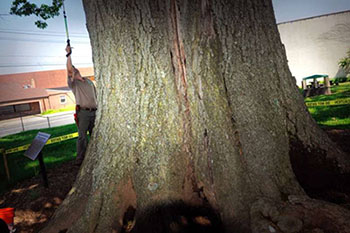 The majestic oak that sits on the corner of Cedar Lane and Palisade Avenue in Teaneck is headed for the chopping block this week, but the historic tree may live on, if experts can manage the tricky feat of cloning it.
The practice of cloning plants and trees — producing genetically identical copies — is nothing new. From impatiens at the local nursery to irises in Montclair’s Presby Memorial Iris Gardens to cherry blossoms in Washington, plants and trees have been cloned to replicate desirable traits.
“It’s been done for thousands and thousands of years,” said David L. Kidwell-Slak, a horticulturist in the floral and nursery plants research unit at the U.S. National Arboretum. “It’s really the primary way people have domesticated any plant.”
But matching the 250-plus-year-old red oak might be more challenging, according to tree experts. That’s because oaks are among the most difficult plants to clone. Callery pear, American holly, Atlantic white cedar, yellowwood and birches are easier to clone through cuttings, said Mike D’Errico, the executive director of the state’s Society of Certified Tree Experts.
Typically, about 6 inches of the branch tip, called soft wood growth, is cut, dipped into a rooting hormone to stimulate root growth, then put into a moist, warm environment.
Depending on the plant, the stem cuttings will form roots and be ready for replanting within weeks or months, said David Slaymaker, a professor of molecular plant biology at William Paterson University.
“The new plant is genetically identical to the plant the cutting came from, since it was actually part of that plant,” Slaymaker said.
The cuttings also can be grafted onto another plant. The results will be genetically similar, although the roots will belong to another tree.
A second, slightly more expensive and modern method of plant cloning is through tissue culture. In this process, young tissue is cultured in a sterile environment and treated with plant hormone to stimulate root growth.
If the Teaneck oak is saved through cloning, it would not be the first time that a tree of historical and emotional significance has been propagated for future generations.
Some of the cherry blossom trees around the Tidal Basin in Washington are clones of the original gifts from Japan in 1912. The Archangel Ancient Tree Archive has been cloning and archiving the genetic material of the world’s oldest species, studying their genetic makeup to discover the secret to their endurance, and replanting some of them.
Closer to home, in 2009 the township of West Caldwell took 122 cuttings from what was then the state’s largest cucumber magnolia to make genetic copies.
The tree’s image had become the town’s symbol, engraved onto its official stationary and police cars, said Clay Allison of the Beaver Brook Nursery in Wantage, Sussex County, who handled the process.
Of the 122 cuttings, only about 25 to 30 of the offspring were successful, Allison said.
Bergen County is planning to cut down the northern red oak in Teaneck this week, after a report that concluded that extensive decay, termite damage, the aftereffects of a lightning strike five years ago and the loss of 40 percent of its root system all weakened the tree, increasing the likelihood that it or its limbs will fall and hurt — or kill — someone.
The tree has special significance in some corners of the township. Over the years, many have fought to save it from developers. An ordinance this year gave it official historic status.
The ordinance explained, “The tree was standing before the birth of our nation and before George Washington’s retreat over the Hackensack River at Historic New Bridge Landing.”
The Puffin Foundation, which made a donation to Bergen County to take care of the tree in perpetuity, is working with tree experts to keep the oak’s lineage alive.
“Nobody wants this tree to go down,” said Todd Mastrobuoni, a certified tree expert, master arborist and tree risk assessor, who suggested cloning it. “And, at least, if we can come up with a way to give people something — that it’s not a total end to it — it will be worth the time and effort.”
The Puffin Foundation’s tree experts contacted Jason Grabosky, an associate professor of ecology, evolution and natural resources at the New Jersey Agricultural Experiment Station at Rutgers University. Grabosky says the group is considering three methods to increase the chances of success.
They will try taking terminal cuttings from the tree and using growth hormones to initiate rooting; try taking small branches and storing them in an environment with adequate humidity, a process that would induce the branches to use their stored carbohydrates and force them to grow shoots; and try using the sprouts that will be generated once the tree is cut down.
“There will be three different opportunities to try to make this work,” Grabosky said. “Red oak, as a group, is not very easy to do by cuttings. Younger ones are better. Older ones are hard. … With a 300-year-old large red oak, the odds are that this will not be highly successful.”
Nina Bassuk, a professor of urban horticulture at Cornell University who has been researching oak cloning since the late 1980s, said she has had measurable success with basal sprouts, the third method Grabosky plans to use.
In her method, the tree stump would be left about three or four inches off the ground. Once the sprouts appear, they will be put in the dark — a process called etiolation — by building a structure over them or covering them with dark cloth. The basal part of the sprouts will be treated with a rooting hormone and the roots allowed to grow. When the shoots are a few inches long, the dark covering will be removed and the bases painted with more rooting hormone.
After several months they can be planted, she said.
“It’s a difficult thing to do,” Bassuk said. “So if they can wait until October, they can get acorns, but if not, it’s possible that they can try this other method we have been working on. But with a 250-year-old tree, it’s not going to be a sure thing, but it’s a possibility.”
Cost is not likely to be a factor, she said, but the process is time-consuming.
If they were not looking for identical genetic material, the group could use the tree’s acorns, experts said. The acorns are not likely to be exact replicas, and could contain genetic material from any other tree in the area besides the famous oak.
Even if the cloning is successful, however, there is no guarantee that the offspring will live as long as its parent.
Sometimes, it’s just the luck of the draw, said Dirk Vanderklein, who teaches plant physiology at Montclair State University.
“All trees potentially can live quite long,” he said. “In fact, in theory, they can live forever. … The fact that that tree is the lone survivor of probably a couple thousand seeds that sprouted — it was just the luck of the lottery that that tree happened to make it through all the various things that have happened to all the other trees.”
Tree expert’s report points to safety hazard from Cedar Lane oak
By Noah Cohen
The Teaneck Patch, June 20, 2013
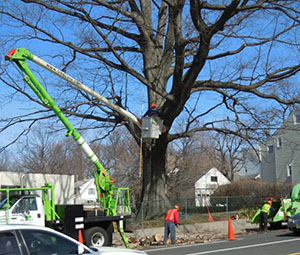 A centuries old oak tree in Teaneck that residents have long fought to preserve will be chopped down after a tree expert determined the oak presented a “real hazard to people and property,” a county official confirmed Friday.
The tree, which is maintained by the county, is set to be removed by Memorial Day, said Jeanne Baratta, chief of staff at the Bergen County Executive’s Office. County officials briefed various Teaneck stakeholders on the situation earlier Friday.
“The county did a lot of due diligence on this,” Baratta said. “This is a safety issue. The tree has severe decay.”
Baratta said the tree is largely hollow, attracting termites and officials are concerned it could come down in a major storm. An initial review suggested the tree was in good condition, but a more thorough follow-up inspection uncovered rotting and described the tree’s condition as hazardous.
“This tree, in my professional opinion, must be removed as soon as possible. The tree poses a real hazard to people and property. There is no treatment or method of care that will eliminate the hazard that this tree poses. Removal is the only option,” William R. Comery, a certified tree expert hired by the county, wrote in an inspection report obtained by Patch.
“The potential targets because of the location and size of the tree are many, including motorists, pedestrians and young children and staff in the play area under the tree canopy,” the report states, also pointing to possible damage to property and utility lines.
Past efforts to chop down the tree have prompted opposition from residents. Supported residents pushed to save the tree and the land was granted a county conservation easement in April 2011, a move that protected the site and put its care under the county parks department.
The Puffin Foundation, which helped fund the easement, planned to have its own tree expert conduct a review, Baratta said.
A decision in early 2010 by former property owner the Union for Traditional Judaism to remove the tree led to a public outcry. UTJ filed for bankruptcy and the land was purchased by Netivot Shalom, which vowed to save the tree.
Teaneck bestowed historic status on the tree last year in a move many thought would provide longtime protection for the 250 to 300 year old oak at the corner of Palisade Avenue and Cedar Lane.
Representatives from Netivot Shalom and the Puffin Foundation could not be immediately reached for comment Friday afternoon.
By RICHARD COWEN, Staff Writer
The Record, September 20, 2014
The stately red oak that stood in Teaneck for about 300 years before falling to the ax is getting a new life.
Cut down last year amid concerns that disease and rot had made it a safety hazard, the red oak appeared headed to the (saw)dustbin of history.
But not so fast. The Bergen County Department of Parks has teamed up with the Puffin Foundation to offer a piece of the tree to anyone who wants to give it a kind of second life — as art.
The parks department has scheduled two days in October when any artisan, artist, wood-crafter or plain old tree-hugger can pick up a piece of the mighty red oak, free of charge.
Since coming down in June 2013, much of the tree has been stored in bits and pieces in two warehouses in Bergen County. The uncut tree trunk and limbs have been in storage at the Saddle River County Park in Rochelle Park. The rest of the tree has been milled into slabs and planks and is at Campgaw Mountain County Park in Mahwah.
The pickup days are Oct. 7 at the Saddle River County Park storage area on Lotz Lane, and Oct. 9 at Campgaw Mountain County Park, via Fike Road. Pickups are between the hours of 2 and 7 p.m.; parks staff will assist people in cutting wood and moving it to their vehicles.
“It was a mammoth tree,” said Gladys Miller-Rosenstein, executive director of the Puffin Foundation. “It would be a shame if it was just discarded.”
Mammoth might be an understatement. As measured in 2010, the oak was 80 to 85 feet tall and close to 200 feet wide. The trunk was listed as about 70 inches in diameter and 18½-feet in circumference.
Miller-Rosenstein said no one is certain how old the tree was when it was chopped down, but the estimates ran between 250 and 300 years old. “It withstood hurricanes and 80 mile an hour winds,” she said.
As the tree grew bigger, there were numerous threats to chop it down, but each time preservationists rushed in to save it. The Teaneck-based Puffin Foundation, which is dedicated to advancing the arts, became the tree’s biggest defender.
Then in 2013, Bergen County, which is responsible for maintaining the tree and the safety of the intersection, determined that the red oak had to go. Bergen County found the tree was suffering from decay and termite damage and posed a risk to pedestrians and motorists.
But Miller-Rosenstein said the tree did not outlive its usefulness. It’s sturdy wood, she said, would make for a great bench, kiosk or furniture.
“When they were cutting it down, a lot of people came up to me and said, ‘I’d love a piece of that wood,’Ÿ” Miller-Rosenstein recalled. “Now here’s their chance. We hope people take a piece home.”
By Michael McCue, Library Director
December 1, 2015
The Teaneck Public Library is pleased to announce the installation of a slab of the historic red oak tree that graced the corner of Cedar Lane and Palisade Avenue for some 250 years. The section of the tree now sits on the main floor of the library courtyard on a stand constructed by Anthony Santella, with an explanatory Plexiglas sign designed and fabricated by Majestic Signs of Teaneck.
The magnificent tree succumbed to disease and was cut down in June 2013 after efforts to preserve it by the Puffin Foundation. The tree stood on a lot that also housed a historic home that dated back to colonial times as well. It was owned by Julius P. Richter from 1921 until at least the 1960s.
The piece of the tree joins a portrait of the first township clerk, the 1976 bicentennial observance committee sign, the WPA murals in the reference room, a portrait of William Walter Phelps, a bust of Edith Van Buren and other artifacts that make the library a little Smithsonian. All are on public display.
For more information, contact Michael McCue at [email protected] or 201-837-4171.