
Teaneck Volunteer Ambulance Corp
From The Teaneck 100 Year Book , pp. 50-53
In the summer of 1939, a group of members of Hose Company Number 4 of the old Teaneck Volunteer Fire Department decided that Teaneck needed an ambulance corps that could serve its 23,000 residents (the population at that time) 24 hours a day, every day of the year and without charge. Prior to this time, the Township was served by ambulances operated by area hospitals. They offered irregular response times and often little more than transportation.
The driving force was Cornelius Van Dyk, a Hose Company member who was then the town’s animal warden. Since he lived and worked in Teaneck, he felt that he, and others, would be available at any time of the day or night to respond to an emergency.
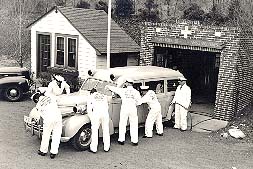
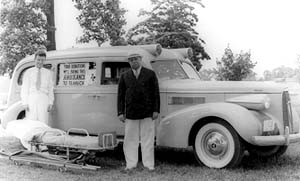
Van Dyk located an ambulance in a small town in Ohio which could be purchased inexpensively, and he and Jimmy Thompson journeyed to Ohio to bring the rig to Teaneck. Their find turned out to be a 1936 LaSalle, which looked very much like a hearse, somewhat like the transport ambulances used by some private services today, but it carried minimal equipment. Van Dyk and Thompson devoted their spare time to raising enough money to pay for the ambulance. Appearing all over town with the ambulance, they made person-to-person solicitations for contributions. Many donations were as little as a quarter. They formed a nonprofit corporation and named it the Teaneck Volunteer Ambulance Corps (TVAC).
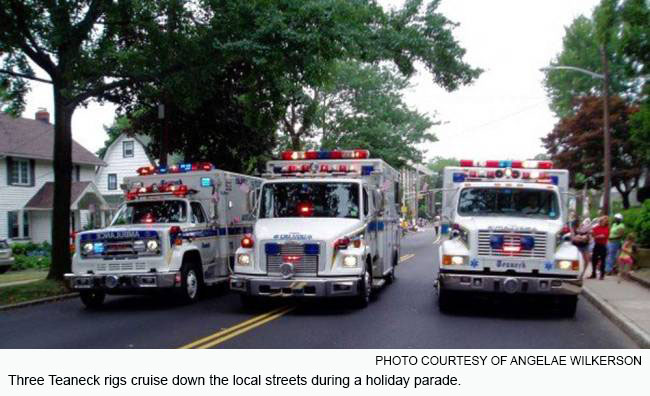
Today the corps has 115 active, highly trained members, hundreds of alumni, four modern ambulances with another on order, and a central headquarters building with facilities for the ambulances, crew quarters, a kitchen and sleeping accommodations for six or more members. The TVAC now serves a community of 40,000. It’s a busy life in the TVAC, with three highways, two nursing homes, a hotel-and-office complex, an industrial area and a major university to be covered.
Throughout the last fifty-plus years, the corps has never charged a patient or the patient’s family for service, whether the patients are Teaneck residents, visitors, or people who need medical service while passing through the town. The corps also renders service in nearby towns as part of a mutual aid system, again without charge. In fact, the most important word in the name of the organization is “volunteer,” an identification the members zealously protect. In recent years, the corps has averaged 3,500 runs a year and the total number of calls made in its history is estimated at between 100,000 and 110,000.
How has the TVAC operated? It has every expense of a large corporation except payroll. The corps literally finances itself. It receives a stipend from the Township Council (the maximum allowed by law when a community does not own and operate the corps), but this covers only some 14 percent of the costs. The balance comes from donations from residents, solicited by the corps once a year. Thanks to the generosity of residents, the typical donation is no longer 25 cents.
These funds must cover fuel and service for four ambulances; medical supplies (a very significant expense); oxygen (used on many calls); maintenance of the headquarters building from which the corps members respond; insurance, utilities and a reserve for ambulance replacement, to mention just some of the basics.
Replacement of ambulances is a major expense. The ambulances operate around the clock, and must deliver peak performance at all times. Consequently, the corps must replace an ambulance before it reaches the end of its useful, dependable life. The difference between a happy ending and a less-than-happy ending could be the dependability of the ambulances. Due to rising costs and decreased income, TVAC, for the first time ever, recently had to ask the Township to buy two new ambulances. They were delivered in 1995.
TVAC has been at the leading edge of ambulance innovation. In 1972, hearse-type ambulances were replaced by vehicles having a pick-up truck chassis. In 1989, the process of phasing in the safer and more reliable medium truck chassis commenced, and two more were added this year.
Starting in 1975, a number of innovations such as mounting the patient’s cot in the center of the compartment allowing EMT care from both sides, standardized kits and improved warning devices to reduce traffic hazards were initiated by Walter Pinches who was a member of the corps from 1965 until his death in 1994. The skills and devotion of the ambulance crews are essential. Every regular member of the Teaneck Volunteer Ambulance Corps today is a state-certified Emergency Medical Technician (EMT), trained to standards established by the Federal government. The basic certification consists of 130 hours of formal training outside of the corps, usually at the Bergen County Fire and Police Academy, or the Bergen County Emergency Medical Training Center in Paramus.
During the 9- to 12-month probationary period, each member undergoes additional training on the corps’ equipment and learns its procedures. Every three years, each EMT must recertify with the State of New Jersey by taking an additional course of 48 hours and another state-administered examination, which includes a demonstration of hands-on skills as well as a three-hour written test.
One-third of the TVAC members are certified to use the semi-automatic defibrillators which were purchased through the generosity of the residents of Classic Residence on Pomander Walk. Defibrillator service started in 1994 after 20 years of negotiations with the NJ State Department of Health to gain the right to provide it.
Corps members are fully trained for emergencies ranging from strokes and heart attacks to broken bones, heavy bleeding, shock, diabetic crisis and the hundreds of injuries which follow auto and home accidents. Many members of the corps have had the thrill of assisting a mother in delivering her baby. In addition, many members have voluntarily sought and maintained certification in pre-hospital Trauma Life Support, Heavy Rescue, Hazardous Materials Operation, Incident Command, Water Rescue, Sign Language, and other advanced skills.
In the last few years, the TVAC has been assisted on about 10 percent of the calls by paid paramedics from the local hospitals. They are actually an outreach of the emergency rooms. Their vehicles are not ambulances, but carry equipment for use in advance procedures which had previously been administered only in emergency rooms. Paramedics make emergency room procedures accessible to patients precious minutes sooner, which can make a difference. The hospitals so charge for this service.
The 3,200 calls a year answered by the Teaneck Volunteer Ambulance Corps represents an average of about eight runs every 24 hours every day of the year. Many corps members have passed the 1,000-call mark and a select few have exceeded 5,000 calls, for which an award is given. Unlike many area towns, the TVAC is an in-house corps; that is, there are members on duty who are present in the building 24 hours a day. This accounts for the very fast response time. If additional members are needed, a back-up paging system is used.
The building at 855 Windsor Road is the fourth home of the Corps. In 1939, the ambulance was kept in a single garage that still exists in the embankment behind the municipal building. The garage just about accommodated the rig, so four years later the Corps moved to a single-bay building on Teaneck Road now occupied by a roofing company. The third home was a two-bay building on Teaneck Road, which was given to the Township in exchange for the land on which the present building is located.
Shortly after the move to Windsor Road, the Corps initiated a system of having a crew sleep in the building to make fast responses during the night. Since then, there has always been a crew assigned to sleep-in duty. It would be difficult to characterize the members by any standard except their desire to help people, and to save lives where possible. Some members are high school students who are mature enough to feel the same dedication as the older members, some of whom have grandchildren.
Occupations range all the way from lawyers to computer experts and technicians, retail executives, clergymen, medical workers, police officers, firefighters, accountants–men and women from every walk of life. And they represent every religious group and every ethnic background. The corps was one of the first of its kind to accept and recruit women, who now account for about half of the membership and who have served as officers up to the top operations post of Captain.
Requirements for membership are good health, the ability to lift and proof of character. Each ambulance that responds to a call is staffed by at least two fully trained regular members. All drivers receive special training and pass a rigorous driving test.
Ambulance service has changed over the years. In some states, service was rendered by undertakers. Most hospitals ran ambulances years ago, although many were not equipped to provide immediate emergency service. At one time, many hospitals required interns to ride on the rigs as part of their training. This ended with World War 11, when there was a shortage of physicians, and it has never been resumed.
In earlier years, ambulances “swooped and scooped,” that is, rushed to the scene, loaded the patient, and rushed to the hospital. Today, with the training of Emergency Medical Technicians and Mobile Intensive Care Unit Paramedics, the procedures have changed. Physicians who specialize in emergency medicine depend on the ambulance personnel to arrive at the scene, evaluate the condition of the patient (a skill for which they are now trained) and to stabilize the patients before moving them. This involves using a host of modern pieces of equipment designed especially for this purpose. Ambulance personnel now report a patient’s condition to the hospital via radios in the rigs so that physicians can order other procedures and the hospitals can be ready to receive patients for whom treatment has been initiated by ambulance personnel. Patients enter the emergency medical system with a head start, which has been observed to produce significant improvements in final results.
Teaneck ambulances are dispatched by the Teaneck Police Department. By dialing 911, one reaches the police within seconds. A dedicated ambulance phone line is located on the police switchboard. In addition, the rigs are equipped with police and fire department radio frequencies, so that dispatchers can always reach them on the road.
The corps urges residents to call for an ambulance if there is the slightest thought that an ambulance is needed. Members would much rather respond to an incident only to find they are not needed, than to respond where there has been a delay and it is too late.
The corps also provides non-emergency medical transportation for Teaneck residents when arranged in advance by a physician or authorized hospital personnel. Bringing people home is always a happy trip. To conserve resources, non-emergency transports are available from 7:00pm to I 1:00pm and on weekends.
The corps works closely with the police and fire departments. Both are most helpful and assist in many ways. If there is a highway accident, or other problem involving entry into a building or a vehicle, the Fire Department also will respond to provide forcible entry, extrication, hazard control or assistance with a patient as needed.
In short, Teaneck residents and visitors have a state-of-the-art first response emergency medical service. The members of the Teaneck Volunteer Ambulance Corps are proud of their part in making this a reality and look forward to another fifty years of serving the public, without charge, with the best skills and equipment they can provide. The Teaneck Volunteer Ambulance Corps (1939 – 1989) looks to another fifty years of service.
Written and updated by Bill Shambroom
From Teaneck Report , v.1, no. 1, September 1953
Ambulance Corps, Handles 6,155 Calls
In Fourteen Year History of Service
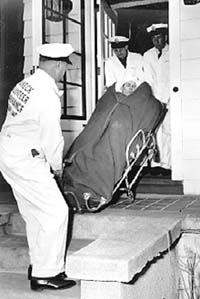 Teaneck’s volunteer Ambulance Corps is one of the largest and most efficient organizations of its kind in the nation. Founded in 1939, it has grown to a complement of thirty men who own their own building and two modern Cadillac ambulances. In its fourteen year history the Corps has handled 6,155 calls.
The Ambulance corps was organized by a group of men who made a house to house canvass raising funds to purchase the first ambulance. The Corps has grown through its fourteen years to the extent that it now owns its building, two Cadillac ambulances equipped with inhalators, resuscitators and doctor’s bags. The later in turn contain stethoscopes, blood pressure machines, sterile needles, gauzes and other other such paraphernalia for use in emergency situation. Bandages, adhesive tape, splints and Thomas splints, to be used in connection with compound fractures, complete each vehicle’s equipment.
The Corpsmen are on call 24 hours a day, every day, to respond in any emergency. Since its Inception, up to and including July 31, 1953, the ambulances have responded to 6,155 calls, covering 27,179 miles.
The Teaneck Corps is a member of the Third District of the New Jersey State First Aid Council and the International Rescue and First Aid Association.
Teaneck’s Corps is a part of a cover-up system whereby neighboring communities, in case of disaster or for any other reason, cover each other by pre-arrangement. For transportation to distant points there is a relay system plan.
Each Corpsman hold a First Aid Card — Standard Course.
Once a year the Teaneck Corps campaigns for contributions through the mail. It is these contributions that keep the ambulances rolling. Overhead expenses such as water, gas and electricity for the ambulance headquarters are provided by the Township Council, but the voluntary monetary support enables the Corps to improve constantly its services of mercy.
The ambulance service is available without charge to all Teaneck residents and is procured through the family physician or by calling Teaneck Police headquarters at Teaneck.
From The Teaneck News , Wednesday, October 17, 1979
Everything You Want to Know About
The Teaneck Volunteer Ambulance Corps
By Hy Grober
 Who make up the corps? About 80 members, 65 of them on active duty, who stagger their shift around the clock, 24 hours a day, 7 days a week, 365 days a year. They range from Life Members Walter Pinches, John Rohrbeck, Frank Kohout and Larry Parrish to Scott Careccio and Mary Frances Dunican, both of whom are 17 years old and are still probationary members. Mary Frances’ brothers, Pat and John, are both full time members of the corps.
The membership of this extraordinary group of individuals is comprised of people from all walks of life, from practically every social and economic level. The diversity of occupations is limitless. On its present roster the corps’ membership (to mention just a few) include a police sergeant, a diamond salesman, a fire lieutenant, a vice-president of a bank, a nurse, a manufacturer, an ordained rabbi, buyers, housewives, a mailman, a telephone company employee, a teacher, a security man, a personnel administrator at a major New York bank, a trucking executive, high school students, a medical secretary, a C.P.A., a designer of office interiors and numerous others. About 25 percent are females. There are two husband and wife teams…Ron and Irene Jaeger and Kevin and Carole Regan. Ron is a vice-president of a bank. He and Irene moved to Westwood more than a year ago but they are still fulltime working members of the Teaneck group even though they are now both members of the Westwood corps too. Then there is a father, son and daughter combination, although Dr. Donald Springer, a psychologist, is no longer active, however his son and daughter, Randy and Stacee are very much involved.
 Teaneck Volunteer Ambulance Corps. Building dedicated during Teaneck’s “Diamond Jubilee Celebration” on October, 1970. This new building features two ambulances, with room for a third.
Source: Teaneck Shopper , Wed. Sept. 13, 1970
The Teaneck Volunteer Ambulance Corps is one of the busiest in North Jersey. During 1978 they logged 2517 calls. In the first 6 months of this year, there were 1457 calls, of which 1011 were emergencies. These include auto accidents, coronaries or difficulty in breathing, fractures and falls, second alarm fires and any sickness calls. Burn calls are made to take fire victims to the Hackensack Hospital Burn Center. In addition, mutual-aid trips are made to help other towns. Also, there were 264 transport calls made from the beginning of the year to the end of June. Contrary to popular belief, hospitals do not have ambulances (with the exception of Bergen Pines whose ambulance is used solely for the transportation of patients with communicable diseases).Therefore, the Teaneck ambulances make more than 500 transport calls per year. These involve taking patients from home to hospital or nursing-home and vice versa. Instructions or orders for moving a person from one place to another must be given by a doctor. In addition there are special calls which include taking patients to out-of-county or even out-of-state facilities which specialize in services for life threatening conditions not easily available in the local area.
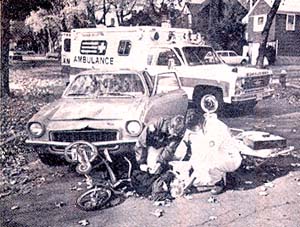 Psychiatric patients are transported by the ambulance corps to Bergen Pines. In this regard, it is interesting to note that the corps is not empowered to forcibly transport a psychiatric patient to Bergen Pines unless the police deem it necessary. During this 6 month period 11,686 miles were clocked and 4690 man hours were expended on calls. This does not include time spent at headquarters awaiting the signal to move. 126 times, 2 ambulances (doubles, as they are called) were out at the same time and 10 times, triples (3 ambulances) were out at once on their errands of mercy. Each member makes from 150 to I 80 calls per year on average, although John Piepoli, the C.P.A. has over 2500 calls to his credit in only 7 years.
The corps owns 3 ambulances, each of which can handle all kinds of emergencies, including bad accidents and cardiac arrests. However, one of the rigs is a specialized sound-proofed one costing more than $40,000. This vehicle is equipped to transport 3 coronary cases at one time and includes a heart and lung resuscitator costing $3000. Being sound-proofed it naturally reduces the level of the traffic noise and the screeching siren heard by the patient; this is psychologically much better for the person being rushed to the hospital. The other 2 ambulances can each accommodate 4 patients, although if necessary as many as 11 people can be serviced. Included in each vehicle is a life-pack monitor which costs $5000, complete medical kits and other necessary items. And if you’ve wondered why the word “ambulance” looks like ECNALUBMA (with the E C L N B backward) when you are approaching it, it’s so that it reads AMBULANCE as on look through your rear view mirror when all of a sudden you hear a wailing siren behind you asking you kindly to move over so that he ran get through.
In order to become a member of the ambulance corps, one must be at least sixteen and a half years of age. The applicant must supply 3 character references and pass a doctor’s physical examination. Having satisfactorily done this, the applicant now begins his term as a probationary member. The probationary period can last from3 to 6 months and some times as long as 9 months. This time variation depends on how fast the trainee can absorb and pass one of 2 rigorous training programs. During the training period at least 50 ambulance calls are made. In the E.M.T. (Emergency Medical Technician) program the probationary member must spend 100 hours with instructors either at the Bergen Community College or at Passaic County Community College. John Sause, a member of the corps, is in charge of training. These 100 hours of training at the school are in addition to the time spent at headquarters and going out on ambulance calls. The New Jersey State 5 point training program is given at Bergen Tech and it includes courses in C.P.R. (cardiac pulmonary resuscitation), emergency child-birth, extrication, advanced Red Cross First Aid and defensive driving.
Defensive driving is very important since ambulances cannot legally break any traffic laws or run a red traffic signal, contrary to what many people may think. Ambulances involved in accidents while performing their normal duties are judged and handled similarly to any citizens’ accidents. Screeching sirens and dervish-like revolving lights atop an ambulance are nothing more than a polite way of asking others to make some room for it.
Once a person has completed a training program, passed all tests and has been accepted as a member, he or she is required to put in a minimum of one 4 hour shift per week plus a full Sunday (from 7 A.M. to 7 P.M.) every 13 weeks. These are the minimum time requirements for all members, but there are many people who put in quite a bit of extra time of their own volition. In addition, there are more than 20 members who have volunteered to be available at all times during the day (people whose job or business is in town for instance) and those people who have volunteered to be available at any time during the night. These volunteers are equipped with special communications gear known as a Plectron, which is connected by radio directly to the police department. In an unusual emergency, or if 2 of the ambulances are out and more people are needed for another call, the police dispatcher “hits the Plectron button” which simultaneously alerts all of those corps members have this special device in their homes or if out, on their person. Many Corps members will tell you that if it’s about 2:30 a.m. and miserable outside, or if they’re about to sit down to a well-prepared hot meal or standing in the check-out line of a supermarket, that’s the time the Plectron goes off. And quick as the proverbial flash everything stops except the corpsman who by now is on the way to the scene of the accident.
Unlike the image that many people had years ago, an ambulance corps is not a taxi service rushing through red lights, with sirens screaming, wildly careening from one side of the road to the other in order to get a patient to a hospital. The Teaneck Volunteer Ambulance Corps is a highly specialized, thoroughly and rigorously trained group of motivated and dedicated people who are professional in the true sense of the word. They are a most important extension of the hospital to which they are safely and carefully conducting a patient. Through H. E. A. R. (hospital emergency ambulance radio) they are constantly giving the hospital vital information of the patient’s condition, so that upon arrival at its destination, doctors are ready to administer to the victim’s needs. In a sense, it can be said that the corps’ ambulance is a “mobile hospital” in which expert professionals are applying life-giving measures, making the patient comfortable and monitoring all vital signs. Before the arrival of the ambulance, doctors at the hospital know all pertinent facts regarding blood pressure, pulse beat, heart and lung conditions, sex and age of victims and specific injuries. There is no question that many people’s lives have been saved before they reached the hospital. As Warren White, an officer in the Teaneck Police Department so aptly put it, “they are the finest, most dedicated professionals I have ever met, and when I’m at an accident, there’s nothing I’d rather see than the lights of that ambulance. That’s when I know that somehow everything will be O.K.”. This type of expertise does not come easily. In order to maintain this high degree of competence, every member of the corps must be re-certified every 3 years. This is done by again taking a 40 hour E.M.T. course involving similar training to the 100 hour course taken before being admitted to the corps.
Many people are constantly amazed at how fast an ambulance is at the scene after an accident on the highway or a heart attack in a house. When confronted with an emergency, people will first of all call the police department. Their dispatcher immediately sends a squad car to the scene, and at the same time calls the ambulance corps on its “black phone” which is kept open at all times. While the person on the phone with the police is getting the information as to location, type of accident or case.3 to 5 members under the direction of a crew chief are grabbing their coveralls and scurrying into the ambulance. From its headquarters on Windsor Rd. just north of Cedar Lane, the corps prides itself on the fact that it can reach the farthest point in town in under 4minutes.Once at the scene, a “first-in-member” rushes into the house, or if an accident, to the victims, in order to assess the situation. In this way it can immediately be ascertained what equipment is needed. For instance, in the case of a heart attack, a resuscitator; in an auto accident, splints, bandages, etc. Word is now passed on the others to bring all the requirements. Meanwhile, the “first-in-member” is busy taking “vitals” (blood pressure, pulse rate and respiratory signs.) Ministering to the needs of the most seriously injured first, (a principle known as triage) is seen to by the “first-in-member” who must assess and act fast so that lives can be saved. Broken bones are sprinted and bandaged. In case of whiplash, or internal injuries, a backboard is utilized so that the victim is immobilized. It is important, in moving a person in such a condition, that he or she be moved “as one piece” so that no further damage is inflicted during the ride to the hospital. Through H.E.AR. the corpsman is apprising the hospital of all vital information regarding the victims they will soon be receiving. In the case of a heart patient who is being made ready to be moved from his home, his EKG (electrocardiograph) can be transmitted to the hospital by telephone. In a situation that is not a life or death one, the patient or family can choose the hospital to which the patient wants to be taken. If the patient’s personal physician is associated prefers to be conveyed there.
Their “cargo” having safely been delivered, the crew now returns to headquarters amidst a pervasive gloom, only occasionally broken by an irrelevant remark to break the tension and ease the pent-up emotions. For though these admirable individuals have by experience become inured to nearly every kind of gory scene, seemingly acting like automations when lives are at stake, once they have done what ever possible for the victims they immediately revert to the compassionate human being that they are. To become emotional when steadfast nerves are required or not to think and act quickly is detrimental to the well-being of the patient. So to be impersonal, going about their jobs efficiently, with dispatch and professionalism, is paramount for the welfare of the one whose life is at stake. But once the job is over, the inherent emotional make-up of each crew member comes to the surface. Depending on the kind of a case it has been reactions vary accordingly. Most deeply felt are situations involving children. Suicides or auto accidents culminating in someone’s death or serious injuries affect every one the most. Some cry softly by themselves; others burst into a few seconds of swearing at no one in particular, repeatedly asking, “why, why did it have to happen?”; at times some silly things will be voiced, evoking here and there a perverse laughter or nervous tittering. It is necessary that tensions and gloom be dispelled as much as possible, for who knows, any time now there maybe another serious call to action. All serious situations are devastating experiences, for a corpsman personalizes and associates the victims with relatives, friends, parents, brothers and sisters. Many of these experiences are never easily forgotten, being seared into the memory and consciousness of the corpsman involved to such a degree that in many instances he or she will refuse to discuss it for years after. Of course, every call is not tragic. There are “false alarms” where someone has been reported injured or suffered a heart attack which turns out to be not serious at all. The “Victim” can walk away because he is not seriously injured, or the “heart attack” turns out to be nothing more than seems pains caused by indigestion. These experiences lead to a spate of raucous banter among the crew members on the way back to headquarters … another example of letting off steam and displaying their relief that the call was not as serious as had been anticipated. Then there is the call which is truly a joyful one. When a maternity call comes in, it immediately evokes a joyful outburst. Everyone present wants to be part of the crew, and should the newborn infant first sees the light of day or night in the ambulance, (as has already happened) before it reaches the hospital, pandemonium breaks loose. Back-slapping, embracing, shouting good wishes to all becomes the order of the moment. Each crew member has just become a mother or a father.
From The Teaneck News , Wednesday, October 17, 1979
| Name | Yrs. on corps | Name | Yrs. on corps | Name | Yrs. on corps | Name | Yrs. on corps |
|---|---|---|---|---|---|---|---|
| Alexander, Paul | 7 | Grossman, Rachel | 4 | Myron, Mary Lou | 3 | Rottner, Bruce | 4 |
| Atkatz, Steve | 5 | Goldstein, Bruce | 4 | Novak, Gerry | 4 | Salcedo, Terry | 5 |
| Bank, Marty | 12 | Haab, Herman | 3 | Ogden, Sheriden | 9 | Sause, Ed | 3 |
| Barker, Greg | 5 | Haase, Andy | 3 | Organ, Della | 5 | Sause, John | 5 |
| Biddlecome, Rich | 5 | Jaeger, Irene | 3 | Ostrow, Paul | 10 | Sauvageot, Don | 5 |
| Blanco, Wayne | 4 | Jaeger, Ron | 8 | Ostrow, Stu | 11 | Shapiro, Marion | 4 |
| Boak, Steve | 5 | Kaplan, Mark | 3 | Paronett, Bob | 16 | Shay, Peter | 2 |
| Careccio, Scott | 1 | Kohout, Frank | 18 | Parrish, Larry | 16 | Spears, Schuyler | 3 |
| Cooper, Jordan | 3 | Levigne, Phil | 9 | Past, Howard | 2 | Spierer, Roy | 6 |
| Depompeo, Mike | 3 | Lemberg, Susan | 7 | Piepoli, John | 7 | Springer, Randy | 6 |
| Dick, Howard | 6 | Liegner, Wayne | 1 | Pinches, Walt | 17 | Springer, Stacee | 4 |
| Dunican, John | 4 | Lubben, Gene | 3 | Regan, Carole | 7 | Stopper, Danny | 5 |
| Dunican, Mary Fran | 1 | Malone, Carol | 3 | Regan, Kevin | 5 | Sussman, Harold | 5 |
| Dunican, Pat | 6 | Mannion, Mary | 4 | Renz, Patty | 4 | Tiboldo, Lou | 6 |
| Federico, Mary | 3 | Merchant, Joel | 1 | Reyes, Davey | 3 | Trenn, Diane | 2 |
| Fisch, Stan | 3 | McGann, Elaine | 2 | Roberts, Jack | 3 | Tuttman, Peter | 3 |
| Flaherty, Grace | 1 | Muller, Robert | 1 | Robertson, Larry | 3 | Weiss, John | 14 |
| Gelles, Mike | 4 | Mulligan, Mary | 6 | Rohrbeck, Gerry | 12 | Wilson, Bob | 9 |
| Greene, Sandy | 1 | Myron, Jaimie | 1 | Rohrbeck, John | 16 |
From Press Journal , April 16, 1981
Teaneck Corps Men Win Life Memberships

Life membership status has been awarded to six members of the Teaneck Volunteer Ambulance Corps whose total service adds up to more than 73 years.
The new life members are Paul Ostrow, Stuart Ostrow, Gerrard Rohrbeck, Martin E. Bank, Patrolman Sheridan Ogden and Patrolman Philip LaVigne. All are relatively young, since each joined the ambulance corps when he was in his teens. Together, they have answered more than 11,000 calls for assistance.
Engraved gold badges signifying service of more than 10 years were presented to them by Mayor Frank Hall at a meeting of the Township Council.
New Life Members of Teaneck Volunteer Ambulance Corps with Mayor Frank Hall after presentation of badges. Left to right: Martin E. Bank, Paul Ostrow, Patrolman Sheridan Ogden, Gerrard Rohrbeck, Mayor Hall, Patrolman Philip LaVigne and Stuart Ostrow.
–-photo by Roy Spierer
Life Membership literally means that the recipients will remain full members of the corps even after their active participation ceases. It is an honor which acknowledges unusual service to the people of Teaneck. The gold badge is a traditional symbol and it is usually displayed on a plaque.
Recognizing that changes in business and family obligations often curtail members’ activities, the ambulance corps recently voted to honor life member after 10 years of service. Previously, there were only 14 life members in 41 years.
During the presentation, the mayor asked for moment of silence in memory of David Musicant, a founder of the corps and a Life Member, for whom funeral services had been conducted that day. His son, Arthur, is also a life member.
Two of the new life members are also Teaneck police officers.
Patrolman Sheridan Ogden has been in the corps for more than 11 years, had made more than 1,500 calls and has served as a trustee. Married with one child, he is a Teaneck native, a graduate of Teaneck High School and was president of his class at the Bergen County Police Academy.
Patrolman Philip LaVigne, who has served as a lieutenant, is a graduate a Bergen Vocational and Technical High School. In more than 10 years he has made more than 1,500 calls and has delivered two babies.
Paul Ostrow, a life-long Teaneck resident, is a graduate of Teaneck High School, the University of Pittsburgh and Fairleigh Dickinson University. His is in business in New York and is married to the former Ricki Glassen, a Teaneck teacher. They have a son. He is a veteran of 13 years of service and 2,200 calls.
His brother, Stuart Ostrow, is a graduate of Teaneck High School and Fairleigh Dickinson and is a health officer in Mahwah. In 12 years he has made 2,100 calls. Both Stuart and Paul Ostrow have been officers in the corps.
Martin E. Bank, a merchandising executive at K-Mart Stores, has held officerships including the posts of captain and vice-president. He is a Teaneck High School and Fairleigh Dickinson graduate with 13 years of service and more than 2,200 calls.
Gerrard Rohrbeck is also a Teaneck and Fairleigh Dickinson graduate. He is married and has one child, and has more than 13 years of service and 1,500 calls. Together with Stuart Ostrow and Philip LaVigne, he started the program of having members sleep in the ambulance quarters to speed up response time at night.
The Teaneck Volunteer Ambulance is staffed entirely by non-paid personnel and provides the only emergency medical service in the Teaneck, 24 hours a day. Last year, the corps answered 2,900 calls for assistance.
Ambulance members on call for 75 yearsBy Megan Burrow, Managing EditorTeaneck Suburbanite, July 17, 2014, p. 1
 The Teaneck Volunteer Ambulance Corps (TVAC) was formed 75 years ago, in the summer of 1939, by a group of members of the Teaneck Volunteer Fire Department’s Hose Company No. 4. Since then, the township has grown from about 24,000 residents to nearly 40,000, and the ambulance corps has grown to more than 100 members, continuing its mission of providing 24 hour a day service.
According to Larry Robertson, the township historian and a 38-year member of the ambulance corps, there was no ambulance service of any kind in Bergen County until 1888. Then, Englewood and Hackensack hospitals began providing service, but it was only available to patients of doctors affiliated with those hospitals. When Holy Name Hospital opened in 1925, it also provided affiliated ambulance service. In 1939, when TVAC was formed, its mission was very much in line with its mission today: to provide first aid or transport to a hospital for anyone who became ill or injured in Teaneck.
It began operating that August, and its first patient was a person on South Hemlock Terrace experiencing a stroke.
“In those days the ambulance did only a few hundred runs a year,” said Robertson. “There were only about 25 members and only one vehicle, a 1936 LaSalle.”
 Although TVAC had just one ambulance, it had two stations. During the night, the ambulance was housed in a vacant fire station on South Hemlock Terrace and Glenwood Avenue in Teaneck, which was in the neighborhood where many of its members lived in at the time. During the day, the ambulance was parked in a garage near the municipal building because many of the members were municipal employees.
“Actually that arrangement resulted in fast response times because that’s where the members were,” Robertson said. “At that time no one staffed the ambulance corps building.”
In 1949, the headquarters was moved to Teaneck Road, and members were called at home by telephone when there was an emergency. This arrangement caused delays, said Robertson, and residents realized they needed a building that could be staffed. In 1968, TVAC obtained the property where the headquarters now stands on Windsor Road, which was used as a railroad passenger parking lot, and a new building was constructed.
TVAC has received some major calls over its 75 years. In 1946, the ambulance corps responded to a supermarket fire on Cedar Lane where 50 firefighters were injured because they didn’t have enough breathing apparatus.
In 1972, there was a fire on the north side of Cedar Lane at a swimming pool supply store. The chemical chlorine was involved and about 50 firefighters were injured. In 1977, there was a leak from a tank car parked on the railroad tracks. More than 50 patients, mostly residents of the area, were treated for inhalation of anhydrous ammonia. Then in June of 1984, a bus overturned near where Route 80 and I-95 meet and about 25 people were injured.
“We’ve had some challenging calls,” said Robertson. “About 17 percent of our runs are traffic accidents and most of our calls are for elderly people, many living alone without a lot of family support.”
Past President Angelae Wilkerson said in the 12 years she has been a member, calls have increased to nearly 4,400 a year, making TVAC one of the busiest volunteer ambulance corps in the area. Most members come from Teaneck, but others travel from towns like Nutley, Garfield and Clifton to volunteer with TVAC, drawn to the organization because of its reputation.
“There are people from all walks of life here,” she said. “Some are going into the medical profession, there are teachers, firefighters. It’s a nice little extended family.”
Marriages have even resulted from volunteering with the organization. “Lots of members have been here for a long time, met good friends and even husbands and wives here,” said Wilkerson.
“Because it’s a busy, busy place, people who really want to do EMS are encouraged to come here, because it’s not boring. We get calls 14, 15 times a day,” said Robertson.
The average response time for calls is just 6.5 minutes and last year there were only 70 calls where a patient in Teaneck was brought by some other ambulance to the hospital.
Residents can begin volunteering at 16 years of age. After they join, members must become certified EMTs and also complete an internal training program and take a qualifying test. Although the minimum time on duty is four hours a week, most members give a lot more than that, said Robertson.
Deputy Mayor Elie Katz joined at 15 and has been on more than 2,500 calls. “It’s a nice mix of the entire town. It really brings everyone together,” he said of the organization. “Over the years it has taught me a lot about people and about responsibility. It’s a great opportunity to meet people and help the entire community.”
The department is celebrating the 75th anniversary Aug. 14, with a gala at World of Wings on Windsor Road.
Every year TVAC honors a person or organization that demonstrates a spirit of community service. At the August celebration, the organization will honor the residents of Five Star Premier Residences of Teaneck, who have supported the ambulance corps with more than $250,000 in donations over the years from special in-house fundraisers.