
The Early History
| 1822 | Teaneck’s first school organized |
| 1869 | School built next to the present Town House known as “The Little Red School House.” |
| 1895 | Teaneck Township officially established; public school population numbers at 221. |
| 1906 | Original School #2 (Washington Irving), now the Town House, completed. |
| 1910 | School #1 (Longfellow) erected. |
| 1912 | School population numbered at 407 students |
| 1916 | School #3 (Emerson) erected. |
| 1920 | School #1 (Longfellow) rebuilt after being partially destroyed by fire. Additional rooms added 1921. |
| 1922 | Public School population numbered at 1,154 students. |
| 1923 | School #4 (Whittier) erected. |
| 1925 | School #5 (Hawthorne) erected. |
| 1926 | School #6 (Bryant) erected; Whittier School auditorium added. |
| 1928 | Public School population numbered at 2,318. |
| 1929 | Senior high school erected. |
| 1934 | School #7 (Lowell) completed. |
| 1936 | Dedication of junior high school wing at the senior high school. |
| 1937 | Two side wings added to Whittier School |
| 1941 | Present School #2 (Washington Irving) completed. |
| 1949 | Construction of Bryant School addition. |
| 1950 | Back wing of Whittier School added. |
| 1954 | Teaneck High School goes on double session (until the construction of the Benjamin Franklin Junior High School). |
| 1955 | Construction of second addition at Bryant School and at high school; public school population numbered at 6,977. |
| 1956 | Renovation of Longfellow School; construction of School #8 (Eugene Field). |
| 1957 | Benjamin Franklin Junior High School erected. (Students goon double session until completion of Thomas Jefferson Junior High School.) |
| 1958 | Thomas Jefferson Junior High School completed; public school population numbered at 7,861. |
| 1960 | Public School population numbered at 8,152. |
| 1964 | Establishment of the township’s central sixth grade school at Bryant School. |
| 1968 | Establishment of the township’s central kindergarten at Washington Irving School. |
| 1970 | Public School population numbered at 8,267. |
| 1972 | Establishment of the township’s central kindergarten – first grade schools at Washington Irving and Bryant Schools; the dissolution of Teaneck’s central sixth grade school. |
| 1976 | Public school population numbered at 6,839. |
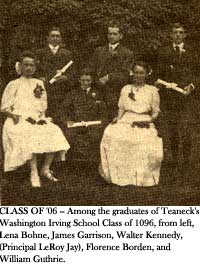 Teaneck Youngsters who recently returned to classes in the town’s multimillion dollar school system can ponder what education in Teaneck was like in the early days.
Children walked miles to go to one room schools. There were no discussions about class size — one teacher taught all eight grades. In the 1850’s a man teacher was hired at $60 a quarter and to “find” or board and lodge himself. Central heating was a pot bellied stove. The drinking fountain was a well with a tin dipper. Sanitary facilities were frame structures behind the school.
Teaneck’s first school built between 1810 and 1820, is standing today on East Fort Lee Road. It is no longer a school, but a private home east of a gas station. The schoolmaster’s house next door is the home of Mr. and Mrs. Ray Lawrence.
The Westervelt family donated land for the school. Children came from lower Teaneck, Leonia, Fort Lee, Little Ferry, and Ridgefield. The late Mrs. Rachel Moore Demarest recalled when she was in her ’90s that her father had gone to the school from his home in Leonia, often crossing Overpeck Creek in a boat. In winter children was transported by sleighs.
Workmen who remodeled the school house for the late Mr. and Mrs. Joseph Bauerlein, who lived there for many years, admired the hand hewn shingles and oak beams. They hound five floors, one on top of the other. The cloak room, where wraps and dinner pails were stored, is now a kitchen. A former outhouse is a tool shed.
The school was used until 1910, when the present Longfellow School was built. The late George V. Demarest, a trustee whose father also attended the school, saw to it that the bell was moved to the new building.
 Children in upper Teaneck in the early 19th century went to school in James Purdy’s chair shop on New Bridge Road, organized in 1822 for pupils from Schraalenburgh (Dumont). Liberty Pole in Englewood and from the northern part of Teaneck. The teacher was an Irishman by the name of Gilfillin.
In 1841, Union School District NO. 10 was formed at a meeting in the home of Gilliam A. Bogert. Plans were made to replace the school in the chair shop with a building on a corner of widow Sarah Stagg’s land on River Road. The sum of $67.50 was raised by subscription! How’s that for a school building program? Stone, timber and sand worth $300 were donated. This building was later replaced with a structure destroyed by fire in 1940.
On May 5, 1851, a resolution was passed at a meeting of “taxable inhabitants” to call Union School District No. 10 the Teaneck Institute. D. L. Van Saun took up his duties two weeks later, having been hired at $60 a quarter and to “find” himself.
In 1854, a school was provided in the center of present day Teaneck. Henry J. Brinkerhoff sold to the trustees for $50, 50 by 100 feet of his land on Teaneck Road, east of Forest Avenue. The rent was one cent a year, as long as it was used as a school. A frame building, 20 by 60 feet, was constructed. It was eventually moved across the street.
The hall of learning was replaced in 1869 by an “elegant structure” on the present playground of School No. 2. The building, 24 by 38 feet, had a Mansard roof and was furnished with the best of equipment. The total cost: $3,677.75! Alexander Cass, who taught there for over ten years, later became Bergen County’s first superintendent of schools.
Residents received full value for their school investment. The “elegant structure” doubled as a school during the week and as the home of the Washington Avenue (Teaneck Road) Union Sunday School on the Sabbath. When the Township was organized in 1895 it became headquarters for municipal government, thus serving Teaneck’s educational, spiritual and civic needs.
These three schools serving upper, lower and central Teaneck had a combined registration of 221, it was reported at the annual meeting on March 19, 1895.
The school was replaced in 1907 by Washington Irving School, the present Town House but the “elegant structure” lived on, serving as the Municipal Building. Later it became the home of Capt. Stephen T. Schoonmaker Post 1428. Veterans of Foreign Wars, and was moved to Bedford Avenue.
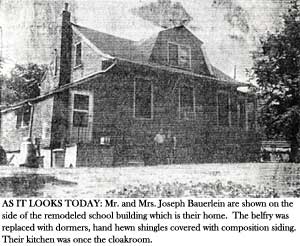 The one-room school built 150 years ago to serve Little Ferry and Ridgefield stands today, practically unnoticed in the traffic whirring up and down Fort Lee road at the edge of the meadows. Nearby is the schoolmaster’s house also built long ago.
The schoolhouse, now the home of Mr. and Mrs. Joseph Bauerlein of 365 Fort Lee Road, is located below a gas station at Fort Lee and Teaneck Road across from an apartment house. The belfry is gone. dormers have been added to provide three rooms on the second floor. The hand hewn shingles have been covered with composition siding, but some of the original shingles may be seen in original shingles may be seen in the kitchen. The large square room that served pupils from the first through the eighth grades has been partitioned to form a pleasant living room, a dining room, a bedroom and bath.
The long, narrow coatroom at the back where generations of girls and boys hung their wraps on pegs has been converted into a modern, compact kitchen. Initials carved by children of long ago are visible through the white paint on the window frames.
The kitchen windows look out on a garden which was once a playground. At the back of the property is a small building, now used as a tool shed. It was originally marked “Girls.” Mrs. Bauerlein’s parents, Mr. and Mrs. Oscar Gloeckler moved it when they bought the property in 1920. For a time it was used as a chicken house.
Mrs. Bauerlein’s parents moved into the school house when Raymond Witham and his family moved out. Raymond Witham was the brother of Lt. Jesson Witham, retired, one of the first two officers appointed when the Teaneck Police Department was organized in 1914.
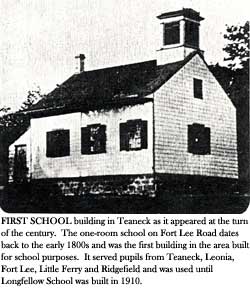 Teaneck School No. 1 first structure built in the area for school purposes, served the southern end of the area while children in the New Bridge section were going to classes in James Purdy’s Chair Shop on New Bridge road. It was used until Longfellow School was built in 1910. On Sundays it was used by the lower Teaneck Sunday School Association of which the Teaneck Methodist Church is an outgrowth.
George V. Demarest of 12 DeGraw Avenue, who will be 93 next month, went to the Fort Lee Road School with his sisters. He was a member of the Teaneck Board of Education when Longfellow School was built and brought to the new school house the bell that had hung in the old belfry. Unfortunately, the bell was lost, probably during a fire which broke out many years ago in the present school No. 1.
Mr. Demarest’s wife, the former Rachel Moore, says that her father went from his home in Leonia to the Fort Lee Road school, often crossing the creek in a boat when the water was high. Lt. Witham says that children used to go to the school from as far away as Tenafly.
The age of the building is apparent in the foundation of squared red stones. The original oak beams may be seen in the basement. Mrs. Bauerlein says that during remodeling workmen uncovered five floors — one plank floor had been laid on top of another. The walls are built of timbers so stout that it was impossible to bore through for utility connections.
Bringing the building up to date has presented many problems to the Bauerleins and the Ray Lawrences, owners of the former schoolmaster’s house at 381 Fort Lee Road. Their water meter is located in the gas station on Teaneck Road.
The Bauerleins were fortunate enough to be just on the right side of the line to connect with the sewer line. Not so the Lawrences. If they want to connect with the Bergen County Sewer they will have to pay several thousand dollars. Both homes use bottle gas. The expense involved in connecting with the gas line would include tearing up a section of Fort Lee Road and replacing it.
Nothing tells the story of Teaneck’s growth as vividly as the expansion of the school system.
Three schools served the residents of this locality in the early nineteenth century. One, in the New Bridge district dates back to 1822 and met first in the chair shop of James Purdy. The teacher was an Irishman by the name of Gillfillan.
A second school was located in lower Teaneck and was known as the “little red school house.” The third was located on the southeast corner of Teaneck Road am Forest Avenue. In 1854 the building was moved to the west side of Teaneck Road and finally replaced in 1869 by the “elegant structure” dear to the hearts of the people of Teaneck and known as the Old Town Hall. In this building the threads of Teaneck’s history cross and recross. All movements, religious, educational and political started there.
When Teaneck Township was formed in 1895 the three schools described above were known as District No.5, lower Teaneck; District No.9, Teaneck; and District No. 10, New Bridge. These districts were relisted as 1, 2, and 3 respectively at the annual meeting held March 19, 1895.
The Board of Education at that meeting included, Jasper Westervelt, James B. Demarest, Henry J. Parker, Peter I. Ackerman, Walter Bound, Peter Raderman, Robert Stevenson, John H. Brower and John H. Ackerman.
The entire school population in 1895 numbered 221 for three schools. Forty years later 4,075 chi1dren attended school in eight public school buildings and 325 pupils are enrolled in the parochial school of St. Anastasia.
The New Bridge school with a small enrollment was abandoned early in the history of the Township and the pupils were transported to District No.2.
Old residents speak frequently of Alexander Cass who came to Teaneck in 1853 and served for about thirteen years as a teacher. He later became the first Superintendent of Public Instruction in Bergen County. Other teachers whose names appear in the early records are Joseph B. Miller, Esq., Adelaide Sherwood, Margaret Murray, Vida Myers, J. Edgar Waite, A. A. Hoover, William Banta and Walter DeClarke.
During the past twenty-eight years Teaneck has been engaged in an almost continuous program of school construction to keep pace with the increasing population. The oldest school now in use is School No.2, named Washington Irving and completed in 1907. School No.1, Longfellow School, followed in 1910. The minutes of the Board of Education reveal the completion of the others as follows: School No.3, Emerson – 1916; School No.4, Whittier- 1923; School No.5, Hawthorne – 1925; School No.6, Bryant – 1927; Teaneck High School – 1929; School No.7, Lowell – 1935; Junior High School wing now in the process of construction.
The elementary schools are strategically located throughout the township. There is an elementary school within easy walking distance in every section of Teaneck. This enables your child to avoid the danger of crossing many streets or walking long distances during bad weather. In these schools your child meets with experiences and high type of instruction that establishes not only thoroughness in the fundamental subject but also builds desirable habits, attitudes and appreciations which contribute to the complete development of your child. The plan of individual instruction prevails.
The Junior High School continues the close pupil supervision that is carried on in the elementary schools. The early adolescent period of your child’s life is given over to exploratory, broadening and finding courses.
The Teaneck High School is accredited by the Middle States Association of Colleges and Secondary Schools and is approved by the New Jersey state department of education.
Real living depends not only upon the wise selection of a home or community, but upon educational opportunities available for your children. Teaneck offers more than thirteen consecutive years of educational activity, provisions being made for one year of Kindergarten, six years in the Elementary Schools, three years in the Junior High School and 3 years in the Senior High School. Teaneck invites you to consider the opportunities for your child.