
Teaneck Fire Department
History of the Teaneck Fire Department
In this section, you can find many interesting documents related to the history of the Teaneck Fire Department.
Organization improves with equipments, faces hotter fires
BY MEGAN BURROW, Managing Editor
 TEANECK – One hundred years ago, Teaneck’s first official municipal fire department was formed when four of the township’s five independent volunteer fire companies combined.
Although its members remained volunteers, the Teaneck started paying for some expenses, including rent on four fire stations in town.
Now, the department has 93 members, including 31 officers, 60 firefighters and two civilian staff. Although the organization has grown tremendously in the years since it was first formed, and its equipment has become much more sophisticated, each member still works with the same goals in mind: to prevent fires from occurring and respond immediately to a fire, controlling and extinguishing the flames and rescuing any trapped occupants.
The Teaneck Fire Department will celebrate its centennial Oct. 4 with an open house from 10 a.m. to 2 p.m. at the department’s headquarters, located at 1231 Teaneck Road.
 Residents are invited to come participate in interactive demonstrations and learn about staying safe in a fire at the Fire Prevention Trailer and take a firehouse tour. A tower ladder and rescue truck will be on display, and there will be a forcible entry station and fire prevention giveaways. In addition, there will be an area available for children to use a real fire hose and participate in other activities.
Fire Chief Anthony Verley, a member of the department since 1987 and chief since 2010, said the department is inviting retired members back for the celebration and will be hanging a banner outside to mark the occasion.
In his time with the department, Verley said the equipment firefighters use has improved, but the hazards they face have also changed. Because homes are now filled with plastic materials, “when things burn, we’re seeing much hotter fires.”
The lightweight truss construction that is often used makes it more dangerous for firefighters to go into a burning building, Verley said.
Now that many people no longer use landline phones, Verley said he has seen problems arise from residents unable to contact the department during emergencies. About 240 public fire alarm boxes are spread throughout the town that residents can use to notify the department of a fire.
“I encourage everyone to go on the township website and take note of the closest fire box to you,” he said.
 According to township historian Larry Robertson, before the independent fire houses were combined, Teaneck was served by several different fire organizations. The first known organized fire protection in town was provided by the Hackensack Township Protection Society, a local police organization that provided equipment to residents to use for their own “rudimentary fire defense.”
Before 1888, the equipment included leather buckets, ladders, lanterns and axes.
The first organized fire company in Teaneck was Defender Hook and Ladder Company, founded on New Bridge Road in 1895. When the local fire companies combined in 1915, this company chose not to, and instead it eventually became part of New Milford Fire Co. 2.
In 1920, a new fire department headquarters was built on Teaneck Road, next to where the current headquarters now sits. At the time, the only paid employee was the fire chief. Eventually, the department began to add paid officers until it became a fully paid professional organization.
There are still four firehouses in town: the headquarters on Teaneck Road, Fire Station 2 on Cedar Lane, Fire Station 3 on Teaneck Road near Degraw Avenue, and Fire Station 4 on Windsor Road.
The department remains extremely busy, averaging about 10 calls a day, said Verley.
“We’re very proud of the contributions that we’ve made and continue to make to Teaneck. Firefighters have always adapted to the circumstances of the time. We have an extremely brave and innovative cadre of men and women who have built upon the progress that the firefighters before us have made,” he said.
PROCLAMATIONCONCERNING FIRE PREVENTION WEEK
WHEREAS, the President of the United States has designated the week of October 4th as Fire Prevention Week throughout this country, and
WHEREAS, the President has asked the cooperation of all State and :Municipal officials, and of the people in general,
THEREFORE, I. MILTON G: VOTEE, Mayor of the Township of Teaneck, in the County of Bergen, New Jersey, do hereby ask our people to observe this week in an appropriate manner, primarily by an inspection of their own premises, to discover and remove fire hazards and also by taking part in such public lectures, ceremonies or exhibitions as may be arranged by the local Fire Department, and by committees and organizations working in cooperation therewith.
Given under my hand and seal,
Attested: this 28th day of September, 1936.
HENRY E. DIEHL MILTON G. VOTEE
Township Clerk Mayor
| Organization | Location |
|---|---|
| Allendale Fire Dept | Allendale, N. J. |
| Alpine Hose Co. No. 1 | Alpine, N. J. |
| Bogota Hose Co. No. 2 | Bogota, N. J. |
| Bogota Hook & Ladder Co. No. I | Bogota, N. J. |
| Bogota Engine Co. No. 1 | Bogota, N. J. |
| Bogota Hose Co. No. 3 | Bogota, N. J. |
| Alert Fire Co. No. 1, Inc | Bergenfield, N. J. |
| Prospect Fire Co. No. 1 | Bergenfield, N. J. |
| Bergenfield Fire Co. No. 2 | Bergenfield, N. J. |
| Friendship Hook & Ladder Co | Carlstadt, N. J. |
| Bergen Engine Co | Carlstadt, N. J. |
| Chemical Hose Co. No. 1 | Carlstadt, N. J. |
| Hose Co. No. 2 | Carlstadt, N. J. |
| Franklin Lakes Borough Fire Dep’t | Campgaw, N. J. |
| Cresskill Volunteer Firemen’s Association | Cresskill, N.J. |
| Knickerbocker Hook & Ladder Co. | Closter, N. J. |
| Alert Hook & Ladder Co | Congers, N. Y. |
| Dumont Fire Co. No. 2 | Dumont, N. J. |
| Independence Co. No. 1 | Dumont, N. J. |
| Engine Co. No. I | Dumont, N. J. |
| Dumont Hose Co. No. 3 | Dumont, N. J. |
| Demarest Volunteer Fire Ass’n | Demarest, N. J. |
| Defender Co. No. 1 | East Paterson, N. J. |
| Defender Co. No. 2 | East Paterson, N. J. |
| Defender Co. No. 3 | East Paterson, N. J. |
| Hose Co. No. I | East Rutherford, N. J. |
| Truck Co. No. 1 | East Rutherford, N. J. |
| Engine Co. No. 3 | East Rutherford, N. J. |
| Emerson Volunteer Fire Dept | Emersion, N.J. |
| Englewood Cliffs tire Protection Co. No. 1 | Englewood Cliffs, N.J. |
| Fair Lawn Vol. Co. No. I | Fair Lawn, N. J. |
| Fair Lawn Vol. Fire Co. No. 2 | Fair Lawn, N.J. |
| Fair Lawn Vol. Fire Co. No. 3 | Fair Lawn, N.J. |
| Grandview Hook & Ladder Co | Fairview, N.J. |
| Hose Co. No. 3 | Fairview, N.J. |
| Hook & Ladder Co. No. 2 | Fairview, N.J. |
| Tiger Hose Co. No. 1 | Fairview, N.J. |
| Protection Co. No. 1 | Fort Lee, N.J. |
| Engine Co. No. 2 | Fort Lee, N.J. |
| Fire Co. No. 3 | Fort Lee, N.J. |
| Garfield Fire Co. No. 2 | Garfield, N.J. |
| Fire Co. No. 3 | Garfield, N.J. |
| Fire Co. No. 1 | Garfield, N.J. |
| Engine Co. No. 4 | Garfield, N.J. |
| Garfield Co. NO. 5 | Garfield, N.J. |
| S. W. Johnson Fire Engine Co | Garnerville, N. Y. |
| Glen Rock Fire Department | Glen Rock, N. J. |
| Harrington Park Fire Co. No. 1 | Harrington Park, N. J. |
| Hook & Ladder Co. No. 1 | Hasbrouck Heights, N.J. |
| Hose Co. No. 1 | Hasbrouck Heights, N.J. |
| Hose Co. No. 2 | Hasbrouck Heights, N. J |
| Rescue Hook & Ladder Co. | Haverstraw, N.Y. |
| Cosgriff Hose Co. No. 4 | Haverstraw, N.Y. |
SOURCE: Yearbook commemorating the 25th anniversary of the New Jersey and New York Volunteer Firemen’s Association (1913-1938) held on June 23rd, 24th, & 25th, 1938.
TOWNSHIP OF TEANECK
 |
 |
 |
| Chief of Department F. A. MURRAY |
Township Manager and Fire Commissioner PAUL A. VOLCKER |
Assistant Chief Fire Department JOHN WM. CRANE |
GREETINGS
The Mayor and Council of the Township of Teaneck, the Teaneck Fire Department, and the citizens of Teaneck join in felicitating and congratulating the New Jersey and New York Volunteer Firemen’s Association in attaining twenty-five years of active and faithful service to the people of Bergen and Rockland Counties. Their wish is that the Association may continue to serve for many more years, and that their efforts may be crowned with greater success as the years roll on.
A FEW HIGHLIGHTS OF THE TEANECK FIRE DEPARTMENT FOR THE CALENDAR YEAR 1937
- The Teaneck Fire Department responded to 490 alarms. The apparatus traveled 1,260 miles, consuming 2,754 gallons of gasoline and 201 quarts of oil.
- The Department laid 9,900 feet of 2 ½ inch hose and 27,351 feet of booster hose and delivered 99,604 gallons of water on fires.
- The total valuation of property involved in fire was $939,245.00.
- The total loss was $8,820.33, a per capita loss of 38 cents.
- Five hundred hours were devoted to drilling and schooling, 3,267 inspections were made of commercial buildings and 517 inspections were made of the 458 oil burners which were installed during the year.
- During the year 1938 Teaneck was placed in Class B by the Schedule Rating Bureau, being the only Town in Northern New Jersey and the smallest municipality in the State of New Jersey to be so honored.
SOURCE: Yearbook commemorating the 25th anniversary of the New Jersey and New York Volunteer Firemen’s Association (1913-1938) held on June 23rd, 24th, & 25th, 1938.
Officers and Past Officers of Teaneck Fire Department

Back Row, left to right: Captain William Lindsay, Jr., Lieut. Frank Wacha, Captain C. Van Dyke, Captain August Mergl, Lieutenant Harry Davis.
Front Row, left to right: Ex-Ass’t Chief Charles Kinsey, Ass’t Chief John W. Crane, Ex-Chief Charles Larsen, Ex-Chief George Tetz.
TEANECK CITIZEN PATRONS
| Peter Swan | Mr. and Mrs. H. B. Cadmus |
| 0. Saiminen | Arthur R. Poleski |
| Mark Turpan | 0. G. Pratt |
| Harold Merber | P. A. Egan |
| L.E. Ericson | Mrs. G. Theurer |
| L.F. Tankard | H. Zatulove |
| W. H. Palmer | L. W. Cox |
| Rodger Nutt | Mrs. C. B. Zeigler |
| Mr. and Mrs. Franklin T. Muzzy | Fred J. Marx, M.D. |
| E. J. Boehm | West Shore Fuel Co. |
| Mrs. Walter Bound | Al Summers |
| Charles G. Senger | Mrs. R, L. Hayward |
TEANECK FIREMANIC PATRONS
| Roy White | John A. Madden |
| John W. Crone | Captain Wm. Lindsay, Jr. |
| W, A. Johnson | Francis A. Skrable |
| Lieut. W. G. Johnes | George A. Beaumont |
| John Collins |
SOURCE: Yearbook commemorating the 25th anniversary of the New Jersey and New York Volunteer Firemen’s Association (1913-1938) held on June 23rd, 24th, & 25th, 1938.
THE TEANECK FIRE DEPARTMENT
(as described in 1938)
The organization of the Teaneck Fire Department consists of a Deputy Fire Commissioner and Chief, an Assistant Chief, two Captains, four Lieutenants and thirty-two full paid firemen, four fire companies, three of which are manned by paid firemen on duty twenty-four hours per day. The volunteer firemen in these companies are used as second line defense and are only summoned to multiple alarm fires.
The Glenwood Park Volunteer Firemen retain their status as a complete volunteer company and respond to first alarm fires in their district and also to second alarm -fires in all other parts of the Township.
Headquarters Company, located at Teaneck Road and Fairview Avenue, houses an Emergency Truck, an aerial ladder truck, a pumping engine of 1,000 gallon capacity and the Chief’s car. Engine 2, located on Kenwood Place, houses a 750 gallon pumping engine. Company 3, located on Morningside Terrace, houses the Searchlight Wagon and a quadruple combination truck equipped with a 350 gallon pump, a full complement of ladders, booster equipment and 700 feet of hose. Hose Company 4, located at Glenwood Avenue and Railroad Avenue, houses a hose wagon carrying 700 feet of hose and a full booster equipment.
The alarm system consists of two box circuits, one alarm circuit and a manually operated central office. Through arrangements made with the Bell Telephone Company, it is possible to report a fire from either part of the Township without the necessity of giving the telephone number to the operator. By merely saying “Teaneck Fire Department Emergency” the telephone operator connects the person with the Fire Alarm Bureau. Since Teaneck is served by the telephone exchanges in Hackensack and Englewood a great saving of time is effected. A separate telephone is used for the transaction of Department business. A broadcasting amplifying system connects all fire stations, the Chief’s residence and the Police Department. This system was installed by the Teaneck Fire Department and was one of the first of its kind to be used in the Fire Service.
A Fire College, held annually since 1932, furnishes instruction to the Teaneck Fire Department and to the firemen of the surrounding municipalities. The completion of the seventh semester, in March of this year, had an average attendance to its eight meetings of one hundred and twenty-five firemen from seventeen towns in Bergen and Rockland Counties.
The Teaneck Exempt Firemen’s Association has a membership of exactly 100, a few of whom are still on the active list.
Note: Since the time of this brief historical account, there have been many changes. The Department is no longer manned by volunteers. The number of officers and fire fighters still totals about 100 (according to the 1997 budget), but they perform, in addition to the traditional services always associated with firefighting, a broad ranger of tasks which could never have been predicted in 1938.
History of the Teaneck, New Jersey Fire Department
Brief History, 1911-1966
By Edward T. Black
Many of you know that the Teaneck Fire Department is one of the finest in New Jersey. The Department is a fully paid unit, with the only volunteers being members of the Box 54 club and the fire auxiliary. This is part of a series of reports on the development of the Teaneck Fire Department, from founding to present in 1974.
Until the year 1775, there were only three Townships in what is now Bergen County.
The first Township, Hackensack, was formed in 1692. It was composed of land between the Hackensack and Hudson Rivers. In 1709, New Barbadoes Township was created, and it consisted of the lands between the Hackensack and Passaic Rivers. Lastly, Harrington Township was formed in 1775. Harrington was composed of lands from portions of both Hackensack and New Barbadoes Townships.
In 1871, Hackensack Township was reduced in size when Ridgefield, Englewood, and Palisades Townships were organized. Teaneck residents who lived in the northern section then paid their taxes to Englewood, and those in the southern end to Ridgefield.
The residents, being dissatisfied with the lack of public services which were supposed to have been supplied with, voted to form the Township of Teaneck in 1895.
The assets of the Township (land values, etc.) were valued at $377,650. The Township’s physical assets were:
- one hose cart valued at $600
- one hose cart valued at $75
- 500 feet of canvas hose
- 1,000 feet of rubber hose
- two sets of harnesses valued at $240
- six lanterns valued at $9
- one life net valued at $60
- nine nozzles valued at $50
In 1911, four companies, all volunteer, served the Township. Each company owned a hand drawn hose cart, and alarms were sounded by striking a hammer against a locomotive tire.
In 1915, the Volunteer Association’s (as they were known) were organized into one municipal Department, with K.V. Ridley as Chief. The Township purchased badges, boots, fire extinguishers, and lanterns for the Volunteers.

During January of 1917, Chairman William Bodine of the Township Committee authorized the town to buy fire apparatus that was on sale in Edgewater, New Jersey for $125.
It was not until 1920, when Martin Veuve was Township Chairman, that an automotive vehicle was purchased. Upon his appeal to the Committee, an American LaFrance 350 Gallon per minute (GPM) pumper totaling $4,285 was obtained. Of course this called for a new building to house it in. Since none was large enough, a proposal to build a combined municipal Building/Fire Station put before the voters of Teaneck. The issue was defeated, but -the taxpayers did agree to a fire bond issue totaling $40,000,
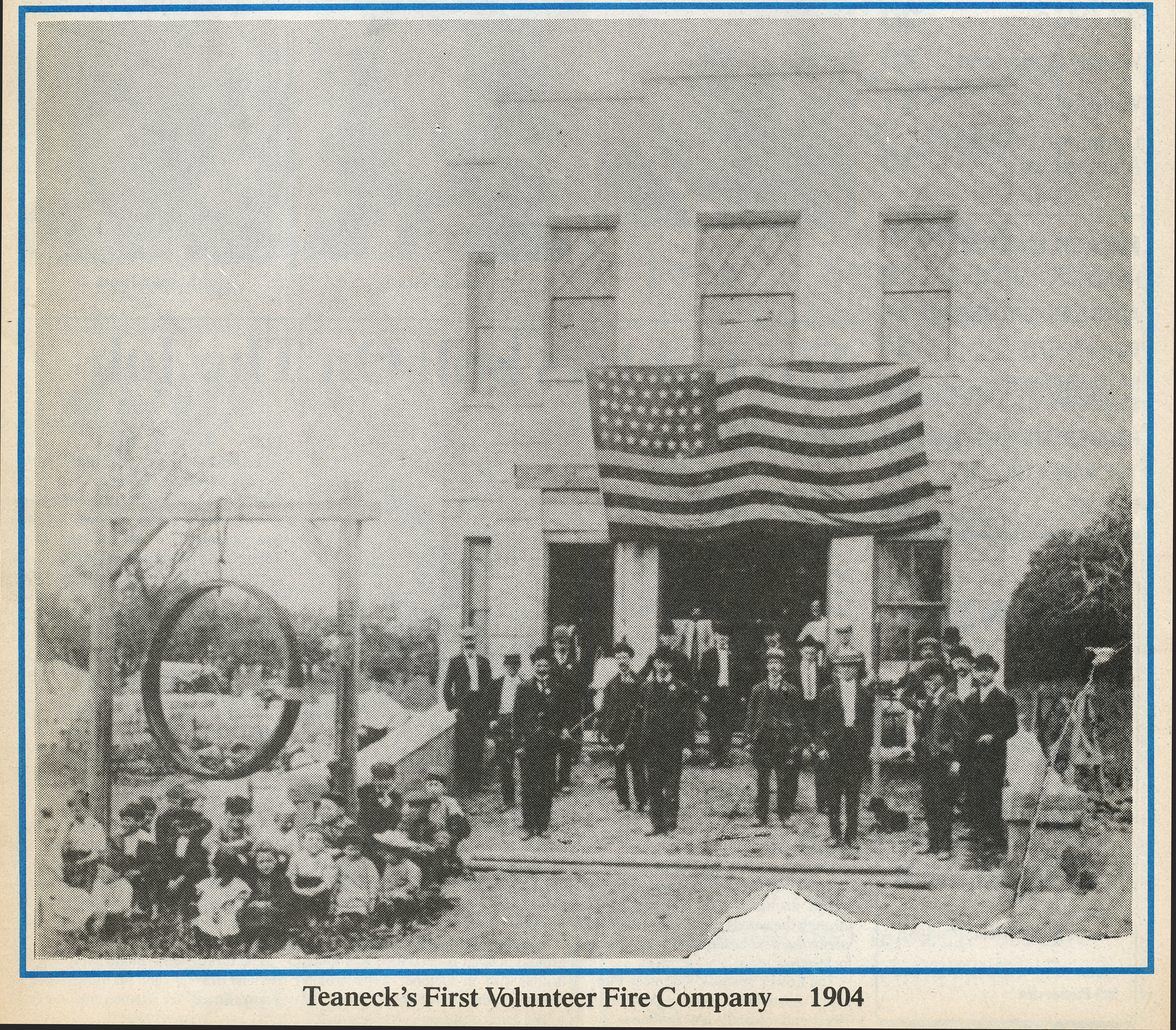
Company No. 1 was established in 1904, and was quartered at the southwest corner of Teaneck Road and Forest Avenue. The Company protected the section of town known as Manhattan Heights, West Englewood Park and Upper Teaneck. Some of the organizers of the company were Walter Kaltenback (later to become the first paid fireman in Teaneck), K.V. Ridley (to become the first Chief) and Carl Carlsen. The company’s protective district was north of Cedar Lane to the Bergenfield line, and as the second due engine in -the remaining three- districts.

The owner of the firehouse in which the Company was stationed decided that he no longer wanted the volunteers for his tenants, and they were forced too seek new quarters. A barn for sale on Lafayette Avenue was available, and the Company bought one half of the building and moved it to Fairview Avenue, directly behind the 1920 fire headquarters After clearing the road to make a path to move the structure, the barn was given a complete overhauling, and converted into a firehouse.
The Company operated a hand drawn hose cart and a hand drawn aerial truck. In 1920 a new station was erected, and this Housed the new 350 GMP LaFrance engine. In 1926, an American LaFrance Type 14 city service truck was purchased, and this replaced the hand drawn aerial. The city service truck, carried 235 feet of ladders, variously sized pike Poles and other miscellaneous equipment.
In 1929, the 1920 engine was replaced with a new 1,000GPM American LaFrance engine. The old LaFrance then became known as Engine Two, and the 350 pump was replaced with a 750 GPM pump.
In 1936, the city service truck was converted into a quad 1936, by the Department shops. It consisted of rearranging the superstructure to accommodate the 350 GPM pump which was removed from the 1920 LaFrance. Also, a 40 gallon booster tank was added, and a Hose bed to hold 1,000 feet of hose.
Cedar Volunteer Firemen’s Association, or Hose Co. #2 was located on Kenwood Place. The Company also operated a handdrawn hose cart until 1920 when they received a now Reo chemical and hose wagon with 1,000 feet of hose,

The Company was formed in 1908, and the original cart was housed in a barn owned by Joseph Douglas on Linden Avenue until 1912, when a new station was built on Kenwood Place.
Company Two protected north to West Englewood Park, and west of the West Shore railroad to the Hackensack River.
Hose Company No. 1, the third Company was organized in October of 1911, and served the section of town known as Lower Teaneck.

In 1912, the Company obtained a used hand drawn hose cart with 500 feet of hose. In 1913, to better equip the cart, an additional 500 feet of hose was purchased from the Diamond Rubber Hose Company.
During 1914, the members erected a sub-station in Fred Damrau’s greenhouse. This ‘station’ as you may call it, housed a push cart equipped with a ladder, hose and nozzles.
Shortly before World War One, the Company acquired two building lots on a cowpath named Morningside Terrace, and built their quarters (this building today houses TFD Engine three), in 1920, the Company received a 1920 Reo engine,
Company Four, or the Glenwood Park Volunteer Firemen’s Association was organized in 1911. Their original truck was a Phaenton straight body hose wagon which was housed in the blacksmith shop of John J. Kennedy. In 1920, the Company also received a 1920 Reo chemical/hose wagon with 1,0OO feet of hose. Due to the extensive areas of brush and meadow, and the heavy usage of the truck, a new 1933 Reo hose/chemical truck model JB was purchased. The truck came equipped with 750 feet of 2 ½ inch hose and a 110 gallon booster tank.
In 1938, the Fire Underwriter’s suggested that a new company be established in the west Englewood Park section. Because of the proximity of the Glenwood station and Hose One, it was recommended that the Glenwood Company be shut down, because Hose One was at this time had some paid firemen. The 1933 Reo which they operated then became a reserve engine in 1939, and in 1948 it was converted into the present light truck.
After their dissolvement, the members founded the Teaneck Volunteer Ambulance Corps, which is the predecessor of the Corp today.
The last and by far the most mysterious company was really never a part of the Municipal Department. Known as Defender Hose Company No. 1, they served the New Bridge sections of both Teaneck and New Milford (then known as Palisades Twp.).
The Company got its start in 1913 when a group of citizens from both communities decided that more fire protection was needed. Up until that time, whatever coverage there was had been supplied by the Germania hook and Ladder Company (present day New Milford Co. 1) located in Peetzburg, and by the Teaneck Company No. 1 on Teaneck Road. In 1915, Defender Hose moved from their station on New Bridge Road to Trenton Street, New Milford, where they were re-chartered as New Milford Co. 2 on September 1, 1915.
The town furnished the fire equipment only, and allowed 250.dollers per Company per year to Companies 2, 3 and 4 for housing and maintenance of the apparatus. Each Company purchased its own equipment and had to pay for it itself. The houses and the furnishings were the sole property of the individual Company. The only source of revenue outside of the Township funds was from dances and entertainment.
In 1932, there were 370 hydrants, twenty of which were from the Bogota water and Light Company in the Bogota section (Hose No. 2’s district), and the remaining 350 were from the Hackensack Water Company. Prior to 1923, the hydrants, were mainly six inch gated branches, and the barrels either had two 2 ½ inch stems, or one 2 ½ inch stem with one five inch steamer connection. Those placed after 1923 had two 2 ½ inch outlets and one four and one-half inch steamer connection.
Some recommendations from the then Fire Commissioner, J. W. Supfer in 1924 reported that the hoop alarm system (locomotive tires) was obsolete and inadequate. The Township checked into a Gamewell box alarm system and found the cost too prohibitive, In Hackensack, the report states that of all of the alarms received, eighty percent were telephoned in via the operator.
The Commissioner also submitted that the New York Telephone Company install a new system whereby all alarms could be transmitted from Headquarters to the Companies automatically. The system would also operate the sirens on each firehouse automatically.
It was also recommended that the Township take on an insurance policy for the Department personnel, as there wasn’t any protection covering death or disability to firemen while on duty.
Mr. Supfer also noted that a third man should be hired to reduce the workload from twelve hours a day to ten, and from seven days a week to six. The cost of adding another man on was whopping $1,800 a year
GOING PAID
The first paid fireman in Teaneck was Walter Kaltenback of company No. 1. He was appointed in 1920. In 1924, W. Lutthans was hired, and in 1925 and 1926, H. Gogolen and J. Crane were appointed. In 1927, two additional men were added, J. Donnelly and W. Jahnes. In 1929 H. Davis, R. White, Nels Johnson and William Lindsay were appointed. In 1935, the Department had a total of 24 Paid officers and men.

Francis A. Murray (father of the present Chief, Joseph R. Murray) became the first paid Chief of the Department in 1932, succeeding. Coming from Morris Cove, Connecticut, Chief Murray came to teach efficiency in firefighting to both the paid and volunteer firemen. He served the position well for twenty-two years, and brought the Fire Underwriter’s rating (New Jersey rating) from a class ‘E’ to a very high ‘B.’
In 1954, Chief Murray was succeeded by William Lindsay, and, an ex-Glenwood Park volunteer member, and one of the first paid men.
When Chief Lindsay retired in 1966, he was succeeded by Joseph R. Murray.
Teaneck, New Jersey, 1912. Gift of George C. Ahrens.



SOURCE: Teaneck Suburbanite, March 4, 2009. p. 3.
Truck needs permanent home for retirement (1933 REO Hose Wagon)
Fire Chief Montgomery seeks to save township’s history
By Howard Prosnitz, Staff Writer
 An antique of Teaneck history sits inaccessible to public view in the Windsor Road firehouse. The 1933 REO hose wagon was converted by fire department mechanics in 1949 into a light and sound truck. The truck, which is still operable, was last used in the 1970s.
Fire Chief Robert Montgomery wants the township to establish a historical society and set up a building for proper display of the truck and other fire department and Teaneck memorabilia. He envisions a structue built on a parking lot south of the Windsor Road firehouse similar to a partially glass enclosed fire department museum in Wildwood. In such a building, he said, the truck would be visible from the outside and visitors would be able to enter to view other memorabilia.
Montgomery has spoken to township building official Stephen Gluck about the feasibility of the project.
Montgomery rejects the suggestion of using the old police headquarters as a township museum, siting asbestos, lead contamination and absence of heat in the building.
The fire department has an abundance of memorabilia and old photographs, much of it is stored in Montgomery’s garage. He has been informed by former township manager Helene Fall that a 501 account would have to be established with the IRS in order to set up a historical society.
“It could not be done with tax money but by private donations. We would have to have a board of trustees and could spend the money solely for historical purposes,” Montgomery said.
“Teaneck has never had any sort of historical museum. We have a historian but notiong else.”
The 1933 hose engine was originally part of a volunteer fire department in Glenwood Park.
Montgomery’s father, an iron worker and a member of the Glenwood Park fire department, was asked to fabricate the body for the renovated truck.
“At the time he was reluctant because he remembered it as the old Glenwood Park hose wagon. He did not become a paid firefighter until 1940s,” Montgomery said.
 Until the 1950s fire trucks had open cabs. The closed cab, which was added as part of the conversion, was taken from a Dodge pickup truck. A Model T engine was installed in a side compartment to generate power for the two lights and two speakers that were mounted on the roof during a fire.
“In those days fire trucks did not come with a lot of side lighting to light up an area. Light trucks were state-of-the-art,” Montgomery explained.
A permanently mounted deck gun took water from four separate hoses, generating a high volume stream for heavy fires and those where the building was inaccessible to firefighters. The stick shift operated vehicle reached a maximum speed of 25 miles an hour. Montgomery recalls using it at a 1970s fire at the former Ronald’s Furniture store on Teaneck Road.
REO manufactured automobiles and fire trucks from year to year. The company was established by Robert E. Olds after he left the Oldsmobile, which he had founded.
Gluck did not return a phone call by press time.
Councilman Elie Y. Katz said he supported the idea of establishing a historical society and museum and suggested using the vacant Police Athletic League building as its headquarters.