
Teaneck As a Model Town
Teaneck was selected as a Model Town by Army authorities from 10,000 communities in 1949. The photo exhibit was shown in Japan and other occupied countries.
There’s a new wrinkle in political education. The Army has put Teaneck, N.J., in pictures to show occupied countries free government at work …
By Howard W. Young
Photographs by Victor De Palma
 Seven stories above lower Manhattan’s bustling, noisy traffic, an Army officer leaned back in his swivel chair, clasped his hands together and stared at a picture of General MacArthur signing the surrender document aboard the Missouri. The officer was thinking.
This week, three months after the idea first bloomed in that officer’s mind, a series of photographs was being tacked up in U. S. information centers and on street-comer bulletin boards from Tokyo to Vienna. The pictures, some of which are shown on these pages, will help teach citizens of the occupied countries what real democracy looks like and how it operates.
But the displays are not, as one might expect, simply a collection of photographs depicting men and women going to the polls, worshiping in their fashion, enjoying a hearty Thanksgiving dinner or cheering a political rally. Nothing as obvious and unsubtle as that Honest and direct, they illustrate the government of a single U. S. town – Teaneck, N. J. Officially the brain child of the Army’s New York Held Office, views of town-council meetings, housing projects, schools, police and fire departments, town health clinic and town-sponsored clubs – all have been grouped together without brash propaganda to show Hans and Matsuzo, Gretchen and Haruko what a democratic community does with self-government.
 Turning Words Into Pictures
The Army’s purpose is as straightforward as its exhibits. When the occupied nationals see in pictures something about what they’ve heard in words, the political-education problem will be eased.
In picking Teaneck from a list of 10,000 towns, the Army labeled it “a model of democracy” -a place where everyone knows his public officials, where every voter really can have his say. To keep the citizens up-to-date on town issues, regular publicity is handed out to the homes, and even copies of the 64-page annual budget report – survey of the town’s administrative affairs are slid under the front door of every home in the community.
Divorcing national party politics from Teaneck’s local government, town-council elections every four years are held in May. The five winning candidates then elect one of their number mayor, next appoint the town manager. Ever since the council-manager plan was adopted in 1930, the office has been held by Paul A. Volcker, a kindly, gray-haired executive who runs Teaneck’s administration like a successful business enterprise. Mayor Clarence W. Brett, like most of Teaneck’s working males, commutes to his Manhattan office five days a week.
 Other town officials also lead a double life as far as professions are concerned Architect George M. Cady, as building supervisor, set up one of New Jersey’s first veterans’ housing projects. Barnet S. Bookstaver, a physician and surgeon, serves for a dollar a year as the director of the department of health, and New York advertising executive Alvin Gardner directs the town’s public relations.
That this community across the George Washington Bridge was chosen to represent America across the world has of course given civic pride a boost. Real-estate agents are already advertising Teaneck as “the model town” to entice new residents. But many people have already discovered the town for themselves. Seventeen years ago, Francis A. Murray visited Teaneck to train volunteer firemen, liked it so well that he stayed on to organize and become the first chief of the permanent fire department.
He Made 300 Shots. These and other officials like Police Chief Cornelius Harte, Supervising Principal of Schools Dr. Lester N. Neulen, Public Librarian Agnes Norton and Deputy Manager James T. Welsh are all included in the 300 photographs taken by Victor De Palma in three days of shooting under the direction of Lucile Annin, representing the Army, and publicity man Gardner, representing Teaneck. De Palma covered every activity from square dancing in the schools to a get-together at Retired Men’s Club, a low-dues social organization run by the town’s Recreation Director Richard Rodda.
The membership list of the Retired Men’s Club includes a couple of millionaires as well as some men a long way from that financial position. But the majority, like most of Teaneck’s 35,000 inhabitants, represent the large, comfortable group of Americans loosely bunched together under the heading of “Upper Middle Class.”
For Teaneck is not a typical town; it’s a model town. It embraces no factories, sprouts no slums. One of Manhattan’s myriad outlying bedrooms, it has a sort of snug, chintzy atmosphere that could never be attributed to industrial communities like Lynn, Mass., or agricultural centers like North Platte, Nebraska.
No Eyesores
 The adults are reasonably well-to-do; the children–and there are many of them–happy and non-delinquent; the landscape picturesquely free — by law — of billboards and roadside lunch stands.
Twenty per cent of Teaneck’s six square miles have been reserved for parks and playgrounds, and most of the rest of the land area contains private, one-family homes planted amid medium-sized suburban lawns and gardens. There are some big buildings and apartment houses, but relatively few.
 Uprooting Graft In government, too, as the Army discovered, Teaneck is a model. Politics in the derogatory sense of mudslinging and favor-coddling, while not unknown, usually fail to sway the minds of the majority. Graft doesn’t get a chance to take root with public spirit keeping watch over the community.
In fact, Teaneck is fast achieving such stature as America’s “model of democracy” that another photographic suggestion has cropped up. “After the exhibits are over in Europe and Asia,” an official of the National Municipal League recommended, “why not send them on a tour around the United States? They might teach Americans something, too,”
Teaneck on Film As Model TownBy Kalman Seigel
Army Completes 3-Day Effort to Picture U.S. Community for Propaganda Abroad
This northern New Jersey township ended a three day period as a photographer’s model today with all the aplomb of a Conover girl.
Except for a few brief interruptions in the administration of its municipal affairs and the cultural pursuits of its children and townspeople, the township took in stride its role of a model United States community-the part it played for the civil affairs division of the Army.
Selected by Army authorities from 10,000 communities, Teaneck bared its operations to the camera lens of Victor De Palma for an exhibition of United States democratic processes to be used in the Government’s re-education and re-orientation program in occupied countries.
The exhibit–thirty photos “with text and captions–will be displayed first In Japan and the Ryukyu Islands and later in Australia. It is designed specifically to demonstrate how a small city government is organized, how it functions and how, through the Interrelation of diverse departments, law, order, public welfare, recreation and community life may be placed at the disposal of the town’s citizenry.
Army Selected Community
Army authorities, in selecting Teaneck as an “excellent subject,” explained that they were motivated by the townships “fine municipal spirit and the high quality of its government service.”
Teaneck responded willingly, and wore alternately an ear-to-ear grin and a sheepish smile. It was proud of the “signal honor,” and joined enthusiastically in the pictorial effort to bring a better way of life to the to the war-torn lands of the world’s former enemies.
Long before the photographer began his pictorial record of dem ocracy in action last Monday, there had been much eager talk about it on the township’s well-treed streets, much speculation about what Asiatic and European neighbors would think of Teaneck.
Like other models, Teaneck primped, and wore its Sunday best for the photographer. It’s mothers turned out in unprecedented record numbers for the first parent-teacher association meeting of the fall term; its streets were free of debris and litter; its children moved from recreation area to library to school in consonance with the photographer; and its municipal departments were a model of efficiency and cooperation before the camera.
Many Questions Asked
Present also were the wry quips and endless questions that bother photographers the world over. At the Retired Men’s Club the other day, an octogenarian turned to the photographer and asked: “Are you collecting antiques?”
Mr. De Palma, a freelance photographer engaged for the project, began to make his pictorial record on Monday, accompanied by Miss Lucille Annin, photo editor of the Civil Affairs office in New York City. He began at the town hall and recorded on film the work of the Police Department, the township treasurer, the tax collector, the town clerk.
He turned his lens on the construction of a sewer project, the children’s safety patrol in action, the tax assessor, the township manager, Paul Volcker; the Health Department, the supervising principal of the township’s schools, the high school Parent-Teachers Association board in session, the veteran’s housing project, the public works department, the building department, recreation department, the public library, the elementary schools and the town Council in session.
On the final day, he recorded the Fire Department, a parochial school, Magistrate’s Court and the meeting of the school board.
The project, however, was not without problems. Although the broad framework of the task–a pictorial record of governmental functions–was obvious, it remained for the photographer to capture the most interesting and revealing phases of these functions. Just as significant also were the “taboos” he faced on certain possible pictures because of the propaganda role the photos are destined to play.
The township’s reaction was best summed up by Mr. Volcker, its manager for nineteen years.”All people of Teaneck feel pride and satisfaction in this national recognition,” he said.”I have always found Teaneck people highly intelligent and proud of their town. They are ready to fight at the drop of a hat over any live issue.”
All photos were taken by Victor De Palma for the exhibition in Japan and other occupied countries in 1949.
DEPARTMENT OF THE ARMY
OFFICE OF THE UNDER SECRETARY
REORIENTATION BRANCH
NEW YORK FIELD OFFICE
139 Center Street New York 13, New York
Teaneck is a suburban New Jersey town of 35,000 people. Since most of them commute to nearby New York City or various New Jersey industrial cities to their jobs or businesses, they look to Teaneck to provide comfort, peace, and the best in educational recreational facilities for their children.
The town is capably governed under the Council-Manager plan. This means that the people every four years elect five councilmen, who in turn elect one of their number as Mayor. The town council then appoints the town manager to conduct the affairs of the township much as a business executive would direct a business enterprise. The various departments of the municipal government, such as the Health Department, the Police and Sanitation Departments, work under the direction of the Town Manager who makes periodic reports to the Town Council on the state of affairs of the community.
Located in rolling countryside, the town has a natural beauty which its Department of Parks and Recreation does much to foster. Occupying roughly six squire miles, the town has reserved 20 percent of its area for parks and playgrounds. Situated only miles from the George Washing Bridge, which connects New Jersey and Manhattan, Teaneck is served by Route 4, a main highway leading directly to the Bridge. The town has purchased strips of land along either side of the highway, and is landscaping this parkway area, prohibiting advertising and other signs.
But what it does for its children makes Teaneck an outstanding community. A modern high school and seven excellently equipped grade schools comprise the educational system. There is also a Catholic school for those who prefer it. The Recreation Department, which has a paid Director, provides adequate recreational facilities for children at every age level. The Department of Health maintains Child-Hygiene Station which, among other services, provide free injections for smallpox, whooping cough and diphtheria.
This series of picture shows how the town of Teaneck is governed, and reflects the friendliness and informality that mark the relationship of government and people in this democratic town.
 |
 |
 |
 |
 |
 |
 |
 |
 |
 |
 |
 |
 |
 |
 |
 |
 |
 |
 |
 |
 |
 |
 |
 |
From N. Y. Harold Tribune , Sunday, September 9, 1951
The Township of Teaneck, with a population of 32,789, often has been chosen by magazines and newsreel companies as a model to illustrate the approach to an ideal American residential community. The community lies approximately three miles west of the New Jersey end of the George Washington Bridge.
Teaneck is almost entirely a community of homes. Such industry as exists is for the accommodation of residents. That goes far to explain the tax rate of $6.27 per $100 of assessed valuation. The residents prefer to pay for the privilege of having large lots, on which many have had built beautiful homes. The mayor and council, and the township manager, make sure that the zoning laws are enforced. This keeps State Route 4 clear of business, and clear of advertising signs. It is part of the civic pride that no district may be disfigured by construction of buildings which do not conform to the architectural theme already existing.
Until after World War II there were very few apartment houses in Teaneck, but the extreme demand for housing resulted in erection of several large apartment buildings on Cedar Lane, one of the chief traffic arteries. These buildings, in the vicinity of the township hall, which is built in a period style, were made to conform to the general scheme.
New School Under Way
There are public schools for each area of population, and the smaller St. Anastasia parochial school is to be replaced by a large new building now under construction. The Catholic Church of the same name is situated in the same vicinity along Teaneck Road, which is another of the main traffic ways, crossing Cedar Lane at its eastern end. Churches of various denominations dot the township, and there is scarcely any religious faith not represented.
Teaneck High School, which tops a hill along Route 4, is architecturally and educationally considered a model, both by architects and educators. It offers the students a large athletic field and a broad expanse of grass-covered campus.
The free public library, just next to the township hall, has a surprisingly complete selection of books. In this building are held art exhibits, handicraft shows and meetings of various clubs and organizations which feature the intellectual hobbies. Flower shows are given in the spring and fall, and a large number of homeowners pride themselves on their abilities as amateur growers of particular flowers.
Many Commuters in Town
Many of the residents are business men or executives in New York City. The West Shore Division of the New York Central Railroad runs thirteen commuter trains daily from the West Englewood station through Teaneck proper to Weehawken, from where the passengers take ferryboats across the Hudson River to Manhattan. There are also a dozen bus lines running through Teaneck to New York City, some of them crossing the George Washington Bridge and others running by way of the Lincoln Tunnel. Buses also run to Jersey City, Hackensack and other connecting points.
Teaneck is among the first six municipalities to be connected in the joint sewer project, the chief purpose of which is to free Overpeck Creek and the Hackensack River of the burden of carrying away refuse. These streams will be restored to their original clearness and beauty when the work is completed, according to Mayer Henry Deissler.
The township, of which West Englewood is a part although having a separate post office, is unlike many other community of like size, in that it has no prevailing national-origins problem. The names of residents include Vogt, Van Wagner, Welsh, Johnson, Jones, Smith, Burton, Layton, Hardman, Bookstaver, Leers, and scores of family names from almost every old World source. Hardman, Bookstaver, Leers, and scores of family names from almost every old World source.
The township is proud of its recreation program, which utilizes public schools during summer vacation, and furnishes supervised play for youngsters and adult has earned high praise.
Holy Name Hospital, which stands in the midst of a 20-acre tract of green lawns and evergreens, is the medical institution for the ill and injured for half dozen communities. It is located across Cedar Lane from the township hall and faces Teaneck Road.
In the West Englewood section on the north is the armory, a large structure capable of housing a circus, and with grounds extending to a width of half a mile in each direction.
An insight into the civic pride may be had through the fact that the township bought great strips of land on each side of Route 4, in order to protect the highway from unsightly signs and building. Its parks, Central Park on the west and a large new park along Overpeck Creek to the east, act as buffers against any possibility of encroachment by nearby municipalities.
From N. Y. Herald Tribune , Sunday, May 18, 1952
By Mel Grayson
Schools Take Half of Tax Dollars; Parks, Playgrounds Occupies Fifth of Municipal Area; Family Income at $7,700 Is More Than Twice National Average
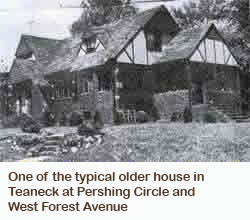 Three years ago, the United States Army conducted what, in effect, was a municipal beauty contest. The idea was to find the most photogenic and civil-minded town in the country, take pictures of it and distribute the pictures in occupied Germany and Japan as part of the post-war democratization program. The town selected — from 10,000 competitors — was Teaneck, N. J.
“Teaneck,” observed an Army Civil Affairs officer, “is an excellent subject. It has a fine municipal spirit and high quality of governmental services.”
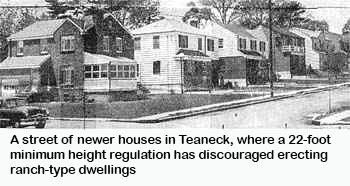 Although he neglected to mention it, what swayed the Army and what undoubtedly made the biggest impression on the Germans and Japanese who later viewed the pictures was Teaneck’s expensively sleek good looks. A community of high-salaried commuters (their average income is $7,700–more than double the national average), Teaneck has no factories to mar the scenery with soot-stained smoke stacks and no slums to make a mockery of its fashionable homes and estates.
This model community, whose rooftops fairly bristle with television antennas, occupies a shallow ridge between the Hackensack River and Overpeck Creek in the narrow Southern neck of Bergen County. Four miles west of the George Washington Bridge, it is quadrisected by State Highway 4, a major artery trailing west from the bridge, and the north-south tracks of the New York Central’s West Shore Railroad.
The Army was by no means the first agency to discover, and capitalize on, the charms of Teaneck. For years, magazine editors in search of feature copy had singled it out as “a representative American community,” which it isn’t, and as “a good town to live in,” which it apparently is.
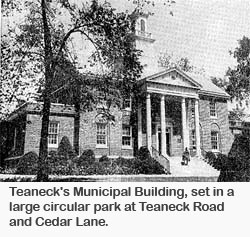 One effect of all this gratuitous publicity has been to instill in the governing officials a desire to make the town worthy of its reputation. This desire manifested itself recently in the construction of a group of public buildings–including a Dutch Colonial police station that looks like a college chapel and a Dutch Colonial firehouse that resembles a museum–so impressive and handsome that they will very likely lure another batch of writers to Teaneck and start the cycle rolling again.
Teaneck’s paid fire department consistently receives the most eloquent testimonial a fire department can get–low insurance rates for home owners. Teaneck’s total fire loss for 1951 was $30,082, or 38 cents per resident, as compared with a national average of $2.14.
Both fire and police departments, as well as Teaneck’s other governmental agencies, are supervised by a town manager who, In turn, is hired by a five-member elected council. The council chooses one of its $1,000-a-year members as mayor, but the manager, a professional administrator, performs all major executive duties.
Council elections are held every fourth May, so as to divorce local politics from state and national campaigns, and the candidates bear no party designation. Sitting on the current body are an engineer, a sales executives, a chemistry professor, a retired corporation official and a railroad passenger agent.
Non-salaried advisory boards, made up of local residents, help the council on technical matters. Mayor Henry Deissler said, “We like to have them advise, because that’s real democracy. Every one should feel he’s part of the town. And, of course, they give us a lot of help.”
One local institution that appreciates Teaneck’s preponderance of professional men is Holy Name Hospital, a sprawling, 252-bed structure that caps a tree-shaded hill near the civic center. Operated by the Sisters of St. Joseph, a Roman Catholic order, the hospital has a full-time staff of competent physicians but leans heavily on the services of big-name specialists who, as Teaneck-to-New York commuters, devote part of their time to Holy Name.
Commuting — an activity indulged in by 90 per cent of Teaneck’s men–is facilitated by the West Shore Railroad, which shuttles Teaneckers to and from New York City via the 42d and Cortlandt Street ferries. Running time from 42d St., New York, is thirty-five minutes. There are eight daily round trips, and passengers can use either of two stations Teaneck–the main depot near the Cedar Lane shopping center or the West Englewood station in the northern part of town.
Despite the two stations, most Teaneck commuters rely on their cars for transportation to New York. They and a number of bus lines use Route 4 and the George Washington Bridge, reaching mid-Manhattan in thirty to forty minutes.
If any group in Teaneck receives preferential treatment, that group is the children. More than half of every tax dollar is spent on schools; 20 per cent of the town’s six square miles is set aside for fifteen parks and playgrounds totaling 127 acres, and child clinics and hygiene stations receive top health appropriation priority.
“Teaneck is a wonderful place for children,” said James T. Welch, town manager since 1948.”The recreation facilities are fine and the schools are excellent.”
Teaneck has seven elementary schools, a public junior-senior high school, the St. Anastasia parochial school and Bergen Junior College. Progressive and far-sighted, the Teaneck school system, in 1932, became the first to offer aviation courses, including flight training, and, in the 1920s, instituted what was then regarded as revolutionary programs in diagnostic testing, vocational guidance and special classes for retarded children.
Teaneck’s parks and playgrounds network, soon to be enhanced by a marine park near Overpeck Creek, is supervised by a full-time recreation director and forty part-time assistants, They officiate at town-sponsored ball games, playground activities, tournaments, square-dances, band concerts and numerous other events.
The history of Teaneck dates back to the seventeenth century, when the Bergen County area was settled by Dutch colonists. In 1704, the first Lutheran Church in New Jersey was built in a clearing that is now part of Teaneck. The political entity of Teaneck was formed in 1895 when sections of Englewood and Ridgefield were split off to form a new township.
As the case in most old communities, nobody seems to know how the name “Teaneck” originated. Some people say it’s all Indian name for “woodland place.” Others say it’s of Dutch origin and means “little neck.” All agree it’s a nice town in any language.
From N. Y. Herald Tribune , 1961 (exact date unknown)
 It’s the people-who make a model town.
Building, roads, government and, most important, its way of life – these are but products of their aspirations, and their work.
Chosen 12 years ago by the Army as “Model United States Town,” after 10,000. were considered, Teaneck, N.J., serves as a prototype for the rebuilding of Germany and Japan. The Army made a film of life in Teaneck, to show democracy in action.
But Teaneck has not been content to “freeze” its progress as of 1949. While holding to its basic principles, the community, has pushed its development to meet the needs of a growing population whose horizons, too, were broadening.
To back up its proud story, “Know Your Town Week,” was proclaimed last week by Mayor Matthew Feldman and his Council. The League of Women Voters joined in the celebration by mailing to all 43,085 residents its 64-page illustrated book, “This Is Teaneck.”
Townspeople differ widely in economic circumstances and in the value of their homes, but jointly they have given Teaneck a single pleasant aspect of a trim, colonial, tailored town on the Hackensack River’s east bank. Democracy is inherent in the community’s major public shaper of the pleasant life. Its public Recreation Department, headed for 18 years by Richard Rodda, for example, in its vast program it sponsors a Retired Men’s Club. Members include a couple of millionaires and some retired railroad workers.
It holds the popular teenage dances, and until he moved a few years ago, writer Jim Bishop dropped in regularly. This longtime Teanecker was active in many local events and it was at his home there that he wrote his popular books, “The Day Lincoln Died,” “The Day Christ Died” and “The Glass Crutch.”
When he gets home to Mildred St., singer Pat Boone spends a lot of time with his Little League ball team. Residents are high in the ranks of the arts, sports and industry. They are pretty proud of such other taxpayers as novelist Robert Molloy, songwriter Moe Jaffe, blind singer Al Hibbler, Eddie Ames of the Ames Brothers, jazz trombonist J. J. Johson, Yankee catcher Elston Howard, N.Y. Giants tackle “Rosy” Brown and Mrs. W. W. Rindlaub, a top ad executive in Manhattan.
Said Township Manager Warner Schmid: “If anyone checked, he’d see we still have the same characteristics and community spirit that earned us the ‘model’ honor in 1949.”
As an individual of its school is perhaps proudest of its school system, on which it spent an astonishing 53.9 percent of its 1960 budget of $8,160,526. Its high schools were first in the state teach aviation back in 1932.
Juvenile misconduct is at a minimum, local government is largely harmonious and intergroup relations are devoid of racial or religious bias. All public services are modem and efficient.
With a foundation of old Dutch, Huguenot and Quaker families — now blended with former New York apartment dwellers–Teaneck has kept itself residential. Except for a few garden-type apartments, homes are largely one-family and there are no factories. Route 4 runs through the community and the town owns the rights-of-way on both sides. Hence, no gaudy billboards, no road-stands.
Parks and playgrounds take up 20 percent of total area. The big park, Municipal Plaza, is the site of Summer songfests and concerts by the community symphonic orchestra and chorus; in the Winter they are given in the Community Center or Armory. The 81-piece orchestra, founded 20 years ago by Donald Mairs, is conducted by Saul Schectman.
No isolated Shangri-La is this “model town.” It is only four miles west of the George Washington Bridge.