
Teaneck Armory
Completed in 1936, has served many roles in its more than 60 years history.
From: Bergen Evening Record Weekend Magazine , Oct. 19, 1957, p. 13
Bergen’s Own Madison Square Garden
By William R. Steng Jr.
 Billy graham’s crusade journeyed across the river from the Eighth Avenue arena in New York City to the arena on Teaneck road in Teaneck last month and once again the Teaneck Armory assumed its role as the Madison Square Garden of Bergen County.
Down through the years the Armory has played host to conventions, dances, home shows, and numerous sporting events, including the roller derby professional wrestling, professional tennis, midget auto racing, and amateur boxing. The Bergen Evening Record library supplied a ticket to these days gone by and a look at some of the heroes who drew the plaudits of Armory crowds.
Strolling down memory lane you might recall the first event staged at the Armory was a dog show sponsored by the Kennel Club of Northern New Jersey in March 1938. The show has become an annual affair and each year draws more than a thousand entries.
One of the most popular events seen at the Armory was the Bergen Evening Record Athletic Association’s Diamond Gloves. Amateur boxers 16-years-old and over throughout Bergen County supplied fans with many a thrill. The first Gloves tournament at the Armory was in 1938, and 8,000 fans saw 16 bouts on opening night.
 The Gloves was conducted in other parts of the County after 1938 and until 1941 when it was interrupted by World War II. In 1947 the Diamond Gloves returned to Teaneck Armory and continued until 1949 when it was disbanded because the draft took so many find young boxers from Bergen it was no longer possible to run the tournament.
The tradition of the 135-pound boxers opening the 16-bout card each night, and names like Pat Best, Dave Archer, and Mike Amatrula are now memories of days gone by.
World War II closed the Armory to other sporting events just as it called a temporary halt to the Diamond Gloves. The end of the war brought the return of many top athletes to Bergen’s sports palace.
On Nov. 2, 1949, Governor Alfred E. Driscoll welcomed the roller derby to the Armory and the Jersey Jolters beat the Washington Generals, 16-13, before a crowd of 4,000. The Armory became the site of Jersey Jolters homestands from 1949 to 1952 and in 1953 was the site of the World Series of Roller Derby.
Moose Payne, Sid Harneck, Toughie Brashun, and the Bergen County trio Frank Baeli, Herbie Plump, and Millie Bruno, thrilled many a fan as they spun around the Teaneck track.
 Antonino Rocca, Gene Stanlee, Tarzan Hewitt, and Skull Murphy are a few who have given wrestling fans their share of excitement. Auto racing fans have had their moments too. In January 1952, Tee-Que midget auto racing made its first showing in the Metropolitan area at the Armory. Tony Bonadies, Tony Romit, and Dick Dowd buzzed around the track at an average speed of 110 miles-per-hour in Tee-Ques.
The speed of the Harlem Globetrotters wasn’t quite as fast as the midget racers, but they had enough wizardry to down the Philadelphia Sphas, 72-51, on Nov. 13, 1955, before 4,000 fans. In the other half of the double-header the Washington Generals beat the Boston Whirlwinds, 73-56, despite a 23 -point performance by the Whirlwind’s Bevo Francis.
On March 1 and 15 back in 1953, the Jersey Titans downed the Elmire Colonels, 81-76, and the Wildes-Barre Barons, 99-93, Sherman White, Ed. Warner, Gerry Calabrese, and George Kaftan are a few of the stars who have played on the Armory court.
 Jack Kramer, Pancho Segura, Don Budge, Frank Sedgeman, and Tony Trabert are a few of the professional tennis players who thrilled crowds at the Teaneck area. any one who sat in the Armory on Feb. 16, 1953, is not likely to forget the titanic struggle between Jack Kramer and Frank Sedgeman. Sedgeman defeated Kramer 10-12, 10-8, and 12-10 in an 2-hour match of 62 games before 3,000 delirious fans.
Other past events at the Armory include dog obedience shows, expositions, food shows, track meets, boat shows, and bingo. Bingo games are best remembered for the traffic jams they created when the thousands in attendance started home.
Completed in April of 1938, the Armory, built at a total cost of $950,000 of which $475,000 was a Public Works Administration grant, was erected to house a National Guard unit in the Bergen area. It has fulfilled this purpose, but it will best be remembered by many as the Madison Square Garden of Bergen County.
From: The Record, Friday, November 21, 1975
Teaneck Armory: Relic of Yesteryear
By Bill Hendrickson, Staff Writer
 John F. Kennedy once visited there. So did Barry Goldwater. Richard Nixon tried, but he wasn’t allowed in.
Lions and Bengal tigers once roared in its halls at night. The Bergenfield and Teaneck youths who drag their cars in its parking lot call it “The Brickpile.”
But James Horton, 20, his wife, Terri, 19, and their 15-month-old son, Jason, call the Teaneck Armory home. Horton is the caretaker of the building which is on a 13-acre site at Teaneck and Liberty Roads in Teaneck.
“When people ask me where I live, I say in a castle,” Horton says.
Actually, he lives in a seven-room apartment on the armory’s second floor. His friends know where to find him: They drive to the north parking lot and honk their horns three times.
Lonely nights
Nights at the armory are lonely, even a little spooky, Horton says. The steam pipes rattle, the halls echo with the sound of his footsteps along corridors lighted by solitary hanging bulbs.
The armory was built in 1938 to house the 104th Engineers of the National Guard, but for 30 years the place was filled with crowds witnessing tennis, roller derby, wrestling, the New Jersey Americans — now the New York Nets — presidential candidates, and evangelists.
Promoters called it Bergen County’s Madison Square Garden.
It is the night of Oct. 7, 1964, and Republican presidential candidate Barry Goldwater is in Teaneck. One hour before his speech, the streets leading to the armory are hopelessly jammed.
When Golduwater steps on stage, the 10,000 people in the armory burst into an emotional explosion. There are cheers when Goldwater raises his hands, cheers when he lowers them. He is mobbed as his speech ends.
Horton is a caretaker of such memories. There have been no public events since 1968, when Teaneck condemned it as a firetrap.
Pushing aside a broom in the armory’s basement – a storehouse for jeeps, armored personnel carriers, and 2 1/2-ton Army trucks used during National Guard drill weekends – Horton walks one flight up to the drill floor, 242 feet long and 150 feet wide.
“This is essentially a garage. It used to be as shimmering as a dance floor,” he says.
Huge steel girders lock the building’s barrel roof in place. Fifty feet above the floor’s center, the ringside lings hang, where once they illuminated the wrestling matches below and singers such as Chubby Checker and bands such as Mitch Miller’s.
Horton, a Teaneck High School graduate, started as a maintenance worker at the armory. The pay was low, and he was ready to quit. Then the caretaker retired and he was offered the job. He says he’s paid $150 a week, and there’s the apartment. It’s not everyone who can say he lives in a castle.
The state says it can’t afford the estimated $100,000 needed to build new exits or install a fire-detection system required by Teaneck to reopen the armory to public events.
President Nixon was refused permission to speak in 1969 because of the fire violations.
Teaneck doesn’t want it open. “Can you imagine a Madison Square Garden in a residential neighborhood?” asks Teaneck Police Chief Robert Fitzpatrick.
The building can hold more people than any similar facility in Bergen – 5,000 for basketball and 12,000 for speeches. But its fate is to sit idle, except for National Guard drills on weekends and for 30 children who play basketball Wednesdays under a Guard-sponsored program.
Vandalism is a problem, mostly broken windows. In 1972, vandals broke in and rammed the 2 1/2-ton trucks into each other in a giant demolition derby, causing $75,000 in damage.
“Good thing they didn’t start a tank,” one policeman said. “They might not have been able to stop it, and it would’ve gone through the building, across the street; and into the [Foster Village] apartments.”
From: The Record, Monday, May 2, 1983
Our Neglected Armories:
New Jersey’s Armories Are Fading Into Decay And Disuse
By The Record’s staff
 The Paterson National Guard armory, where Civil War veterans proudly gathered on Memorial Day 1894 for the laying of the cornerstone, is boarded up, spotted with grafitti, and for sale. The last troops moved out of the block-long, brick castle two months ago.
At the armory in Teaneck, a New Deal symbol of American resilience, water from recent rain soaked from the second floor roof to the basement. Since 1968, the town has considered the building unsafe for public events.
These buildings and New Jersey’s other National Guard armories once were symbols of security, culture, and civic pride. Today, while the National Guard itself enjoys a recession-driven resurgence, some of its homes have aged into decrepit hulks.
The armories, which average 33 years old, are falling apart, Maj. Gen. Francis Gerard, state Defense Department chief of staff, recently told a state legislative committee. He asked for $10.8 million over 10 years, including $1.3 million next year, to renovate 23 of the 40 state-owned armories.
 The plan would further stretch the state budget, possibly at the expense of more visible programs with larger constituencies. Compared to education or welfare, said an aide to Governor Kean, “there is not the same emotional issue” in the armories.
The problem extends beyond New Jersey. Nationwide, renovation and construction run about $800 million behind needs, said Col. Donald Perkins of the National Guard Association of the United States, a professional and lobbying group in Washington, D.C.
“It seems like we’re falling farther and farther back each year,” he said, acknowledging that armory repairs are hard to sell “when you’re short on B-1 bombers and MX missiles.”
In the years before high-technology warfare, when the armories offered more tangible security, their militias were important militarily and socially. It was the golden age of the citizen soldier in the golden age of the city.
Over the years, the 75,000-square-foot armory in Paterson presented events for all: The Paterson Orpheus Club performed Handel’s “Messiah”; Enrico Caruso sang; Clarence Darrow spoke; Joe Louis and Gene Tunney fought, though not each other.
As Paterson native Al Bizaro strolled past the building one afternoon last week, he recalled, “I’ve seen a lot of good circuses here. All your best circus performers came through here.”
 Teaneck’s heyday came later. Built in part with money from the Works Progress Administration, the 133,000-square-foot armory opened to a dog show in March 1938. For the next 30 years its calendar offered everything from a campaign rally for Dwight D. Eisenhower to midget-auto races.
That halted abruptly in 1968, when the town council stopped issuing use permits. The council cited the lack of emergency exits, a fire detection system disconnected about 1950, and vehicles with filled gasoline tanks parked in the basement garage.
Despite the faults in the Teaneck armory, Capt. Anthony Palazzini, who once saw the New Jersey Americans play basketball in the drill hall and now is the building’s administrative officer, said he still turns down requests to use the facility, which can seat as many as 12,000.
The National Guard wants a little more than $1 million to repair the Teaneck armory, which is used by about 800 troops of an engineer battalion, medical battalion, and infantry company. The money would be used to replace the electrical system with its chattering circuit breakers, the leaky galvanized-pipe plumbing, and a heating system run on three mammoth oil-fueled boilers. The budget does not yet include a new roof.
Those troubles are common among the 23 buildings on the repair list: The 23-year-old Lodi armory, which houses two maintenance companies, would get $68,000 for a new heating system. In Jersey City, the building at 678 Montgomery St. – and the problems – are similar to Teaneck’s.
The declining condition of the armories may endanger New Jersey’s troop strength, which is now at 92 percent of its authorized 13,500 soldiers, the National Guard says. Recruitment is strong, thanks to the recession. The National Guard, in its promotional literature, says the $8.4 million which the state spent for National Guard activities last year was “a valuable and cost-effective investment.”
The state Defense Department’s information officer was more direct: Five armories have closed in six years, including Paterson’s, causing troops to be shuffled to other facilities, said Maj. William C. Lowe. If the trend continues, he said, New Jersey will not have enough armory space and will have to send some units to other states.
“That’s equivalent to endangering a major industry in New Jersey,” he said, adding that federal dollars could be lost.
If Gerard is to launch the 10-year renovation plan, he must get from the legislature what he could not from the administration: Kean’s proposed budget allows $596,000 next year for armory construction and maintenance, with virtually every dollar spoken for.
Assemblyman Robert Janiszewski, D-Jersey City, chairman of the Assembly Committee on Revenue, Finance, and Appropriations, called the Jersey City armory “an absolute disgrace,” but added, “I could cite example after example of dramatic underfunding that the committee is sensitized to.”
Despite the condition of its armories, last year New Jersey guard units marched in 26 Memorial Day parades. They also participated in several walkathons, supplied emergency water, and dispatched medical teams to sporting events.
“We’re involved in the community, like the Knights of Columbus, the Elks, or the Moose,” said M. Sgt. Lucas Casbar, noncommissioned officer in charge of recruiting for north-eastern New Jersey. “The only difference is, when you join this organization, you get paid for it.”
As part of its efforts, the 104th Engineer Battalion from the Teaneck armory installed a 10-ton sign and anchor for an American Legion post, cleared parkland in Madison, and built a road to a camp for the retarded in Haskell.
Despite those efforts, the National Guard’s relationship with Teaneck is “just kind of cordial acceptance,” said Mayor Bernard Brooks.
“At the moment, I would say it [the armory] is not an integral part of the town at all,” he said. “It is looked on purely as a piece of state property, and that is it.”
In Paterson, the armory has generated friction. Paterson has made “at least 15 overtures” to the state to buy the armory and convert it to a youth center, said Mayor Francis X. Graves. “They sat on it and sat on it and sat on it,” he said. “What game they’re playing, I don’t know.”
The ornate Paterson armory, once the home of a proud regiment, no longer offers town residents security, culture – or anything else until a decision is made on its sale. Graves said, “They just can’t put their act together.”
From: The Record , February 28, 1988
Teaneck’s Aging Sentinel
This is another in a series of editorial on historic, unusual, exotic, beautiful, or just plain interesting buildings and places in North Jersey.
The Teaneck Armory stands silently in Tudor splendor just off Teaneck Road, an aging sentinel of times past.
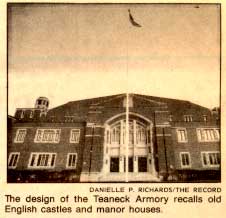 The New Deal project was built in 1938 on 13 acres; part of the money came from the Works Progress Administration. It was designed to house the 104th Engineers Battalion National Guard, which saw action in the Alsace during World War I and later helped create rescue trails for the Palisades Interstate Park Commission.
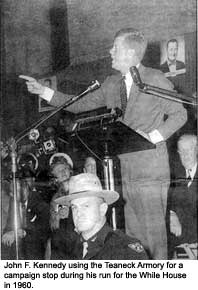
Over the years, the armory has snared bits of history, playing a role as a public arena. It opened with a dog show. Midget-car rallies were held there. Chubby Checker and Mitch Miller sang there. And a host of political candidates, among them John F. Kennedy and Barry Goldwater, stumped there.
But in the late Sixties, the building was declared unsafe because of inadequate fire exits and was closed to public events. Now, it’s strictly used by the National Guard, its role revealed by the numerous Army vehicles parked out back under tarpaulins.
Time has worn away a lot the design, a fine example of what could be called “Tudor Eclectic.” It relies on various architectural elements from the manor houses and castles of 16th century England. Basically, it’s a collection of several buildings unified in a continuous design of standard red brick. Foremost among those mini-buildings is the long barrel-vaulted drill floor, which seated 5,000 for basketball games and 12,000 for speeches.
The armory’s most dramatic elements – a series of battlements that fringed the two front towers – have been removed, apparently the victim of recent repairs. But the towers at either end are still evident and dramatic. They give off a castle feel, thanks to the long, narrow princess windows. And on the north end of the building, a wonderful, albeit truncated, turret rises, complete with modern vents worked into the design.
The front supports the look and feel of old England; groups of casement windows flank the entrance, and decorative sandstone trims the windows and the base of the building. The strongest element, however, is the main entrance, complete with a flattened Tudor arch and three bays of thick, double doors, reminiscent of an old monastery.
From: The Record , Wednesday, January 17, 1996. p. N-3
Repairs Starting At Snow-Damaged Armory
By Jeff Pillets, Staff Writer
Emergency repairs are expected to begin today at the National Guard Armory in Teaneck, a 58-year-old landmark where part of a masonry wall collapsed under last week’s snowfall.
“We’ll do whatever is needed to get the armory up and running as fast as possible,” said Ray Martyniuk, a spokesman for the state Department of Military and Veterans Affairs.
“That’s the biggest armory in the state. We’ll bring it back better than ever,” he said. “It has a lot of good years left.”
Insurance adjusters and township inspectors were at the armory Tuesday assessing the damage to the massive brick building at Teaneck and Liberty roads. They were joined by representatives of a Morristown engineering firm that the state hired on an emergency basis to oversee the repairs.
Martyniuk said most of the damage is a 10-by-20-foot hole that opened up in the south wall when a support beam gave way under the weight of rapidly melting snow and ice. Part of the main floor beneath the hole sustained heavy water damage and must be replaced, he said.
The collapse happened Saturday, and no one was injured.
Although Teaneck officials initially feared that the roof would collapse, it apparently was not damaged. They said the beam that gave way was not part of the steel structure supporting the arched roof.
“It would take a lot to bring that roof down. This place was built like a true fortress,” Deputy Fire Chief Robert Montgomery said.
Work crews were to begin carting away collapsed sections of the wall this Morning. Other work was to begin Thursday.
In the meantime, the main auditorium under the damaged wall has been closed. Administrative offices in the front of the armory will remain open for a small crew of National Guard personnel normally on duty.
The armory will remain home to about 300 members of the Army’s 50th Support Battalion who drill there one weekend a month.
Budget cuts by Governor Whitman’s administration have curtailed community use of the armory, which is owned by the state. The governor has denied funding for a capital improvement plan that would bring the armory into compliance with recently passed fire safety codes, Martyniuk said.
For decades, the armory was the site for a range of events including political conventions, big-band concerts, midget auto races, and high school proms.
In the 1967-68 season, it was the home of the New Jersey Americans, a charter member of the former American Basketball Association. The team moved to Long Island the next year and became the New York Nets. Today the franchise is the National Basketball Association’s New Jersey Nets.
From: The Suburbanite , July 9, 1997, p. 1
Armory Rented For Universal Movie
By Linda Berberian of the Suburbanite
Universal Studios has rented the Armory to film scenes from the upcoming movie Meet Joe Black starring Brad Pitt and Anthony Hopkins, scheduled for distribution in 1998.
According to Col. John Dwyer, public information officer for the state Department of Military and Veterans’ Affairs, Universal had begun shooting scenes for the film in the Jersey City – Armory, but transferred to Teaneck because larger space was needed for interior scenes for the romantic comedy drama.
Most of the filming is scheduled in New York City, a studio representative said.
The Armory has recently completed the renovations allowing it to reopen its doors to events like the sports and concerts scheduled years ago.
Drills will be halted until October, Col. Dywer said. The National Guard is willing to put up with this situation because of the income engendered by the new rental program. “We are upgrading the quality of life for short term inconvenience,” he added.
“The film being partly shot at the Armory is being directed and produced by Martin Brest. Pitt plays an otherworldly character who falls in love with a powerful businessman’s daughter while assuming a human identity.
Cast as the daughter is Claire Forlani (The Rock). Hopkins portrays her father.
According to Col. Dwyer, the typical rental cost for the facility can be between $45,000 and $90,000, depending on how much space is needed. The price negotiated by Universal was not available.
“We can maintain and upgrade the facility now, while decreasing the burden on the taxpayer,” the colonel said.
The state spent approximately $500,000 to install a fire suppression system that was needed to allow the facility to be opened for public use and leased.
‘It’s a tremendous capital investment on our part. Over time it should pay for itself by the leasing of the Armory,” said Col. Dywer.
Since 1968 the Teaneck Fire Department had forbidden Armory use for the major public events that used to be staged there because the massive building did not meet fire safety code requirements. The state decided to do the work last year after spending thousands on repair of a wall that had collapsed from the snow of the previous winter.
System installation is far enough along for other uses such as sporting events like boxing or basketball, Dwyer said.
From: The Record , Wednesday, January 2, 2002, p.1
A Place For Troops, Troupes, Hoops
Teaneck Armory Still Vital
By Tom Davis
 Connie Hawkins shot three-point baskets there. David Bowie used the site for rehearsals. John F. Kennedy stopped by to campaign for presidents in 1960. Movies have been filmed there. And professional wrestlers have slugged it out at the Teaneck Armory.
Currently, members of the New Jersey National Guard sleep there in between 12-hour shifts patrolling the George Washington Bridge.
Completed in 1936 at a cost of nearly $1 million, the Teaneck Armory — with its 37-foot-high arching roof — has played a valuable role not just in the current war on terrorism, but also during peacetime.
Sitting on 13.66 acres, the brick-and-stone structure was built by Depression-era laborers. They each spent only two days a week on the job because the government stretched the project to keep people employed as long as possible.
“It took two years to complete,” said Command Sgt. Maj. Richard Bammert of the National Guard’s 50’th Main Support Battalion. “They didn’t want to rush it.”
Around the same time, New Jersey and New York built similar armories in Jersey City, Brooklyn, and elsewhere.
Because armories tend to have vast floors, high ceilings, and few obstructions, many have become popular among filmmakers shooting indoor scenes.
in recent years the Teaneck site has been in especially high demand because it’s close to Manhattan, and its presence in a quite residential neighborhood allows producers to make their films in relative peace.
“There are things you can’t fin in Manhattan,” said Helen Robin, line producer for Perdido Productions, Woody Allen’s production company. The acclaimed filmmaker shot “Sweet and Lowdown,” starring Sian Penn, at the Teaneck Armory. It was released in 1999.
But the film industry was far from anyone’s mind when the armory was erected for the 104th Engineers Battalion of the New Jersey Army National Guard, which provided emergence assistance during hurricanes, floods, storms, and bridge collapses.
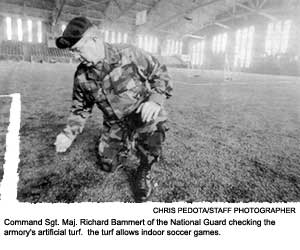 When members of the 104th were involved in World War II, the New Jersey Militia occupied the space. “The militia walked around neighborhoods, making sure people turned out their lights” to save energy, Bammert said.
The 104th disbanded in 1993, and now the 50th, which is the state’s largest guard unit and was formerly headquartered in Lodi, is based at the site. The unit includes about 1,000 people who have civilian jobs but train throughout the year in case they are needed to provide medical assistance, truck hauling, food service, or cargo handling in an emergency.
Recently, guard members have been deployed to provide medical assistance to detectives at the Fresh Kills landfill in Staten Island, where the remains of the World Trade Center are being investigated. The battalion also operated a warehouse in Bayonne that stored donations for victims of the Sept. 11 attacks.
Recently, the armory has also been used by soccer leagues that play indoors on an artificial grass rug.
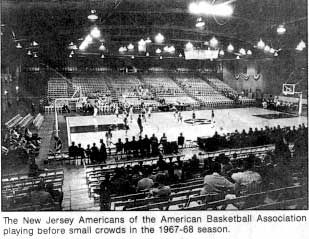 Over the years, the armory has fallen in and out of favor as a site for non-military events. It was especially busy through the 1960s. Auto racers drove midget cars inside at 110 mph. The Rev. Billy Graham visited.
In 1938, 8,000 boxing fans saw 16 bouts in one night. In 1949, Gov. Alfred E. Driscoll allowed roller derby, and the Jersey Jolters beat the Washington Generals, 16-13, before a crowd of 4,000. The Harlem Globetrotters used their trademark basketball trickery to trounce the Philadelphia Sphas, 72-51, in a 1955 game.
A 1957 article in The Record called the armory “Bergen’s own Madison Square Garden,” and focused on a dog show by the Kennel Club of Northern New Jersey.
A turning point for the armory was in 1967-1968 when the New Jersey Americans, who would later become the Nets, played on the the 36,500square-foot drill floor before crowds of just over 2,000 per game.
The Americans were forced to forfeit a pivotal playoff game because a circus group rented the drill floor space that week and there was no other venue available.
 Teaneck Mayor Paul Ostrow said he has fond memories of the Americans, the American Basketball Association team that finished its only season in Teaneck with a record of 36 wins and 43 losses, tying for fourth place in the Eastern Division. Discounts allowed Teaneck school students to pay only $1 for tickets, and see visiting superstars such as Hawkins.
Ostrow said he recalled the armory’s custodians taping a three-point line to the drill floor prior to the games. The ABA popularized the three-point line, which was dismissed for years by the basketball establishment as a gimmick before it became a widely accepted part of the game at all levels.
“It was so unique to have this high-class professional sports team that we could go see,” said Ostrow, who was 16 when he attended Americans games. “The New York Knicks were too expensive and too far away.”
In 1968, the Americans moved to Long Island and changed their name to the New York Nets. That same year, Teaneck officials ordered a halt to nonmilitary exhibitions, saying the lack of fire protection devices and safety exits made it unsafe for public assembly.
That began a period of decline for the armory in which the structure deteriorated and was considered unsuitable for sports or entertainment.
But starting in the late 1980s, the state changed its policy on the armory and again encouraged non-military exhibitions to take place, hoping the revenue generated in fees could be put back into the facility.
The strategy worked, many believe. The state got enough money to install fire alarms, exit doors, and a new roof, and purchase new boilers to replace the building’s inefficient heating system, Bammert said.
Bowie’s rehearsals for his 1990 tour were considered a sign of a revival.
“We gave him a National Guard jacket that he wore on tour,” said Bammert, who has been at the armory since 1972.
In recent years, Mariah Carey rehearsed inside, and Woody Allen and others filmed there and turned classrooms into fitting rooms.
Three years ago, indoor scenes from “You’ve Got Mail,” starring Tom Hanks and Meg Ryan, were shot on the drill floor under the arching roof.
Col. John Dwyer, a spokesman for the state Department of Military and Veteran Affairs, couldn’t specify how much money and armory generates in leases to movie production companies, but said the amount is significant. He said a “good movie filmed there will pay the armory’s utilities for an entire year.”
While the armory generates no tax revenue for the township. Ostrow said Teaneck officials now welcome its presence and do collect some permit fees.
Ostrow said he anticipates the armory continuing to serve non-military functions.
“In the 1990s, there was a resurgence in the use of it. It was like, hey, we’re a part of the community. Let’s open our doors,” he said.
From: Bergen County Autumn Years , Winter 2021/22, Vol. 8, No 3. p. 48-57