
History of the Churches of Teaneck — Information about the development of various churches in Teaneck.
Text from: Teaneck New Jersey Forty Years of Progress: 1895-1935 , by Township of Teaneck, c1935. pp. 14-18.
Photos from: Local History Photo Collection of Teaneck Public Library

TEANECK PRESBYTERIAN CHURCH
 Starting in the property known as the Old Town Hall, the public school building of Teaneck, the Sunday School which was then known as the Washington Avenue Union Sunday School, secured its present site on Teaneck Road at Church Street, from the Phelps Estate. In 1894, Frank DeRonde, then acting as trustee and treasurer, undertook to raise money by a public concert to erect the first portion of the structure. The transcept and the west wing were built in 1911.
In 1922 the entire building was excavated, redecorated, including the installation of the heating plant, community room, toilets, and kitchen. A year later the manse property and the adjoining lot on Teaneck Road were purchased and the manse was built. In 1930 through the efforts of the Woman’s Guild, an Estey Pipe Organ was installed as a memorial to George S. Coe in view of the services he rendered the church during the days of his life which ended there, February 11, 1927.
The church was incorporated November 12, 1915. The morning services started Easter, 1923, and the same year the Sunday School was changed from the afternoon to the morning session.
 The following pastors have served the church: George L. Roberts, Jr., Charles T. Baillie, Thornton B. Penfield, and the present pastor, the Rev. Reginald Rowland who assumed pastorate December 12, 1922, coming from Washington, D. C., to be the resident minister. The following served as Stated Supplies: A. C. Baird, Leonard Twinem, George Woodbury, Sidney M. Bedford, and Thornton B. Penfield.
Under the present pastorate, in addition to improvements and appropriate care for the physical property of the church, the membership has grown from 135 to 319 communicants, and the Board of Elders has been increased from six to nine in number to keep pace with its responsibilities for the enlarged enrollment.
TEANECK METHODIST EPISCOPAL CHURCH
The story of this church is one of continuous growth and the Sunday School, with its active attendance of 200 per Sunday, crowds even these new quarters. The movement which was to eventuate in the present Methodist Church started back in the Fall of 1901. It started as the Lower Teaneck Sunday School Association. Those who started it met in the old schoolhouse on Fort Lee Road. By April, 1902, under the leadership of Mr. C. P. Bogert as superintendent, a lot was purchased on Teaneck Road just north of the trolley line. By 1905, the group had grown strong enough to assume a mortgage of $1400 and they built the chapel which still stands. Growth continued and this mortgage was eliminated in seven years time. The first trustees of the association were C. P. Bogert, B. D. Westervelt, and Elmer Mabie.
Preaching services started in 1911 with volunteer preachers and in 1912 the Rev. V. A. Wood, then pastor at Ridgefield Park, was induced to preach here as well as his own charge. In 1915 the chapel became a denominational church. After representatives from several churches were heard, a vote was taken and the chapel became a part of the Methodist Episcopal Church. There were eighteen charter members when the church was organized.
Growth continued and it soon became evident that larger quarters would soon become necessary. In 1920 a movement was started to provide more adequate accommodations. In 1923, during the pastorate of the Rev. M. A. Workman, the new building was constructed on DeGraw Avenue and Hickory Street. The lots were donated by Mrs. Rachel DeGraw, the old property sold, and the financing arranged.
In 1928 the parsonage was built and the Rev. Ralph Roby and family were the first to live in it. Mr. Roby was followed by the Rev. Charles Kemble and he by the present pastor, Rev. Alfred E. Willett.
ST. ANASTASIA’S R. C. CHURCH
 Up to the year 1908, the Catholic people of Teaneck were served by the Carmelite Fathers from St. Cecilia’s Monastery, Englewood, N. J. Saint Anastasia Church, the first Catholic Church in Teaneck, was built in the year 1908. Father Peter Kramer, O. Carm was the first pastor.
A bronze plaque with the following inscription may be seen in the present church “Erected to the Memory of Anastasia Kelly, Founder and Munificent Patroness of this Church.”
Born May 11, 1828 in the County Wexford, Ireland, she came in early youth to Brooklyn, N. Y. and resided in that city during the greater part of her life. Removing thence to Teaneck, the zeal for God’s glory and the sanctification of souls which charaterized her whole life, urged her to devote a goodly share of her worldly fortune to the erection of a church, convenient to the residents of this town. This pious plan was happily realized and the church was dedicated August 2, 1908.
Owing to blindness, with which she was afflicted during the later years of her life, she never had the pleasure of viewing the monument she had built.
 In 1923 Father Benedict O’Neill, O. Carm., the next pastor, enlarged this church purchased the Robinson estate and remodeled the house to serve as a rectory. He became the first resident pastor of this fast growing parish in May of the following year. Again the enlarged church was found too small to serve adequately the growing parish. Father O’Neill erected a new building on Robinson Street, the beginning of a school plant consisting of an auditorium and a spacious basement hall; the auditorium to serve as a church until such time when a church could be erected which would serve the future full-grown community. The new building was opened with Solemn High Mass or Thanksgiving Day, November, 1932.
In July, 1933, Father Silverius Quigley, O. Carm. became the second resident pastor of St. Anastasia Church. A month later Father Dominic Lickteig, O. Carm. came as the first resident assistant Pastor.
With the expected increase in the Catholic population of Teaneck, plans have been made for the erection of a new church on the corner of Teaneck Road and Robinson Street.
CHRIST CHURCH
Christ Church Mission was organized in 1913 under the authority of the Episcopal Diocese of Newark. That section of Teaneck, known as West Englewood Park, at that time consisted of about twenty homes completed on one finished street, Ogden Avenue.
Mrs. Fairchild N. Ferry of Ogden Avenue was the pioneer of the parish. She took a group of the children from that neighborhood and taught Bible Studies to them in her own home. Gradually adults began to realize that a church was needed there and a pastor was engaged to preach Sunday services at the Ferry home.
Rev. Flemming James of St. Paul’s Church, Englewood, was the first pastor. During those first two years of the congregation, the church equipment consisted of a wheelbarrow load of prayer books and hymnals, a home-made but well built Prie-dieu (reading desk), and the free services of Rev. F. James.
In 1915 the present church edifice was finished and dedicated by Bishops Lines and Stearley of Newark. Rev. Carl Stridsberg was named rector. Portable seats were installed until 1918 when the present equipment was put in place.
Rev. Carl Stridsberg enlisted in the army and on his return from France served the congregation for one year. He was succeeded by the Rev. P. Hall until 1925 when the present pastor, Rev. William K. Russell was installed. Then came the era of great progress. The Mission was changed to a regular parish, the large community hall was built, and a fine rectory, the gift of Mr. and Mrs. Nelson Ayres, was erected.
The church and rectory are located at Rutland Avenue and Rugby Road.
CHURCH OF THE EPIPHANY
A Sunday School was organized in the Fall of 1917 at the home of F. W. Shulenberger of Glenwood Avenue. Sunday night, January 9, 1921, a church service was held there with the Rev. George Collard of Christ Church, Hackensack, officiating. He was assisted by P. W. Conyers, lay reader.
The Thursday Guild was organized February 10, 1921. March 30, 1921, Rev. A. Elmendorf of Christ Church, Hackensack, with Canon Dunceith and Mr. Conyers, met with the following persons: Miss Osgood, Mesdames Felton, Hall, Shulenberger, Turnbull, and Wiener; Messrs. Holmes, Martindale, and Shulenberger. Officers were elected and a committee appointed to raise funds for a building. Church service was held weekly at the home of Mr. and Mrs. F. W. Shulenberger. P. W. Conyers was in charge of the services with the Rev. George Collard officiating at Holy Communion.
The cornerstone of the church building was laid Sunday, June 15, 1924 when Dr. A. Elmendorf presided and Dr. Lyons of St. Paul’s Church, Englewood, was the speaker. The architect for the building was M. T. Turnbull and the builder, John Rowe.
Besides Dr. Elmendorf and Rev. Collard, the following rectors have served the church: Rev. William White, Rev. Richard Baxter, and the present officers are Rev. William K. Russell, rector; F. W. Shulenberger, warden; P. W. Conyers, treasurer; and Mrs. F. W. Shulenberger, organist.
SMITH COMMUNITY CHURCH
After a period of years during which members of the various churches who lived in the neighborhood of Emerson School had been holding Sunday Chapel services and Sunday School sessions in various homes and in the Kenwood Place firehouse, it was decided to erect a building. Rev. F. K. Shields, then associate pastor of the Bogart Memorial Church, had been conducting the services.
Early in 1922 when the building was completed, the church was finally incorporated as the Smith Community Church under the Reformed Church in America and Rev. Shields continued to conduct services of the church. In 1924 the congregation accepted with regret the resignation of Rev. Shields and called the Rev. L. H. French, who served as its pastor until 1929. In the spring of 1930 John J. Soeter was called to become pastor of the church and served until 1935, when upon his resignation, the church called its present pastor, Rev. Martin A. deWolfe.
The church had its beginning as a community project and has sought to maintain during all its years the ideal of being “A Neighborly Community Church.” The steady growth of the church and the widening of its influence in the community through its various activities, are evidenced by the growing interest of the community in the church.
The many organizations of the church have been active in many community projects as well as in projects of the church at large.
Through cooperation with other organizations which work for the welfare of the community, the Church’s Community House and the interest of its members have contributed much to the social, moral and educational welfare of Teaneck.
ST. MARK’S EPISCOPAL CHURCH
In April 1924, a Mrs. Floyd F. Chadwick of Cedar Lane realized that a church or at least a Sunday School, should be organized for the residents of that section. She took it upon herself to teach five children of the neighborhood in her own home each Sunday. Then the adults became interested and met at her home for church services. Four families comprised the original membership.
September, 1924 saw a drive started by Mrs. Chadwick, Mrs. Richard Copley, Mrs. J. M. Boteler, and Mrs. Charles Reihler to raise funds to build a chapel. These women canvassed the town and realized $700. Services were still being conducted in the Chadwick home when the chapel was completed and the first service held there on Christmas morning, 1924, with the Rev. William J. White as celebrant and Stanley Chadwick as server.
By the time the chapel was completed the Sunday School enrollment had increased to forty-five children. A Guild was formed by Mrs. Floyd F. Chadwick, president, Mrs. William Berghorn, Mrs. Foster McClelland, Mrs. William J. Wahl, and Mrs. Charles Peihler. One of the outstanding affairs held in 1925 by the Guild was the outdoor musical held on the lawn of the home of Mrs. Chadwick.
The Rev. William J. White was pastor until Oct. 1925 when he was succeeded by the Rev. Richard W. Baxter who remained until December, 1934. The Rev. George Collard was then appointed pastor but resigned in May, 1935, to take a position elsewhere. At the present time the church is without a minister but it is expected that one will be procured within a few months.
BAHA’I CENTER OF TEANECK
The unique and picturesque log cabin where Baha’i meetings are held weekly was the outgrowth of a man’s hobby. Roy Wilhelm built this structure on his large estate at Alicia Avenue and Evergreen Place during the war. After having taken seven years to complete it, it soon proved inadequate and four more years were devoted to construct it as it now stands.
About half of the logs are Norway Spruce which were dying over this entire area and Wilhelm was granted permission for their use from the Phelps Estate. In addition to these, two carloads of white cedar logs were brought from Canada.
Since the study of rocks and odd varieties of stone is the hobby of Wilhelm, the interior of the cabin is decorated in a novel manner. The fireplace, in particular, is built of odd stones gathered from all over the world, carrying out the idea that in this building representatives of religions from all over the world meet in friendly understanding.
In front of the cabin there is a huge rock garden with pools of water, fountains and colored lights under the surface of the water. These pools are fed from a well drilled to a depth of seventy-four feet, all the first eight of which are through ground stone rock. The largest stone, nine feet high, was found and transported from within a mile of its present location. It weighs thirty tons. A difficult task was encountered drilling through these large rocks for the water pipe and wire for their illumination.
The late Louis Bourgeois, famous architect and formerly of Bogert Street and Alicia Avenue, Teaneck, also was a well-known figure in the construction of a Baha’i meeting place. He designed the newly constructed Baha’i Temple at Wilmette, a suburb of Chicago, which is visited by members of the Baha’i faith from all over the world.
THE NORWEGIAN EVANGELICAL FREE CHURCH
The history of this church dates back to 1889 when a nucleus of Christian friends, with Rev. J. H. Meyer as pastor, organized a mission in Hoboken. In 1890 the church was organized and for forty-three years services were held there. During this time, two churches were built. In 1925 the church on Teaneck Road and Hillside Avenue was annexed to the mother church in Hoboken. A Sunday School and Mission were organized.
Three years ago the church had most of its membership in Teaneck and vicinity so the property in Hoboken was sold and the two churches merged. Nine pastors have served. The present pastor, Rev. H. C. Anderson, came from Chicago in 1927 and has served ever since.
The services are conducted for the most part in the Norwegian tongue. Besides the work at Teaneck, the church is supporting three missionaries: Rev. and Mrs. T. Olsen, Rev. G. Gjestland and a native evangelist.
Branches of the church consist of Sunday School, with J. Johansen as superintendent; Church Choir, R. A. Larsen, director; Stringband, H. Fostvedt, director; Ladies’ Aid Society, Mrs. H. Moy, president; and Mildred E. Anderson, organist.
ST. PAUL’S LUTHERAN CHURCH
The attention of the Missionary Superintendent was drawn to the field of Teaneck by the fact that many people had built or bought homes and the need of a church was imperative. This section was canvassed between October 15 and October 22 and the first service was held on November 8, 1925 at the home of a parishioner.
A congregation was organized January 3, 1926 with thirty-five members on the charter list. Sunday School was organized January 10 with twenty-four members.
The need of a place of worship was so great that the contract for a plot, 150×150 with a new house on the corner of Church Street and Beaumont Avenue was taken January 24, 1926. The congregation was incorporated on February 17, 1926.
Rev. Charles W. Schnabel of Hamma Divinity School was invited to appear as a candidate on February 14 and the call was extended to him and accepted on March 8, 1926.
All of this was accomplished within three months time and that in the private house of one of the members as no quarters were available for services as yet.
From that point regular services were held each Sunday in the parsonage until 1928, when on October 7, the present building was dedicated with an impressive ceremony. Pastor Schnabel served continuously until his sudden death, July 2, 1935.
The present enrollment of the church is 435 members and 302 pupils in the Sunday School with a staff of 32. While the congregation is still without a pastor it is hoped that the pulpit will be filled in the very near future.
PHELPS MANOR METHODIST EPISCOPAL CHURCH
In August, 1929, the Jersey District Missionary Society of the Methodist Episcopal Church (Newark Conference) purchased the house in which services are now held, 1000 Queen Anne Road and three adjoining lots. The Rev. Ralph R. Roby was then pastor of the Teaneck M. E. Church and under his direction a Sunday School was organized with seven scholars. Mr. Harry Rice, a teacher in Bogota High School, was appointed superintendent and rendered efficient service in that capacity for four and one half years.
Rev. Charles Waldron, a retired minister, was appointed pastor in April, 1930. He served the church for four years. During his pastorate the church was organized, February, 1931; a Woman’s Guild started which has become the main support of the church, and an Epworth League Society formed. A real growth was experienced and then as the “depression” continued many of the families who started the church moved away from the locality.
In April, 1934, the Rev. Merle N. Young was appointed to serve the church and had a year of great activity only to be removed to a field of enlarged opportunity.
The church is at present on a two point circuit with the Teaneck Methodist Episcopal Church and is served by the Rev. Alfred E. Willett.
GRACE LUTHERAN CHURCH
This church was founded in the Fall of 1930 by the Rev. Carl Bergen, pastor of Calvary Lutheran Church, Leonia, N. J. Pastor Bergen served the newly organized congregation faithfully until the task of serving two separate charges proved too great. In January, 1934, the Rev. Theodore W. Beiderwieden of St. Louis, Mo., was called to the pastorate.
At present the congregation is meeting temporarily in the Teaneck Center Building, 405 Cedar Lane. As soon as suitable financial arrangements can be made the Grace Church intends to erect a colonial type church with a seating capacity of 185. This building, to be erected on the corner of Helen Street and Claremont Avenue where the church owns a plot of ground, will be liturgically and correctly furnished. The social life of the congregation will be taken care of in the well-equipped basement.
 Grace Church has a communicant membership of 75. The total number of parishioners is 238 and the Sunday records show a membership of 70 under the guidance of a superintendent, E. J. Scheiwe, and a corps of nine efficient teachers.
The Church Council is made up of the officers of the congregation, T. K. Torgesen, president; Alan Eifert, vice-president; R. C. Trygstad, secretary; and George Rath, financial secretary and treasurer; and the following men: John Schumacher, Henry Runge, C. A. Anderson, and John Deyst.
Mrs. Paul G. Marcher, organist, and Miss Helen Steuber, director of the Boys’ Choir, have charge of the music.
JEWISH COMMUNITY CENTER OF TEANECK
In the summer of 1932 a pressing need for the Jews of Teaneck to hold High Holy Days was realized. Dr. J. Dewey Schwarz, Israel Doskow, Dr. N. Saviet, and S. Stithres met at the home of Israel Doskow and arranged to hold the first services ever instituted in Teaneck. The studio of Israel Doskow on Elm Avenue was the chosen place of worship.
More than seventy persons attended the first service under the direction of Rabbi Pearlman, accompanied by a cantor. The need for regular services for the year was thought of and from then on Friday evening services were held there.
In the beginning of 1933 a Sunday School was opened wherein the children of Jewish faith were taught. This steady increase of enrollment made it necessary to engage what is now known as their headquarters, 780 Palisade Avenue.
The Center was obliged to engage the Square Circle Clubhouse for the High Holy Days of 1935 because of the crowded quarters on Palisade Avenue. More than 400 Jews attended these meetings.
Rabbi Emanuel Green was the first to serve the Jewish Community Center of Teaneck to b`e succeeded this year by Rabbi Charles Freedman.
Text from: Teaneck New Jersey Forty Years of Progress: 1895-1935 , by Township of Teaneck, c1935. pp. 14-18.
Photos from: Local History Photo Collection of Teaneck Public Library
In January, 1922, the first reception of members in this church took place. There were 109 charter members according to the permanent records. Previous to 1922, however, a Sunday School had been conducted for some time. The meeting place was the auditorium of the volunteer firehouse on Kenwood place. Soon after the organization of the church the present site on the corner of Elm Avenue and North Street was acquired. Because the church is located one block south of Cedar Lane it naturally followed that the larger number of early members and friends were drawn from the Bogota section. In fact the early post office address of the church was “Bogota”! With the rapid growth and expansion of Teaneck the church enlarged its field. Today many come from the newer section north of Cedar Lane and also from east of the West Shore Railroad.
There have been three ministers since the founding of the church. The first was the Rev. Frederick K. Shield, Sr., who remained until 1924. Rev. Mr. Shield was the founder of the organization. Following him came the Rev. Lawrence H. French, who served for five years, from 1924 to 1929. Since the church was without a pastor after the resignation of Rev. Mr. French, Rev. Mr. Shield, who resided just north of the church, again stepped in and aided in the work. He remained until July, 1930, when the present minister, Rev. John J. Soeter, became pastor.
It is significant to note that there are eleven different denominations represented in the membership of the church at present. It is well that this is so. The present trend in American church life is toward closer alliance of the various protestant groups. Success has been marked in cities and towns throughout the country where churches of different denominations have united for the common good and purpose. The outstanding result in most cases has been that instead of several small and struggling groups there emerged one large, strong body of Christians. So it has been in the Community Church here. Work has been carried forward without any great difficulty which might come from having so many creeds and doctrines placed together under one roof. It is a credit to the people of the church of the present age, in that they can see the deeper truths which can unit all Christians, while they overlook the surface facts of formerly having been members of this or that “denomination’.
while this church carries on the full work of the church in various branches from September to the end of June, there is a let-up during July and August. During the latter two months the usual Church School is omitted. The hour of Sunday worship is changed from the usual time of 11 a.m. to 9 a.m. The nine o’clock services are held on the Last Sunday of June, all of July and the first Sunday of August. During the remaining three Sundays of August and the first Sunday of September the church is closed. On the first Sunday after Labor Day all work commences again for the year.
The people of Smith Community Church appreciate the courtesy of “The Town Manager” in kindly extending to the Churches of Teaneck the opportunity to outline their various historical sketches and programs.
Source: The Community Church of Teaneck 50th Anniversary Golden Jubilee 1922-1972 — Pamphlet from the Teaneck collection of Teaneck Public Library

The Year 1922
It was the year Mussolini marched on Rome and led the Fascists to power in Italy. . . Warren Harding was President of the United States. . . Mrs. Rebecca Felton of Georgia became the first woman to be a U.S. Senator. . . The Giants and Yankees met in their second straight Subway Series, the last such series the Giants were to win.
And in Teaneck Frederick Griffith was Chairman of the Township Committee (what passed for Mayor in those days) . . . Theodore Human, who had been appointed Superintendent of the new Department of Public Works the year before, began to see that houses in the township were properly numbered. . . Carnivals were outlawed by an ordinance against traveling shows. . .
And, of course, The Community Church of Teaneck was officially organized. But its roots go back several years further. And to understand these beginnings, we must take a look at the unusual kind of municipality Teaneck was in those days.
Teaneck at the start of the Twenties
What was to become the largest community in Bergen County was still a very small town then. The Federal Census of 1920 showed a population of 4,192. It was to quadruple in the next decade and today, of course, it is more than ten times as big.
But what really marked the community in those days was that it wasn’t much of a cohesive community at all. That’s because most of the population was located in outlying areas adjacent to neighboring towns and in many ways felt closer kinship to those towns than to their fellow inhabitants of Teaneck.
The central area of Teaneck was comparatively undeveloped, largely because much of it was part of the Phelps Estate which centered around today’s Municipal Building. (And along Queen Anne Road was a big hayfield.) The widow of William Walter Phelps died in 1920 and then two years later in June 1922, just five months after our Church was formally born, the Bergen County newspapers proclaimed the big news of the region: “Phelps Estate to be opened to development.” Only after that did the center of today’s town slowly take shape.
Teaneck’s dispersed population pattern at the time the Church was being formed is well illustrated by the locations of the three public schools and four volunteer fire companies that were in existence in 1922. The West Englewood section of Teaneck, adjacent to Englewood, was served by the original Washington Irving School (now the Town House) which was completed in 1906, and by Volunteer Fire Company #1, organized in 1904, also located at Teaneck Road and Forest Avenue.
Then there was the section known as Lower Teaneck, next to Ridgefield Park and Bogota, which was served by the Longfellow School on Oakdene Avenue, completed in 1910, and by Teaneck Hose Company #1, Morningside Terrace, organized in 1911. A little further east in the Glenwood Park section, the Glenwood Park Volunteer Fireman’s Association was also organized in 1911.
Finally, there was the section in which our Church is located, which quite logically was known as the Bogota Section of Teaneck. Actually, it was the first part of town where real building activity developed. The area was served by the Emerson School, completed in 1916, and by the Cedar Volunteer Fireman’s Association, organized in 1908. The Fire Company was first located in the barn of Joseph Douglas on Linden Avenue and set up in its fire house in Kenwood Place in 1912.
Our Church’s Community
Let’s take a closer look at the Bogota Section as it was around 1920. We find the people more closely connected with Bogota than with Teaneck. Mail was delivered from the Bogota Post Office. Commuters used the Bogota railroad stations. Water was supplied by the Bogota Water Company. The principal shopping center was Main Street and Fort Lee Road, Bogota (Cedar Lane had not yet developed into a shopping district). People did their banking in Bogota, the only financial institution in Teaneck being the Teaneck Building & Loan Association. (The West Englewood National Bank, far from our area anyway, opened in 1923; the Teaneck National Bank, which has since become the Peoples Trust branch, didn’t arrive till 1926.)
And, as might be expected, most residents of the Bogota Section also went to church in Bogota. Quite a few were members of the Bogart Memorial Church there.
At that time the automobile had not as yet achieved the status of a necessity; walking was still a fairly common means of locomotion. However, it was quite a long trek from Teaneck down to Bogota to attend church services, prayer meetings and Sunday School, especially for the children and older people and particularly when the weather was bad. And so, early in 1919, some of the residents got together and began holding prayer meetings in their homes. These prayer meetings led to the formation of the Teaneck Chapel of the Bogart Memorial Church.
The story of the Teaneck Chapel is told in what was undoubtedly the first published history concerning our Church. It appeared in the program for a play given by the local people for the benefit of the Chapel on June 10, 1921. Since it is an authoritative account of the very beginning of our Church, we reprint it here.
History of The Teaneck Chapel
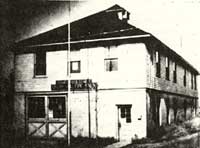 “During March and April of 1919 prayer meetings were held in the homes of various residents of the Bogota Section of Teaneck, and they met with such success and were so well attended that the homes were too small to accommodate the people, and the Fire House on Kenwood Place was secured. A service has been held weekly since then, and the attendance has surprised even the sponsors of the Chapel.
An organization known as the Trustees of the Teaneck Chapel of the Bogart Memorial Church was formed with the following officers:
| Rev. F. K. Shield, President | William Bennerscheidt |
| Charles H. Stanley, Vice President | John William Crane |
| Douglas T. Allen, Secretary | William Kinzley |
| Thomas T. Conn, Treasurer | Robert J. Lewis |
| Julian E. Batson, Financial Secretary | Oscar Lussenhop |
| William Ward |
“In June 1920, the Trustees, aided by the other organizations of the Chapel, held an open-air Carnival at Elm Avenue and Kipp Street. Conspicuous help was also rendered in the affair by various societies of the Bogart Memorial Church.
“In January 1921, a plot 100 x 150 feet was secured on the southwest corner of Elm Avenue and North Street. This is diagonally opposite the school and is easily accessible to the entire section. One thousand dollars were paid then, and there is a mortgage remaining of six hundred dollars.
“Plans and specifications having been drawn, it is now proposed to build a Chapel and Community House on this ground. It is hoped that the building can be in use by October of this year.” The time schedule was a little optimistic, but the Church was on its way.
The same 1921 program also reports on early church organizations which were already thriving. It lists the Sunday School, organized in September 1919, which by then had 160 children and met Sunday afternoons at three in the Fire House; Christian Endeavor, organized November 4, 1920, which met Thursday evenings at the Fire House; and the Women’s League, started in October 1919, which by then had 46 members.
The groundwork for a new Home and a new Church
As this early account made clear, acquisition of the Elm Ave. & North St. property and the construction of the Community House and Chapel were consummated under the direction of the Trustees of the Teaneck Chapel of the Bogart Memorial Church before our present Church was formally organized.
To finance the project, the Bogart Memorial Church temporarily lent $5,000. William N. Smith, a prominent member of that Church, contributed substantial sums himself and gave his financial backing to secure a $5,000 mortgage loan from the Bogota National Bank. Mr. Stanley made a loan of $500.
By the close of 1921 it became evident that the Teaneck Chapel of the Bogart Memorial Church had just about fulfilled its mission. Since its inception in 1919, a congregation and Sunday School had been organized and a church home built. This record of accomplishment in the space of a little over two years bespeaks the vision, dedication and industry of the pioneers of our Church. The Chapel members were now about ready to leave the protection of the Mother Church in Bogota and strike out on their own. At a meeting of the Chapel Trustees on January 12, 1922, the Rev. Mr. Shield reported that a meeting had been called for Thursday evening, January 26, 1922, for the purpose of establishing a Church under the direction of the Classis of Bergen of the Reformed Church in America.
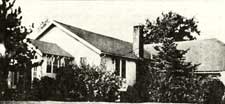 On the appointed day the Rev. Albert Von Schlieder, representing the Classis of Bergen, presided. The Rev. Mr. Shield reported that it was the desire of the people present to be organized into a church under the name of “The William N. Smith Community Church of Teaneck”. The church was then organized according to the constitution of the Reformed Church in America, with 110 Charter Members. Of these, thirty-five were received on letters from the Bogart Memorial Church; eleven on letters from other churches; and sixty-four on confession or reaffirmation of faith. Three Elders and three Deacons were elected at this meeting and at a special meeting four days later two additional Elders and two more Deacons were chosen. The Rev. Mr. Shield then reported that he had resigned as Associate Pastor of Bogart Memorial and and had been appointed as Classical Missionary of the Classis of Bergen, and that he would be able to act as “Stated Supply” (regular fill-in minister) of the new Church. This offer was promptly accepted and he was elected to serve at a salary of $1,500 per year.
At a Sunday evening service on February 26, 1922, the Rev. Andrew Walter Judson, representing the Classis of Bergen, conducted the ordination and and installation of the Church’s first Consistory.
The man behind our first name
We have already seen how William N. Smith’s financial backing helped get our Church started. He continued to support the Church generously during its early years of financial struggle and contributed $1,000 or more each year until his death in 1931. And in addition to his monetary support, he gave freely of himself in time and counsel.
Who was this strong friend? William Smith was born in Buffalo, N. Y., engaged in the paper business in New England, and then came to Bogota where he founded and became president of the Bogota Paper & Board Company. He also became a founder and president of the Bogota National Bank, and served for a time as Mayor of Bogota.
A member of Bogart Memorial, William Smith became a close personal friend of Bogart’s Associate Pastor Frederick Shield and when Mr. Shield undertook the Teaneck project, Mr. Smith gave his invaluable encouragement and support. It was Mr. Smith who first broke the ground to start construction of the Community House and Chapel on October 16, 1921. While not among the Charter Members, a few years later, on December 7, 1924, Mr. & Mrs. William N. Smith became members of the Church that bore his name.
The first sixteen years
After its jubilant start, the young Church was engaged in a rather grim financial struggle for survival for its first six or seven years. The annual expenses were about three to four thousand dollars and were met with a great deal of difficulty. At times the Consistory found it necessary to obtain short-term loans to meet pressing obligations such as the Pastor’s salary, fuel bills and the like. Little, if any money was available for debt reduction.
During the following decade, 1928 through 1937, considerable improvement was made in the Church’s financial situation. The saying “the Lord helps those that help themselves” could well have been the Community Church slogan. Definite plans were made to reduce the debt. Penny-a-meal banks were distributed to members to raise money for the mortgage fund. Year by year the mortgage at the Bogota National Bank was reduced; by the end of 1937 only $1,264 of the original $5,000 loan from the bank remained unpaid. (But the $5,000 loan from the Board of Domestic Missions of the Reformed Church, which in late 1922 had replaced the initial $5,000 advance from Bogart Memorial, was still outstanding.) The Church was also able, by special campaigns during this period, to raise enough money to expand and improve the Community House. It is note-worthy that much of this successful financing was accomplished during the Depression years.
The Trembath Era
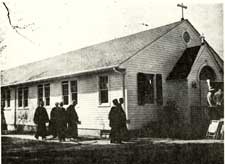 The year 1938 was a special milestone. It marked the end of the old era and the beginning of a new and more successful one. In February of that year, at the annual congregational meeting, a resolution was adopted to change the name of the Church to the “Teaneck Community Church”. At this same meeting, it was voted to request the Rev. William Carman Trembath to become the fifth pastor of the Church. The Rev. Mr. Trembath led the Church with courage and purpose, and it grew and prospered. The balance of the original bank loan was paid off in 1940. In that year the Church was enlarged by building an addition to the front end of the original Chapel which greatly increased the seating capacity. The cost of the addition, new furnishings and a new organ amounted to about $9,400. In 1942 the present parsonage was acquired for about $9,000. In 1946 the debt of $5,000 to the Board of Domestic Missions was paid off. By December 194B the mortgage on the parsonage had been liquidated, and for the first time since it started in 1922 the church was completely out of debt and had a tidy sum in its treasury.
All this time the Township of Teaneck had been growing rapidly as indicated by these Federal Census figures: 1920– 4,192; 1930– 16,513; 1940– 25,275; 1950– 33,772. As the town grew, so did the Church, its membership increasing from 110 in 1922, to 185 in 1930, 250 in 1940, and 492 in 1950. The Sunday School was also growing rapidly, increasing its membership from approximately 100 in 1922, to 287 in 1930,312 in 1940, and 405 in 1950.
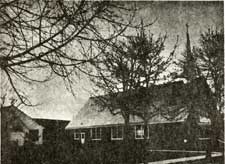 As this growth trend continued, it became increasingly apparent that existing Church facilities would soon become completely inadequate. Accordingly, consideration was given to a new and larger church building. The first major step in this direction was the purchase in November 1949 of additional land on Elm Avenue adjoining the Church’s property. In 1950 an Every Member Canvass was conducted which secured pledges in excess of $60,000 for the building fund, to be paid over a period of three years. This fund-raising drive was followed by others so that by the time construction of the new church was begun in April 1954, a total of over $100,000 was in the building fund. This was supplemented by an $80,000 mortgage loan. The total cost of the new church was approximately $215,000. The ground-breaking service for the new church was held on April 25, 1954, the corner stone-laying service on October 24, 1954, and the dedication service on February 6, 1955.
Growth continued. The name of the Church was again changed, this time to “The Community Church of Teaneck”. Mortgage payments were met as they fell due, and in addition money was available to make needed improvements in the Church plant.
Then, on November 23, 1959, the Church and the town were shocked and saddened by the sudden death of Pastor Trembath. He had served his congregation faithfully and well for twenty-one years. The following editorial which appeared in Teaneck’s local newspaper expressed the feelings of the entire community.
“A man familiar to many Teaneck residents, a fine churchman and a friend to those who needed him, died in Teaneck on Monday. His name was William Carman Trembath, and he was pastor of the Community Church of Teaneck.
“Many people, including members of the Sunday Sun staff, used to enjoy a chat with this remarkable man. He seemed to be one of those rare persons who never show age. But despite this, a heart attack Monday took him suddenly from his congregation in Teaneck.
“It seems a small tribute to a man so well loved as Rev. Trembath to print some faint eulogy on the editorial page of a newspaper. His thoughts and deeds were living ones dedicated to a child, a mother, a mourning husband, to one thousand and one troubled souls who came to him in need. A newspaper’s words may be forgotten with the rush of the next day’s events but a life of service sticks in the mind.
“We hope that when readers forget this small editorial, they will still remember warmly the fatherly man who served them for 21 years. We hope his thoughts will live to in- spire the young members of his congregation and to com- fort the older ones. And we hope that Teaneck in some concrete way remembers the life and works of William Carman Trembath, Pastor.”
Into the Present
In September 1960 the Church installed its present Pastor, the Rev. Harold G. Van Oort. Much further progress has been made in strengthening the Church to meet the challenge of a new era. On Sunday night, December 6, 1962, in the Church’s fortieth anniversary year, a covered dish supper was held to celebrate completion of mortgage payments on the new Church building. The mortgage was formally “burned” on May 7, 1963.
Various major improvements included bricking the front and side of the North Room along with rebuilt roof and ceiling in 1962 and aluminum siding for the Chapel in 1967. In May 1967 the congregation approved a $15,000 program to provide badly needed new Church School and Choir facilities by remodeling the old Chapel and the South Room underneath it. Six church school rooms were created out of the South Room while the Chapel was divided into a music room, another church school room, and a smaller re- modeled Chapel. The project was completed in March 1968.
Meantime, the Church moved through various cycles in ministerial assistants. In the Spring of 1959, Marilyn Spackman, who had briefly served as a student assistant, was engaged as Director of Christian Education with responsibility for the Church School and Youth Work. Miss Spackman became Mrs. Muller in October 1961 and resigned her position the following Spring.
The Consistory then decided to add wider pastoral responsibilities to the school and youth program supervision and in May 1962 arranged for Ronald W. La Rose first, to become a Student Assistant and then Assistant. In September 1963 the Consistory took an even bigger step by providing in the next year’s budget for an Associate Pastor. Rev. Clement Birkelbach was called as Associate Pastor in July 1964. He served five fruitful years, with special emphasis on an effective youth program. Since his resignation in the Summer of 1969, the Church has again resorted to student ministers.
The past few years have not been easy ones for the Churches of America. . . or indeed for most Americans and their institutions. After the tremendous growth of the past quarter century, church membership throughout the country has become static and in many places has receded a bit. A town like Teaneck is especially vulnerable to these trends. The huge influx of the postwar years has come to an end as nearly all available land is occupied. And not only has total population just about stopped growing, the proportion of residents who profess Protestant faiths has declined.
These trends have affected the rolls of the Community Church. Total membership which reached a peak of 785 in 1960, is now 450; the Church School actually had its biggest enrollment way back in 1945 with 416 and now has 150; Congregational giving which peaked at $77,483 in 1965 has slimmed to $62,446 in 1971.
Of course, when surrounded by the mountains of near-term concern, it is easy to lose sight of the long-term perspective, and as we look back on the humble beginnings of 50 years ago, the story is one of majestic growth in size, strength and magnificent facilities for service. And under changed conditions, the Church and its members can again draw inspiration from the stories of those early days when the infant Community Church struggled to stay financially alive during the generally “Boom1ng Twenties” and moved forward with new strength in the midst of the Depression.
The life, spirit and dedication of today’s Congregation is real and deep. Our members spend many hours and considerable energy in leadership roles in the Consistory, in the Church School, in youth work, in the Women’s Guild and Circles. Our Co-Weds retain their energy and enthusiasm as a fellowship and service group, and successfully attract new couples.
Our Youth Groups continue strong and active. The Consistory is increasingly studying and engaging in ecumenical ministry with other churches and synagogues of the community.
The Church has experimented with small home discussion and fellowship groups with some success. A Sunday evening group has maintained a high level of participation and interest. A parent’s group for parents of elementary-age children is currently being organized.
Our Congregation has manifested a deepened commitment to the mission of the church beyond our own Congregation, as expressed in the substantial benevolent commitment of the resources of our Church. We continue to invest more than 25% of our total resources to mission.
The Congregation’s commitment to a community ministry is reflected by the use of our physical facilities. The Church houses a large and active Senior Citizen’s group, a youth Square Dance club, a Cancer Care chapter, a pre- kindergarten school, Boy and Girl Scout troops and other activities too numerous to mention.
Truly, the role of the Community Church continues to be that which was so aptly described in the Township of Teaneck’s own commemorative brochure on “Forty Years of Progress,” published on Teaneck’s 40th birthday in 1935:
“The Church had its beginning as a community project and has sought to maintain during all its years the ideal of being a Neighborly Community Church’.”
And, of course, The Community Church of Teaneck was officially organized. But its roots go back several years further. And to understand these beginnings, we must take a look at the unusual kind of municipality Teaneck was in those days.
Teaneck at the start of the Twenties
What was to become the largest community in Bergen County was still a very small town then. The Federal Census of 1920 showed a population of 4,192. It was to quadruple in the next decade and today, of course, it is more than ten times as big.
But what really marked the community in those days was that it wasn’t much of a cohesive community at all. That’s because most of the population was located in outlying areas adjacent to neighboring towns and in many ways felt closer kinship to those towns than to their fellow inhabitants of Teaneck.
The central area of Teaneck was comparatively undeveloped, largely because much of it was part of the Phelps Estate which centered around today’s Municipal Building. (And along Queen Anne Road was a big hayfield.) The widow of William Walter Phelps died in 1920 and then two years later in June 1922, just five months after our Church was formally born, the Bergen County newspapers proclaimed the big news of the region: “Phelps Estate to be opened to development.” Only after that did the center of today’s town slowly take shape.
Teaneck’s dispersed population pattern at the time the Church was being formed is well illustrated by the locations of the three public schools and four volunteer fire companies that were in existence in 1922. The West Englewood section of Teaneck, adjacent to Englewood, was served by the original Washington Irving School (now the Town House) which was completed in 1906, and by Volunteer Fire Company #1, organized in 1904, also located at Teaneck Road and Forest Avenue.
Then there was the section known as Lower Teaneck, next to Ridgefield Park and Bogota, which was served by the Longfellow School on Oakdene Avenue, completed in 1910, and by Teaneck Hose Company #1, Morningside Terrace, organized in 1911. A little further east in the Glenwood Park section, the Glenwood Park Volunteer Fireman’s Association was also organized in 1911.
Finally, there was the section in which our Church is located, which quite logically was known as the Bogota Section of Teaneck. Actually, it was the first part of town where real building activity developed. The area was served by the Emerson School, completed in 1916, and by the Cedar Volunteer Fireman’s Association, organized in 1908. The Fire Company was first located in the barn of Joseph Douglas on Linden Avenue and set up in its fire house in Kenwood Place in 1912.
Our Church’s Community
Let’s take a closer look at the Bogota Section as it was around 1920. We find the people more closely connected with Bogota than with Teaneck. Mail was delivered from the Bogota Post Office. Commuters used the Bogota railroad stations. Water was supplied by the Bogota Water Company. The principal shopping center was Main Street and Fort Lee Road, Bogota (Cedar Lane had not yet developed into a shopping district). People did their banking in Bogota, the only financial institution in Teaneck being the Teaneck Building & Loan Association. (The West Englewood National Bank, far from our area anyway, opened in 1923; the Teaneck National Bank, which has since become the Peoples Trust branch, didn’t arrive till 1926.)
And, as might be expected, most residents of the Bogota Section also went to church in Bogota. Quite a few were members of the Bogart Memorial Church there.
At that time the automobile had not as yet achieved the status of a necessity; walking was still a fairly common means of locomotion. However, it was quite a long trek from Teaneck down to Bogota to attend church services, prayer meetings and Sunday School, especially for the children and older people and particularly when the weather was bad. And so, early in 1919, some of the residents got together and began holding prayer meetings in their homes. These prayer meetings led to the formation of the Teaneck Chapel of the Bogart Memorial Church.
The story of the Teaneck Chapel is told in what was undoubtedly the first published history concerning our Church. It appeared in the program for a play given by the local people for the benefit of the Chapel on June 10, 1921. Since it is an authoritative account of the very beginning of our Church, we reprint it here.
History of The Teaneck Chapel
“During March and April of 1919 prayer meetings were held in the homes of various residents of the Bogota Section of Teaneck, and they met with such success and were so well attended that the homes were too small to accommodate the people, and the Fire House on Kenwood Place was secured. A service has been held weekly since then, and the attendance has surprised even the sponsors of the Chapel.
An organization known as the Trustees of the Teaneck Chapel of the Bogart Memorial Church was formed with the following officers:
Rev. F. K. Shield, PresidentWilliam BennerscheidtCharles H. Stanley, Vice PresidentJohn William CraneDouglas T. Allen, SecretaryWilliam KinzleyThomas T. Conn, TreasurerRobert J. LewisJulian E. Batson, Financial SecretaryOscar LussenhopWilliam Ward
“In June 1920, the Trustees, aided by the other organizations of the Chapel, held an open-air Carnival at Elm Avenue and Kipp Street. Conspicuous help was also rendered in the affair by various societies of the Bogart Memorial Church.
“In January 1921, a plot 100 x 150 feet was secured on the southwest corner of Elm Avenue and North Street. This is diagonally opposite the school and is easily accessible to the entire section. One thousand dollars were paid then, and there is a mortgage remaining of six hundred dollars.
“Plans and specifications having been drawn, it is now proposed to build a Chapel and Community House on this ground. It is hoped that the building can be in use by October of this year.” The time schedule was a little optimistic, but the Church was on its way.
The same 1921 program also reports on early church organizations which were already thriving. It lists the Sunday School, organized in September 1919, which by then had 160 children and met Sunday afternoons at three in the Fire House; Christian Endeavor, organized November 4, 1920, which met Thursday evenings at the Fire House; and the Women’s League, started in October 1919, which by then had 46 members.
The groundwork for a new Home and a new Church
As this early account made clear, acquisition of the Elm Ave. & North St. property and the construction of the Community House and Chapel were consummated under the direction of the Trustees of the Teaneck Chapel of the Bogart Memorial Church before our present Church was formally organized.
To finance the project, the Bogart Memorial Church temporarily lent $5,000. William N. Smith, a prominent member of that Church, contributed substantial sums himself and gave his financial backing to secure a $5,000 mortgage loan from the Bogota National Bank. Mr. Stanley made a loan of $500.
By the close of 1921 it became evident that the Teaneck Chapel of the Bogart Memorial Church had just about fulfilled its mission. Since its inception in 1919, a congregation and Sunday School had been organized and a church home built. This record of accomplishment in the space of a little over two years bespeaks the vision, dedication and industry of the pioneers of our Church. The Chapel members were now about ready to leave the protection of the Mother Church in Bogota and strike out on their own. At a meeting of the Chapel Trustees on January 12, 1922, the Rev. Mr. Shield reported that a meeting had been called for Thursday evening, January 26, 1922, for the purpose of establishing a Church under the direction of the Classis of Bergen of the Reformed Church in America.
On the appointed day the Rev. Albert Von Schlieder, representing the Classis of Bergen, presided. The Rev. Mr. Shield reported that it was the desire of the people present to be organized into a church under the name of “The William N. Smith Community Church of Teaneck”. The church was then organized according to the constitution of the Reformed Church in America, with 110 Charter Members. Of these, thirty-five were received on letters from the Bogart Memorial Church; eleven on letters from other churches; and sixty-four on confession or reaffirmation of faith. Three Elders and three Deacons were elected at this meeting and at a special meeting four days later two additional Elders and two more Deacons were chosen. The Rev. Mr. Shield then reported that he had resigned as Associate Pastor of Bogart Memorial and and had been appointed as Classical Missionary of the Classis of Bergen, and that he would be able to act as “Stated Supply” (regular fill-in minister) of the new Church. This offer was promptly accepted and he was elected to serve at a salary of $1,500 per year.
At a Sunday evening service on February 26, 1922, the Rev. Andrew Walter Judson, representing the Classis of Bergen, conducted the ordination and and installation of the Church’s first Consistory.
The man behind our first name
We have already seen how William N. Smith’s financial backing helped get our Church started. He continued to support the Church generously during its early years of financial struggle and contributed $1,000 or more each year until his death in 1931. And in addition to his monetary support, he gave freely of himself in time and counsel.
Who was this strong friend? William Smith was born in Buffalo, N. Y., engaged in the paper business in New England, and then came to Bogota where he founded and became president of the Bogota Paper & Board Company. He also became a founder and president of the Bogota National Bank, and served for a time as Mayor of Bogota.
A member of Bogart Memorial, William Smith became a close personal friend of Bogart’s Associate Pastor Frederick Shield and when Mr. Shield undertook the Teaneck project, Mr. Smith gave his invaluable encouragement and support. It was Mr. Smith who first broke the ground to start construction of the Community House and Chapel on October 16, 1921. While not among the Charter Members, a few years later, on December 7, 1924, Mr. & Mrs. William N. Smith became members of the Church that bore his name.
The first sixteen years
After its jubilant start, the young Church was engaged in a rather grim financial struggle for survival for its first six or seven years. The annual expenses were about three to four thousand dollars and were met with a great deal of difficulty. At times the Consistory found it necessary to obtain short-term loans to meet pressing obligations such as the Pastor’s salary, fuel bills and the like. Little, if any money was available for debt reduction.
During the following decade, 1928 through 1937, considerable improvement was made in the Church’s financial situation. The saying “the Lord helps those that help themselves” could well have been the Community Church slogan. Definite plans were made to reduce the debt. Penny-a-meal banks were distributed to members to raise money for the mortgage fund. Year by year the mortgage at the Bogota National Bank was reduced; by the end of 1937 only $1,264 of the original $5,000 loan from the bank remained unpaid. (But the $5,000 loan from the Board of Domestic Missions of the Reformed Church, which in late 1922 had replaced the initial $5,000 advance from Bogart Memorial, was still outstanding.) The Church was also able, by special campaigns during this period, to raise enough money to expand and improve the Community House. It is note-worthy that much of this successful financing was accomplished during the Depression years.
The Trembath Era
The year 1938 was a special milestone. It marked the end of the old era and the beginning of a new and more successful one. In February of that year, at the annual congregational meeting, a resolution was adopted to change the name of the Church to the “Teaneck Community Church”. At this same meeting, it was voted to request the Rev. William Carman Trembath to become the fifth pastor of the Church. The Rev. Mr. Trembath led the Church with courage and purpose, and it grew and prospered. The balance of the original bank loan was paid off in 1940. In that year the Church was enlarged by building an addition to the front end of the original Chapel which greatly increased the seating capacity. The cost of the addition, new furnishings and a new organ amounted to about $9,400. In 1942 the present parsonage was acquired for about $9,000. In 1946 the debt of $5,000 to the Board of Domestic Missions was paid off. By December 194B the mortgage on the parsonage had been liquidated, and for the first time since it started in 1922 the church was completely out of debt and had a tidy sum in its treasury.
All this time the Township of Teaneck had been growing rapidly as indicated by these Federal Census figures: 1920– 4,192; 1930– 16,513; 1940– 25,275; 1950– 33,772. As the town grew, so did the Church, its membership increasing from 110 in 1922, to 185 in 1930, 250 in 1940, and 492 in 1950. The Sunday School was also growing rapidly, increasing its membership from approximately 100 in 1922, to 287 in 1930,312 in 1940, and 405 in 1950.
As this growth trend continued, it became increasingly apparent that existing Church facilities would soon become completely inadequate. Accordingly, consideration was given to a new and larger church building. The first major step in this direction was the purchase in November 1949 of additional land on Elm Avenue adjoining the Church’s property. In 1950 an Every Member Canvass was conducted which secured pledges in excess of $60,000 for the building fund, to be paid over a period of three years. This fund-raising drive was followed by others so that by the time construction of the new church was begun in April 1954, a total of over $100,000 was in the building fund. This was supplemented by an $80,000 mortgage loan. The total cost of the new church was approximately $215,000. The ground-breaking service for the new church was held on April 25, 1954, the corner stone-laying service on October 24, 1954, and the dedication service on February 6, 1955.
Growth continued. The name of the Church was again changed, this time to “The Community Church of Teaneck”. Mortgage payments were met as they fell due, and in addition money was available to make needed improvements in the Church plant.
Then, on November 23, 1959, the Church and the town were shocked and saddened by the sudden death of Pastor Trembath. He had served his congregation faithfully and well for twenty-one years. The following editorial which appeared in Teaneck’s local newspaper expressed the feelings of the entire community.
“A man familiar to many Teaneck residents, a fine churchman and a friend to those who needed him, died in Teaneck on Monday. His name was William Carman Trembath, and he was pastor of the Community Church of Teaneck.
“Many people, including members of the Sunday Sun staff, used to enjoy a chat with this remarkable man. He seemed to be one of those rare persons who never show age. But despite this, a heart attack Monday took him suddenly from his congregation in Teaneck.
“It seems a small tribute to a man so well loved as Rev. Trembath to print some faint eulogy on the editorial page of a newspaper. His thoughts and deeds were living ones dedicated to a child, a mother, a mourning husband, to one thousand and one troubled souls who came to him in need. A newspaper’s words may be forgotten with the rush of the next day’s events but a life of service sticks in the mind.
“We hope that when readers forget this small editorial, they will still remember warmly the fatherly man who served them for 21 years. We hope his thoughts will live to in- spire the young members of his congregation and to com- fort the older ones. And we hope that Teaneck in some concrete way remembers the life and works of William Carman Trembath, Pastor.”
Into the Present
In September 1960 the Church installed its present Pastor, the Rev. Harold G. Van Oort. Much further progress has been made in strengthening the Church to meet the challenge of a new era. On Sunday night, December 6, 1962, in the Church’s fortieth anniversary year, a covered dish supper was held to celebrate completion of mortgage payments on the new Church building. The mortgage was formally “burned” on May 7, 1963.
Various major improvements included bricking the front and side of the North Room along with rebuilt roof and ceiling in 1962 and aluminum siding for the Chapel in 1967. In May 1967 the congregation approved a $15,000 program to provide badly needed new Church School and Choir facilities by remodeling the old Chapel and the South Room underneath it. Six church school rooms were created out of the South Room while the Chapel was divided into a music room, another church school room, and a smaller re- modeled Chapel. The project was completed in March 1968.
Meantime, the Church moved through various cycles in ministerial assistants. In the Spring of 1959, Marilyn Spackman, who had briefly served as a student assistant, was engaged as Director of Christian Education with responsibility for the Church School and Youth Work. Miss Spackman became Mrs. Muller in October 1961 and resigned her position the following Spring.
The Consistory then decided to add wider pastoral responsibilities to the school and youth program supervision and in May 1962 arranged for Ronald W. La Rose first, to become a Student Assistant and then Assistant. In September 1963 the Consistory took an even bigger step by providing in the next year’s budget for an Associate Pastor. Rev. Clement Birkelbach was called as Associate Pastor in July 1964. He served five fruitful years, with special emphasis on an effective youth program. Since his resignation in the Summer of 1969, the Church has again resorted to student ministers.
The past few years have not been easy ones for the Churches of America. . . or indeed for most Americans and their institutions. After the tremendous growth of the past quarter century, church membership throughout the country has become static and in many places has receded a bit. A town like Teaneck is especially vulnerable to these trends. The huge influx of the postwar years has come to an end as nearly all available land is occupied. And not only has total population just about stopped growing, the proportion of residents who profess Protestant faiths has declined.
These trends have affected the rolls of the Community Church. Total membership which reached a peak of 785 in 1960, is now 450; the Church School actually had its biggest enrollment way back in 1945 with 416 and now has 150; Congregational giving which peaked at $77,483 in 1965 has slimmed to $62,446 in 1971.
Of course, when surrounded by the mountains of near-term concern, it is easy to lose sight of the long-term perspective, and as we look back on the humble beginnings of 50 years ago, the story is one of majestic growth in size, strength and magnificent facilities for service. And under changed conditions, the Church and its members can again draw inspiration from the stories of those early days when the infant Community Church struggled to stay financially alive during the generally “Boom1ng Twenties” and moved forward with new strength in the midst of the Depression.
The life, spirit and dedication of today’s Congregation is real and deep. Our members spend many hours and considerable energy in leadership roles in the Consistory, in the Church School, in youth work, in the Women’s Guild and Circles. Our Co-Weds retain their energy and enthusiasm as a fellowship and service group, and successfully attract new couples.
Our Youth Groups continue strong and active. The Consistory is increasingly studying and engaging in ecumenical ministry with other churches and synagogues of the community.
The Church has experimented with small home discussion and fellowship groups with some success. A Sunday evening group has maintained a high level of participation and interest. A parent’s group for parents of elementary-age children is currently being organized.
Our Congregation has manifested a deepened commitment to the mission of the church beyond our own Congregation, as expressed in the substantial benevolent commitment of the resources of our Church. We continue to invest more than 25% of our total resources to mission.
The Congregation’s commitment to a community ministry is reflected by the use of our physical facilities. The Church houses a large and active Senior Citizen’s group, a youth Square Dance club, a Cancer Care chapter, a pre- kindergarten school, Boy and Girl Scout troops and other activities too numerous to mention.
Truly, the role of the Community Church continues to be that which was so aptly described in the Township of Teaneck’s own commemorative brochure on “Forty Years of Progress,” published on Teaneck’s 40th birthday in 1935:
“The Church had its beginning as a community project and has sought to maintain during all its years the ideal of being a Neighborly Community Church’.”
The Ministry of Music
From the first, our Church has been proud of its music ministry. Initially, a group led by Elder & Mrs. William Ward sang as a choir at Sunday morning services. For the evening services, a group of young women joined with the Wards to lead the singing. Some of the early organists were Mrs. Frederick Shield, Mr. Arthur Mayer, Mrs. Munroe Hamill and Mrs. Kenneth Erskine.
In 1932 Mr. Leslie Wilkinson was named organist and he organized the Chancel Choir. Four years later Miss Edith Reis took over as organist and choir director. In 1942 Fred C. Ottignon became the organist and choir director and served for sixteen distinguished years.
Meantime the youth movement came to the Church’s musical life when Mrs. George Russell and Mrs. Kenneth Brown led the establishment of the Primary Choir in 1949. The enthusiastic response soon led to the start of a Junior Choir and the next year a youth choir for the Junior High level was added. This work has been continued by enthusiastic and talented volunteers to the present day.
Nelson M. Doescher came to take over when Fred Ottignon left in 1958 and further expanded the music ministry. When he decided to retire in early 1964, William Gilmer was chosen as organist and choir director. He continues to lead us in music today. Under Mr. Gilmer’s energetic direction, the Church, with its own choir, supplemented by other church choirs and outside artists, presented a gala “Messiah” in the 1965 Christmas season. The Handel masterpiece was repeated the following two years.
 There was recently presented to Christ Church a framed copy of an article appearing in the Interboro Review in September, 1915. This reprint has been given by Mr. Frank Longeway who was a member of the Building Committee and of the original Executive Board of the church. It is thought that the following from this reprint will be of interest to many:
“The opening ceremonies of the beautiful new Christ Church, recently completed and situated at the northwest corner of Rutland Avenue and Rugby Road, West Englewood, will be held Sunday, Oct. 1, at 4 p.m.
“In the fall of 1913, a number of the residents started the church movement by having services in the various homes bi-monthly. The first service was held at the home of Mr. and Mrs. Arthur F. Edeny, on Ogden Avenue. For over a year, Rev. Dr. Fleming James, Rector of St. Paul’s church, Englewood, gave his services and built up the interest, after which Rev. Carl Stridsberg took up the work and organized the present Christ Church. Rev. Stridsberg has greatly endeared himself to the people of West Englewood, who have rallied around him and together have carried forward the work resulting in the edifice to be opened next Sunday. The committee who had charge of the erection of the church building consisted of M. Sheldon Smith, chairman, Fairchild N. Ferry, Frank Longeway, Arthur E. Edney, Ronald W. Thorn, George W. Thurlby, William McNaughton and Z. D. Race. The architect was Frederick Brendel, and the contractor James L. Curray.
“in the purchase of the land and the erection of the church come in for a large portion of commendation. The ladies have worked faithfully, holding from time to time, fairs, suppers and social functions, all of which have been loyally supported and from which they derived considerable money. On a number of occasions they have cheerfully turned money over to the church treasurer to add to the building fun. The first president of the Ladies’ Guild was Mrs. Frederick Lane, who was succeeded by Mrs. C. L. Thorn, and she in turn by Mrs. E. J. Kuhn, the present incumbent.
“Altogether Christ Church stands as a monument for the earnest efforts of its faithful members, and will be one of the important factors in a good and wholesome upbuilding of West Englewood.”
Since that time, the Church has grown tremendously and there has been built the Church Community House, adjoining, and the rectory. The Rev. Carl Stridsberg was called from Christ Church to Cincinnati, Ohio, in 1924. He was succeeded by the Rev. Percy G. Hall who served until 1925. The present rector, the Rev. Wm. K. Russell, came in the spring of 1926. The present members of the Vestry of Christ Church are as follow:
Messrs. George W. Lebeckand Norman K. Althause, Wardens; and Messrs. C. deC. Brower, Raymond G. Ankers, Leland F. Ferry, George W. Thurlby, Edwin H. Hastings, Edgar P. Hildreth, Horace A. Johnson, Fred T. A. McLeod and Edward Raque.
St. Paul’s Lutheran Church of Teaneck, one of the newer churches of the town became a self-supporting congregation on January 1, 1932. After six years under the guidance of the Board of American Missions of the United Lutheran Church this congregation has grown to the extent where it was able to assume its own obligations.
In the early winter of 1926 about twenty-five residents of the town began holding services in a prevate home with the intention of organizing themselves into a Lutheran Church. The property on Church Street and Beaumont Avenue was purchased in March of the same year, but was not occupied until the arrival of the new pastor, the Rev. Charles W. Schnabel who at the time was a senior in Hamma Divinity School of Springfield, O. Upon his arrival on the 15th day of May services were held in the house now occupied by him as his home.
From this small beginning the congregation has grown to almost 400 and a Sunday School enrollment of 429. Societies were organized within the church, the Ladies Aid Society being the first. Later a Men’s Club, Young Men’s Club, Senior Choir, Girl’s Club and Boys’ Club were organized. Each of these organizations have been active in the life of the church and have made a definite contribution to the welfare of the church and to its own members.
The present building of St. Paul’s was erected during the summer of 1928 and formally dedicated the first Sunday in October of that same year. Although at the time of its erection its size was adequate the growing church and Sunday School have overcrowded it.
The present Church Council is composed of the following members: Albert C. Mau, residents’ Henry C. Benzenberg, vice president; Bernhrad A. Bernstorf, secretary; William Hensen, treasurer; Christ Gebelein, financial secretary; I. U. Kershner, Henry J. Sattler, Fred C. Baser, William H. Hendess, George A. Schlobohm, Fred W. Hoffman and Peter F. Martens.
At the recent meeting of the Church Council ti was voted to continue the regular Sunday Services during the month of July and the first two Sundays in August. There will be no service the last two Sundays in August and the First Sunday in September. Sunday School is conducted every Sunday morning at 9:30 and the Service is held at 11 o’clock. Although the Lutheran Church is conservative in its teachings and formal in its liturgy St. Paul’s Church welcomes all those who would come to worship. The seats are free and the people are friendly.
Source: The Record , Thursday, May 4, 1972
By Jo Schaffer, staff writer

 A country life frame chapel and the adjoining modern brick building — one topped with a simple white cross, the other with a tail steeple — show the progress of the Community Church of Teaneck since 1922.
But it’s the 325 people gathering tonight to celebrate its 50th anniversary that tell the real story of the church.
The chapel, now just a portion of the much larger, more modern structure, is a little like the people who started it — comfortable and charming, but fast-paced, functional world of today.
“It was our whole life at that time; it was everything to us,” says Mrs. Ethel Ward of the early church days.
Mrs. Ward, and four other charter members of the Community Church — a reformed Church in America — will be among the guests celebrating the church’s anniversary at a dinner at Innwood Manor. A sixth charter member, Edwin Jacobsen, is hospitalized and unable to attend.
The others are Mrs. Helen Beckley Lee, Mrs. Walter Graham, Charles Germann, and Nels Johnson.
The dinner is the most formal event of the Church’s year-long celebration. Retired couples living in places like Leisure Village will return for the dinner with old friends.
There were 110 charter members and the current pastor, the rev. Harold Van Oort, says their early efforts were years of struggle.
But the members seems to remember it more as a time of shared work and pleasure.
“In those days, it was a mutual friendship meeting,” says Germann.
If one worshiper was missing from a service, the entire congregation would be concerned for his health, Germann recalls. Now, he says he doesn’t know half of the 500 members.
The Community Church was just that what it started; a group of Teaneck neighbors, members of one of the township’s outlying communities, many of them worshippers at the Bogart Memorial Church in Bogota.
The neighbors in the Elm Avenue area were closer to Bogota than to some of their fellow residents across town — which is those days meant across farmlands. Even their mail was sent through Bogota. So it was no unusual for the people to attend church in the next town.
Moved to firehouse
But in 1919, the Rev. F. K. Shield began conduction prayer meetings in private homes in the area. Soon the meetings outgrew private living rooms, and the group moved to the second floor of the Kenwood Place firehouse.
In the summer of 1921, the members raised $1,000 to purchase a piece of land for their church. That was the beginning.
 From the firehouse, the members moved to a community house and, later, into the chapel which over the years was expanded several times and was finally moved in 1955 to make room for the new building.
In a Golden Jubilee booklet, 1922 — the year the church was organized — is described: “It was the year Mussolini marched on Rome and led the Fascists to power in Italy…. Warren Harding was President of the United States… Mrs. Rebecca Felton of Georgia became the first woman to be a U. S. Senator … and in Teaneck carnivals were outlawed by an ordinance against traveling shows….”
Now, 50 years later, the old neighborhood church which grew up during the Depression faces some of the problems of modern times.
The membership, which reached its peak of 750 10 years ago, is down to about 500. But fortunately, says Mr. Van Oort, financial contributions haven’t declines in proportion to the membership.
Young married and retired couples are the age groups that are the biggest loss to the church. People who grow up in the church tend to move away after college, says Mr. Van Oort, and the older people leave for more inexpensive living elsewhere.
“It’s the age of mobility,” says the pastor.
Meanwhile fewer Protestants are moving into the old houses in the neighborhood, which partially accounts for the declining membership. But Mr. Van Oort sees no serious problem in the near future.
But older members like Mrs. Ward seem to wonder. Asked what she thinks has changed the most over the years, she ponders a long while and finally answers, “Just about everything.”
Source: 75 anniversary of the Trinity Evangelical Free Church — Pamphlet from the Teaneck collection of Teaneck Public Library.

Seventy-five years of Christian service is an achievement well worthy of a fitting celebration. It is with this in mind that our church has decided to celebrate its Diamond Jubilee. Our first desire is to “GIVE GOD THE GLORY” for many manifold blessings and marvelous guidance during these many years. We also wish to acquaint our younger people with the rich heritage that is theirs and ours for the achievements, God permitted, through faithful Pastors and members of the church down through the years.
 We are grateful to God and pay tribute to each one who gave of their talents, time and of their means so the Gospel in fullness and purity could be proclaimed from the pulpit at home and overseas. According to the records, each minister came at the right time, and led of the Lord, and proved to be used of Him in proportion to length of service. Only eternity will reveal in full what has been accomplished. It is undoubtedly true that there are more members in Heaven than we have on the rolls today.
The history of our church dates back to October 27, 1889, when a few friends met in the home of Rev. J. H. Meyer at 37 Garden Street, Hoboken, to discuss the possibility of establishing a Christ tan Witness among the Scandinavian people in the Hoboken, New Jersey area.
With the 23 people present, a Mission Society was established. Regular meetings were held in a Methodist Church between Newark and First Streets and subsequently in a Baptist Church at Second and Clinton Streets.
On February 26, 1890, this group became known as “The Norwegian Evangelical Congregational Mission Society”. Times were difficult and the group was hard pressed to carryon the work. At a meeting of this society held the 23rd of April, 1890, Rev. Meyer proposed that the group be re-organized as a regular church body, on Biblical principles. As a result on the 16th of May, 1890, the congregation was organized under the name of the “The Norwegian Congregational Church of Hoboken, N. J.” and consisted of the following sixteen members:
Rev. & Mrs. J. H. Meyer, Mr. & Mrs. D. Bjorkman, Mr. P. Bentsen, Miss M. Eklund, Mrs. Jansen, Mr. Kristensen, Mr. E. Lund, Mr. & Mrs. O. B. Larsen, Mr. & Mrs. O. Larsen, Mr. & Mrs. L. Larsen, Miss Meyer. Many sacrifices were made by Pastor and congregation resulting in a more effective ministry being established.
The congregation soon realized the advantages and the need o fits own place of worship. A lot was purchased at 512 Willow Ave. for $1,690. Construction of a new building started and on August 17, 1890, the corner stone was laid and church dedicated and put in use Dec. 20, 1890. The building seated 125 persons and had living quarters for the Pastor. The building was constructed for about $7000. The Lord blessed the work and souls were saved. Rev. Meyer terminated his ministry in 1892 and a call was extended to A. C. Tychesen a student in Chicago Theological Seminary. He began his ministry August 14, 1892. He was subsequently ordained and served faithfully and effectively for five years.
He was succeeded by Rev. J. H. Pedersen who was a capable under-shepherd and proved a real blessing during his Pastorate, serving from December 2, 1897 to May 13, 1900.
Rev. A. I. Anthony then became Pastor and was used of the Lord from May 18, 1900 to May 19, 1902.
Rev. Morton Olsen became the next Pastor. He served from June 1, 1902 to December 25, 1904. Many souls were saved during his ministry as well, among them was Rev. C. T. Dyrness.
Rev. Charles Nilsen began his faithful ministry in January of 1905 and served until December 3, 1907.
On March 15, 1907, Rev. E. Brekhus came to serve as Pastor of the church in Hoboken and of the Free Church group started in Union Hill. Pastor Brekhus terminated his ministry Dec. 31, 1908.
Rev. John A. Nilsen was then called and he assumed pastoral duties August 1, 1909. During his ministry the congregation voted to make a change in church location. By this time a stone building had been erected on the one side of the church and a factory on the other. The factory was in daily operation and caused considerable disturbance with noise and dust making it undesirable to continue there. Much praying and planning was done by Pastor and congregation regarding the future of the work. After 22 years of worship in their first church, the building was sold to the factory owners for $12,000.00 on July 1, 1912, and the last meeting was held there on July 7th.
 Property was then secured on the corner of 13th Street and Willow Avenue. Construction of a building began shortly after. The cornerstone was laid with Pastor Nilsen officiating on March 30, 1913. Participating in this program were Rev. C. T. Dyrness, Rev. N. W. Nelson and Rev. O. Thompsen. The facilities of the High School on 6th Street and Park Avenue were used during this construction period until the building’s lower auditorium could be used. This first meeting took place August 17, 1913.
The building was completed and the dedication of it was held October 12 that same year. In attendance and participating in the service of dedication were: Rev. W. Caroll, Rev.O. M. Jonswold, Rev. O. O. Sanes, Rev. R. A. Jernberg and Rev. J. H. Nilsen. The church auditorium could seat about 250 people and was constructed at a cost of about $18,300. The work progressed spiritually and in numbers during Rev. Nilsen’s ministry. He terminated his Pastorate March 31, 1914.
Rev. E. N. Reiersen was then extended a call which he accepted and became the under-shepherd of the flock May 3, 1914. He served with warmth of spirit and faithfulness for 13 years. During his ministry, a work was beginning to be established in Teaneck, New Jersey. On Feb. 18, 1920, regular services were started in this area with meetings held in various homes until May of 1922. Space was then rented in the old firehouse on Fairview Ave. where the work carried on.
 A little church on Teaneck Road near Hillside Avenue was purchased as an Annex on September 15, 1924. Sunday School and regular meetings were carried on under the auspices of the Hoboken church. Meetings were carried on in both places every week. The friends in Teaneck were very faithful and made many sacrifices in these early days. After Rev. Reiersen terminated his ministry February 6, 1927, Rev. J. J. Breidablik came as interim pastor of the Hoboken Church and in Teaneck. In August of 1928, the work was organized as a Mission Society. This Society was subsequently pastored by Rev. O. O. Sande, Rev. Helmer Anderson and Rev. E. M. Anderson for comparatively short periods of time, but with much blessing.
When Rev. Reiersen left, a call was extended to Rev. H. C. Anderson to become Pastor of the Hoboken church. He accepted and began his pastorate April 10, 1927. The Lord blessed his ministry. The work grew and a very active program was carried on by Pastor and congregation. Some of the members were moving further away from the Hoboken area and much thought was given to obtaining a new location for the church. Suggestions were made of North Bergen, Cliffside Park or Grantwood, or Teaneck. The latter seemed too far away so the membership decided on either North Bergen or Cliffside Park.
 Tent meetings were conducted during the summer months in these areas, and the Lord blessed with the salvation of many souls. In 1928 property was purchased on the corner of Glen and Nelson Avenues in Grantwood (Cliffside Park, N. J.) with the thought that should the Lord so lead, this might be the future sight for the work.
It soon became apparent that the work of the church would best be served by a merger with the Mission Society of Teaneck. This matter was prayerfully considered and duly voted upon in both places and a merger took place in October of 1932. The church building in Hoboken and the property in Grantwood was sold and the Annex in Teaneck was enlarged that same year to house the congregation.
An effective radio ministry was started by Pastor Anderson, February 1, 1931, broadcasting Norwegian Gospel programs weekly over Station W.K.B.O. on Sunday afternoons. It was then changed to Station W.H.O.M. with 9 broadcasts per week until October of 1936.
With immigration from Norway practically at a stand-still and with the children and young people of the church desiring to hear the Gospel preached in their own language, it was unanimously decided, after much prayerful and friendly deliberation, to conduct all services in the English language. The name of the church was changed to “The Trinity Evangelical Free Church of Teaneck, N. J.”.
The congregation was housed in the modest chapel for some time. It became apparent however, that larger and better facilities were needed to carry on the work. All debts were paid and therefore a building fund was started. After several years of praying, planning and giving, the membership voted unanimously on April 17, 1950 to proceed with a building program. First approximately 12 feet of property was purchased north of the church so expansion could be done. Subsequently approximately 60 feet additional property was purchased for parking. There was some delay in starting the building voted on — however, ground was broken Sunday, July 8, 1951 and construction started.
 The cornerstone was laid October 7 and the building as it now stands was dedicated “To the Glory of God” October 5, 1952.
An active program continued and the Lord blessed with the saving of souls and spiritual strengthening of the Christians. Some of the members moved further away from the area and became active in other churches. The Lord sent others our way to take their place.
After thirty years of faithful and fruitful service for the Lord and the church, Pastor Anderson terminated his ministry, May 5, 1957.
Up to this time the church had no parsonage. Realizing the advantages of having one, the church, on May 29, 1957, decided to purchase the house at 359 Rockledge Place, not far from the church. A service of dedication was held September 29, 1957. Shortly after, a very fine extension was made to the rear of the parsonage resulting in a much larger and modern kitchen.
A call was extended to Rev. A. E. Ramsland to become the Pastor. He accepted and began his ministry October 13, 1957. He too was used of the Lord during his pastorate. It was during this time that the church participated in the “program for progress” sponsored by National Headquarters of the Free Church for three years. We extended this ourselves. This challenged the membership to increase giving with the result that our indebtedness on the Church property was paid off and mortgage-burning took place on May 15, 1960. Pastor Ramsland terminated his ministry June 10, 1962.
A call was then extended to Rev. D. Halvorsen. He accepted and began his ministry October 1, 1962, and is presently serving as our pastor. He and his wife, Lorraine, and sons, Timothy and David, reside at the parsonage. We thank the Lord for leading them our way.
For several years, there has been discussion and planning regarding the possibility of erecting an educational unit adjacent to the church to have better facilities to carry on a more effective teaching ministry. Many attempts were made to secure the town-owned corner property opposite the church to be used for parking so when the time for building came, this would not be a problem. The town refused to release it for sale. In order to take more definite steps to realize this new building the congregation approved Mr. Arnold Osmundsen as architect and selected a building committee consisting of Pastor Halvorsen, W. Myhren, Robert Fostvedt, Gilbert Jonswold and James Jacobsen. Many meetings and hours of planning took place to present a suitable plan for our needs. This was subsequently accomplished and approved by the church. The town Board of Adjustment granted a variance giving us permission to construct this building adjacent to the church. We expect to realize twenty class rooms, larger chapel area, new office and study, library room. The estimated cost of construction is $90,000.00.
Ground-breaking took place Sunday, March 14, 1965, after the morning worship service. Our Pastor led the impressive service with a large group of members and friends attending. Others participating were the building committee, Mr. Otto A. Anderson, Lewis B. Larsen, church chairman and Rev. Lester Westlund, Secretary of Overseas Missions of the Evangelical Free Church of America, who was the principal speaker at the Missionary Conference which concluded that day.
We have thus reached another milestone in the history of the church. Our future is as bright as God’s promises. We who are now engaged in the work, let us continue to press on holding the standard high, proclaiming the good news of salvation through every avenue of service, not relying on things or people, but with complete dependence on and faith in God, and with humility serve Him to the best of our ability.
Space will not permit, naming the many capable leaders or the recording of the establishing of each of the many organizations within the Church. It can be said that they all had an important part in molding the lives of children and young people and have functioned in complete harmony with the church. The church has been blessed with many dedicated and faithful singers and musicians. The Senior Choir, under the leadership of Mr. R. A. Larsen for many years and the String-band with Mr. H. Fostvedt as leader proved to be a great blessing in the ministry of music. Our church organist, Mrs. L. B. Larsen, has served faithfully for about 30 years. Mr. J. Johansen served sacrificially and well in connection with the establishing of Sunday School and church work in the early days of the work in Teaneck and through the years.
At the present time we have the following organizations: A faithful Ladies Aid group which meets the third Tuesday night of each month. For years they have been actively engaged in behalf of Foreign Missions through the church and still carry on this program. We have a group known as the Women’s Guild engaged in supplying needful things for the local church. They meet the fourth Monday of each month. Both these organizations support the efforts of White Cross work and the gathering of clothes and preparing packages of same and sending than to overseas missions and to needy people in certain areas of this country. We have a very active Sunday School which meets for sessions each Sunday morning at 9:30 A.M. with classes for all. A fine group of instrumentalists play each Sunday; they also assist in our Sunday evening services.
The Sunday School sponsors a Junior Choir which rehearses each Monday and a Youth Choir which rehearses each Thursday and they sing during the sessions on alternate Sundays. It also initiated the Good News Club which meets each Monday after school and conducts a two-week Vacation Bible School each summer; contributes to the support of missionaries and sponsors programs to underwrite expenses of sending children to our Free Church Camp in Spofford Lake, New Hampshire.
We have a real good group of young people known as the Free Church Youth Fellowship (F.C.Y.F.) which meets every Sunday at 6:00 P.M. Our Pioneer Girl groups meet each Tuesday evening and our Christian Service Brigade for boys meets each Friday night. Our Senior Choir meets for rehearsal each Wednesday night after prayer meeting and sings Sunday mornings and on other special occasions. A Men’s Chorus has recently been started and meets on alternate Tuesday nights and sings on specia1 occasions on request of the music committee.
Our Church board meets the first Monday night of each month. Our church meets twice a year for business meet1ngs, the first Tuesday in June and on a pre-arranged date in January. Church election meeting is held the first Tuesday in December.
The church had been missionary minded as well during the years. The Tom Olsens were the first missionaries to whom the church contributed support when they went to serve in South Africa in April 1921. Later the Axel Gjestlands were added as they too went to Africa and then the Chris Christiansens. We also had a great interest in the Ed Nilsens as they went to serve the Lord in South America. These are still serving, but in the homeland. Between the church and organizations within, we also contribute to the support of the Roy Jensens and Stanley Conrads in Japan, the Art Johnstons in France, the Magnus Foreids and Stanley Foreids in Portugal, Ruth Jacobsen in Africa, the E. Mc Murrays in the Philippines, the Norman Everswicks in Africa. The August Ramslands, formerly in Portugal, (at present in TEAM headquarters in Chicago), Margaret Wallace, home on furlough from Africa, the Gordon Addingtons in Hong Kong and the Charles Omdals in Hong Kong. We also have a share in the work of the American Mission to the Greeks, the Latin America Mission and the work of Hi-B.A.
From the very inception of the church, the people possessed a spirit of expansion for the work of the Lord through the Free Church in New Jersey and in New York. Our church was the first Evangelical Free Church in the Metropolitan Area. Through the years it has helped to start and organize four other churches. Shortly after the work in Hoboken was started, Rev. J. H. Meyer conducted meeting in Jersey City and helped to organize the Vroom Street Evangelical Free Church. Rev. Morton Olsen started meetings in Orange, N. J. and organized a church there which is now the Free Church in Essex Fells, N. J.
Members of the church moved up on “the hill” to Weehawken and Union Hill and started an Evangelical Free Church during the pastorate of Rev. E. Brekhus who served both churches. This church later went over to the Lutheran denomination and is known today the St. Olav Lutheran Church of Weehawken , New Jersey.
During the ministry of Rev. H. C. Anderson, meetings were conducted in New City Park, New York, resulting in organizing a work which is now the Park Evangelical Free Church of New City.
Another aspect of the work which makes our hearts rejoice is the obedience to the call of God to full-time Christian service, by the following church or Suday School members:
Revs. Louis Johnson, Torleif Lunde, Emanuel Carlsen, Alf Anderson, Thomas Thompson, Tom Olsen, Paul H. Anderson, Axel Gjestland, Edward Nilsen, Stanley Conrad, John Ost, Roy Birkenlund, R.Larrinago, Clara Foreid, Lillian Landru, Phyllis Jensen and Dr. Charles Omdal.
 TEANECK – Over its 125-year history, Trinity Evangelical Free Church in Teaneck has seen many changes.
It was originally founded in Hoboken in 1890 as the Norwegian Evangelical Congregational Mission Society by recent Swedish and Norwegian immigrants. Shortly after, it became affiliated with the Evangelical Free Church Fellowship.
 In 1920, a mission church was started in Teaneck. At the time the church was about 90 percent Norwegian, said Pastor Steve Lorenz.
Now, Trinity is attended by families from 14 different nations, including China, Columbia, the Dominican Republic, Ecuador, Germany, Greece, Haiti, Jamaica, Jordan, Kenya, Nigeria, Pakistan, Peru and the Philippines. A Korean congregation also meets at the church in the afternoon.
Lorenz, who has been the pastor of the church for the past 10 years, said the church moved to Teaneck after the Norwegian, Swedish and German families began moving to the area from Hoboken.
The roots of the Evangelical Free Church date back to the migration of many Norwegian and Swedish families to the United States in the 1800s seeking religious freedom from the countries’ state churches.
 Many of the immigrants were farmers, and settled in the Midwest. But some, who had experience working on ships stayed on the East Coast and eventually started the church, said Lorenz.
“They called it ‘free’ because they weren’t under the authority of the Lutheran Church anymore,” he said. The church still has some of the original handbooks, written in Norwegian.
In 1932, the Hoboken and Teaneck groups merged and formed a new congregation. The new church purchased property in Teaneck and moved to its present location on Teaneck Road.
Within a few years, the name of the church was changed to Trinity Evangelical Free Church. Construction of the current sanctuary was completed in 1952, with most of the work being done by craftsmen in the church.
 “They built the sanctuary themselves. They dug the basement by hand,” said Lorenz.
The church’s educational building was completed in 1966.
In the 1970s, the congregation’s demographics began changing as many of the early Norwegian members either passed away or moved west. Bill and Eleanor Johnsen are the last original Norwegian family in the church, said Lorenz. Eleanor’s father helped design the current sanctuary.
Last weekend, the church held a lunch after its service to celebrate the anniversary. Former pastors and members were invited back, and special music was performed.
A display of old pictures demonstrated some of the milestones and changes the church has seen throughout its long history.


In 1933 a small group of residents attended the first Jewish Service to be held in Teaneck. This event resulted in the establishment of regular Friday Evening Services, and with it came the formation of the Jewish Community Center of Teaneck.
Our membership of that time totaled thirty Jewish families. Today the Center’s membership has reached four hundred and fifty.
In those early days we met on Palisades Avenue, near Cedar Lane. As the Jewish community in Teaneck increased, so did our organization grow and our problem was to find larger quarters.
In 1939 we purchased the building at 1075 Queen Anne Road with our membership of about 125 Jewish families. The Queen Anne Road Center was sufficient for our Friday Evening and Saturday Services but was inadequate for our Sunday School and Religious School children and we were unable to accommodate the demand which grew for High Holy Day Service seats.
In 1940 a concerted effort was begun to build a Community Center which would be large enough for all our religious and social activities. This building, which we are dedicating today, is the result of the idea begun at that time.
We wish it were possible to record here all those who have contributed, in every way, to the progress of our Center. Space not permitting, we can only sincerely hope that the building we dedicate today will be a constant reminder of their staunch devotion.

As part of its commemoration of Bicentennial activities, Grace Lutheran Church and School will celebrate the 45th Anniversary of its founding with a special Eucharist on Sunday, June 13, at 10:00 a.m. In the procession beginning the Service, the various stages of Grace’s growth will be commemorated. Participating in the service will be former pastors of Grace and sons of the parish who have entered into the Holy Ministry.
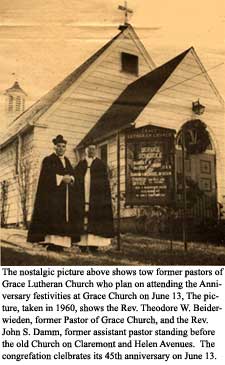 Grace Church was founded in 1931 by the Rev. Dr. Carl Bergen of Leonia as a mission station of the English District of the Lutheran Church. It first met in a second story room at 405 Cedar Lane. In 1934, the mission was strong enough to call its own pastor, the Rev. Theodore W. Beiderwieden, who served the parish for nearly the next four decades and led it through major growth and mission programs. In 1937, the congregation built and dedicated its worship center at Helen and Claremont, a site that “dear old Grace” used continually until the late 1960’s. Pastor Beiderwieden’s vision of the future included plans for Lutheran parochial education, and the congregation was able to purchase land on River Road for its projected Church and School facility. Grace Lutheran School was built in 1956 on the River Road property, and served as the educational springboard for many Teaneck children over the next 15 years. In 1973, Grace School changed its program to be an Early Childhood Education Center. it is presently under the direction of the Rev. Larry W. Smith and is planning to include a second grade program to its already popular and growing program of Nursery, Kindergarten and First Grade. A van for transporting children to and from School will also be available in the School program this year.
In the mid-1960’s Grace Church sold its building on Helen and Claremont and worshipped for the next few years in the School Foyer. In 1972, the parish completed and opened its new Church and combined its entire facilities at River Road. The present Church facility is air conditioned and includes many of the features of the old building coupled with modern functionalism. Three sons of the parish and residents of Teaneck have entered the Holy Ministry of Grace’s history. The Rev. Gary Heice, the Rev. Ronald Johnson, and the Rev. David G. Abrahamson have been ordained at Grace Church over the past 20 years. The Rev. Abrahamson was the first son of the parish from baptism to the ordained into the ministry. He celebrates the second anniversary of his ordination on John 8. Rev. Abrahamson serves as assistant pastor of the Evangelical and Pastor of the Evangelical Lutheran Church of St. Luke in Chicago. His parents reside on Martense Avenue in Teaneck.
Included in the special anniversary festivities will be a dinner-dance at the Imperial Manor. Also being honored that evening will be the Rev. Dr. John S. Damm, who served as assistant pastor and Director of Grace School for 15 years and will be celebrating the 25th anniversary of his ordination on June 15 at an 8:00 pm special service in the Church.
Grace Church and School is presently served by the Rev. Amandus J. Derr, who became Pastor of the Church 1975, the Rev. Larry W. Smith, Director of Grace School since October, 1975 and two other part time assistant pastors. The Rev. William Stubing and the Rev. Ira Derr.
The Rev. Derr will be the celebrant for the anniversary Eucharist with the rev. Dr. Damm as preacher. Pastors Bergen, Beiderwieden, Smith, Stubing, Derr, Abrahamson, Johnson and the Rev. Dr. John H. Tietjen, President of Concordia Seminary in Exile and former assistant at Grace Church will all participate in the service. Grace Lutheran Church and School celebrates God’s past blessings with joy and looks forward to a glorious future of mission and ministry in Teaneck.

Half A Century Of Leadership
The Presbyterian Church of Teaneck, whose fiftieth anniversary we are celebrating this month, is the oldest in the Township. In fact, the organization from which it took its origin is nearly thirty years older than the Township, and the Township itself was organized in quarters earlier occupied by that Christian group.
On May 17, 1866, the first session of the Washington Avenue Union Sunday School was held in a one-room school building, erected in 1841, which stood at the southeast corner of Washington Avenue and Railroad Avenue (Teaneck Road and Forest Avenue today). This Sunday school was organized under the leadership of Lebbeus Chapman, a New York banker who had moved to Teaneck in early 1865.
 The little schoolhouse was superseded in 1869 by an elegant two-story frame building with mansard roof, which arose cater-cornered across the road from the first one. The day school met on the first floor, the Sunday school on the second. In the Bergen County courthouse in Hackensack is a deed, executed June 8, 1890, wherein, for the sum of $1, William Walter Phelps and Ellen Sheffield Phelps convey to the Washington Avenue Union Sunday School Association a plot of ground north of the school property across the right-of-way which has become Church Street — a generous 100×200 feet — for the Association’s first owned home.
The Township of Teaneck was organized in 1895 in the quarters vacated by the Sunday School Association. The building was later moved to the north half of the Town House property when School No. 2, the present Town House, was built. Still later it was removed to the corner of Teaneck road and Bedford Avenue, where it now stands as the clubhouse of Capt. Stephen T. Schoonmaker Post, Veterans of Foreign Wars.
Actual formation of the Presbyterian Church of Teaneck got its first impetus in 1905, when Mr. and Mrs. Thomas H. Oliver gathered a group of Presbyterians at their home on Forest Avenue to explore the possibility of forming a church. There was none of any denomination in the Township at that time.
On May 24, 1906, the date we commemorate today, a committee from Jersey City Presbytery met with 32 persons in the Washington Avenue Union Sunday School building, and formed the Presbyterian Church in Teaneck. Of those 32, three are members today: Mrs. Settone C. Bower, the former Lita Franke; Mrs. Clarence R. Cole, the former Anna Elizabeth Lieffert, and Mrs. Oliver.
One of the 32 original members of the Presbyterian Church of Teaneck was a student just finishing his course at Union Theological Seminary. He was George H. Roberts Jr., who had been attending Sunday and Wednesday evening services and became the little church’s first pastor.
Ordained and installed on November 2, 1906, young Dr. Roberts served as pastor until the end of 1908. Twenty years later, when he was pastor of the First Presbyterian Church of Lake Forest, Illinois, Dr. Roberts recalled with satisfaction that his pastorate saw the church grow to a total of fifty members, and become self-supporting. Its first year’s activities, he recalled, had required a gift of $200 from the Jersey City Presbytery.
The first owned building of the Sunday School Association, which became the first church building, had been completed in 1894. Capt. Frank de Ronde, Marvin S. Coe, and Mr. Phelps had each given $200 toward its erection. Captain de Ronde had organized concerts and sparked other activities to complete the necessary sum of the building.
 By 1911, the congregation had outgrown this structure. A new campaign was conducted to add, at the west end of the building a wing which served as transept and chancel. The building was still in the name of the Sunday School Association. It was not until 1916 that the church paid the Association $3,000 to gain title to the property. The Sunday School Association paid off a mortgage, left from the 1911 acquisition, with this money, and went out of existence after a useful career of half a century.
While the Union Sunday School, as its name indicates was formally nonsectarian, leadership from its inception had leaned strongly upon Presbyterians. Its first decade saw five superintendents: Lebbeus Chapman, Lyman T. Bunnell, Theodore Lozier, John Ackerman and William Johnson. Mr. Johnson was succeeded by George S. Coe who served as superintendent for thirty-nine years — the last twenty of these in the Presbyterian Church of Teaneck.
George Coe was the third of the eleven children of Capt. William P. Coe of Englewood. He was accustomed to walk to Teaneck from his Englewood home every Sunday morning to fulfill his duties. His service as superintendent ended only a few months before his death, February 11, 1927. As the program of the church’s twenty-fifth anniversary observance, on May 24, 1931, noted, George Coe was often called upon for financial advice — and more tangible support — in the first twenty years of the church’s existence. He was a member of the board of trustees for eleven years, several as chairman, a service that only ended with his death. The pipe organ in use in the church today, purchased by the Women’s Guild at the end of 1928, was dedicated as a memorial to this faithful friend and leader.
Assumption of title to the Sunday School Association property, and other responsibilities of a growing congregation, had called for some structural changes in the Presbyterian Church of Teaneck. It was incorporated on November 12, 1915. It still lacked a manse, and was served in this period by a stated supply rather than a resident minister.
 This leader was the Rev. Thornton B. Penfield, who still lives in Englewood and comes to Teaneck to rejoice with the members of his old congregation in the recurrent ceremonies. Under his guidance the church structure was raised in 1922 and a full basement was built, large enough for a kitchen, heating plant, toilets and a fellowship hall. The 1923 annual meeting especially commended Carl R. Franke for his part in this accomplishment. As stated supply and as minister from June 6, 1919, to April 16, 1922, the Rev. Dr. Penfield served the Teaneck church for eight years. Succeeding him was the Rev. Reginald Rowland, a young graduate of Princeton and Hartford Theological Seminary and World War 1 chaplain, who became pastor on December 12, 1922.
First forward step of the Rev. Mr. Rowland’s pastorate was the acquisition in 1923 of the adjoining lot to the west on Church Street, and erection of a manse. He even lent the church $1,000 for a down payment. The lot to the north on Teaneck road was also purchased to provide for future growth.
Hitherto services had been in the afternoon or evening. On Easter Sunday, 1923, service began at 11 A. M. At the same time Sunday School was moved to the morning hour at which it has been held ever since.
The Rev. Mr. Rowland was pastor for twenty years. During his ministry membership increased from 135 to more than 300. Until 1942 the pews had stretched across the nave. With the World Service Association leading in the project, a center aisle was provided, the chancel was divided at the west end of the building, with a platform and parapet. Stained glass windows were installed. Thus the church took the final form remembered by today’s old-timers (anyone who has been a member more than ten years).
When World War II began, the Rev. Mr. Rowland again accepted a chaplainry. His place was taken by the Rev. Roland Holcomb who left in early 1945 to become associate pastor of Highland Park Presbyterian Church in Hollywood, California. The Rev. Herbert C. Wilenberg, pastor of the Presbyterian Church in Waterford, New York, who was called by the session to fill the post, was installed December 9,m 1945.
Even before World War II, with its nearly absolute ban on any but essential construction, had ended, the Presbyterian Church of Teaneck was seeking some way of meeting its desperate need for space. In November of 1944 the board of trustees appealed to the congregation for a postwar building fund. More than $32,000 was subscribed.
By the time the Rev. Mr. Willenberg was installed, half a year after V-E Day, it had become plain that there would be no return to pre-1941 prices and wages. A decade begin in which a building committee, a finance committee to provide the building committee’s wherewithal, were as much fixtures in the church organization as the statutory boards.
A supplementary campaign in February 1946, brought in $10,000. With the $32,000 on hand, it was hoped to obtain half the cost of a $100,000 building, with the balance to be obtained by mortgage. Builders were approached. The price they all mentioned was more like $175,000.
It was out of the question to wait until any such sum could be amassed — or even until a down payment could be raised that would justify a mortgage for the balance. The Sunday School was spread over three buildings. Double services on Sunday began before Advent and stretched nearly to summer vacation. On Easter and Palm Sunday the double services found some worshippers downstairs listening to loud speakers.
In this emergency the pastor sketched a plan for an addition to the building, stretching northward parallel to the Teaneck Road, that would provide a new and larger sanctuary at once, and still fit into future plans for a completely new and adequate building. The addition, as finally built, cost $72,000. The Church Extension Division of the Board of National Missions lent the congregation $25,000. The Jersey City Presbytery advanced $5,000 against members’ pledges which were still to be paid. Work began.
Construction got under way on August 2, 1948. First services were held in the new sanctuary on December 12, 1949. To erect the addition, most of the north wall of the older building was torn down.
On the lower floor the old kitchen was torn out and replaced by a new and larger one. The space beneath the new sanctuary became a spacious Fellowship Hall. The World Service Association equipped the new kitchen.
The feeling of vast room in which to move about and to conduct the church’s business did not last long. The new sanctuary seated 288 persons, true; but with the membership crossing the 600 mark, and children, not only of members but of the whole community, thronging into the Sunday School, another heroic effort had to be made.
 At the annual meeting of the congregation in January, 1953, it was voted to embark on a final building program to replace the old building entirely, and to add a Christian Education building between the existent structure and Teaneck Road. this is the building we have just completed — at least on the outside. We dedicated it on February 26, 1956. Additions comprise an extension of the sanctuary south into the space once occupied by the old church; a narthex occupying the rest of the old church area, entered from a columned portico almost as wide as the old church was long; an entirely new Christian Education building, with a large Fellowship Hall upstairs and a Junior Fellowship Hall below; a connecting structure crowned with a cupola and housing a new kitchen, a minister’s office, a church parlor, a junior assembly room and a board room for the governing bodies of the church. Above the narthex and the rearward extension of the sanctuary is a large room which will be finished as a chapel for youth groups. Primary and nursery quarters and a new furnace room occupy the area of the basement of the old church and its extension east.
The building fund drive for this ambitious program began in June, 1953. Pledges of funds were sought as outright gifts, to the made in thirty installments from July, 1953 to December, 1955, and purchases of twenty-year 3 per cent bonds dated January 1, 1956.
Gifts, in lumps sums, as memorials, and in the thirty-month pledges amounted to $1,000. The entire program cost a trifle less than $183,000. A $50,000 mortgage and the salt of $40,000 in bonds was supplemented with short-term financing designed to the rapidly retired by further gifts.
Thus the Presbyterian Church of Teaneck begins its second half century as it began the first — confronted with many problems, but prepared, with God’s help, to solve them all.

What’s in a name? Certainly, the name “The Presbyterian Church of Teaneck ” signifies more than a structure–beautiful as it is. As we celebrate the 100th anniversary of The Presbyterian Church of Teaneck, we share the story of building a structure that grew over the years to meet our members’ needs. More Importantly, however, we also share the story of building a community of faith that grew over the years, striving to meet the needs of all of God’s children. Ours is a story rich in service and praise to God through Jesus Christ, our Lord.
In the Beginning: Our Building
As the oldest church in the Township of Teaneck, The Presbyterian Church of Teaneck’s history goes back some forty years before its organization in 1906. Not long after the close of the Civil War, a group of like-minded Teaneck residents, under the leadership of Lebbeus Chapman, organized to form the Washington Avenue Union Sunday School Association for the purpose of providing a place for Christian worship for its constituents. They elected to rent a little one-room wooden schoolhouse of 1841 vintage, located on the southeast corner of Washington Avenue and Railroad Avenue (now Teaneck Road and Forest Avenue). The Sunday School Association held its first service there on May 17, 1866.
As the “union” in its title suggests, the Association was initially nonsectarian. However, its leadership was strongly Presbyterian, which attracted more and more Presbyterian adherents into its fold. In any case, it was not long before the fledgling congregation outgrew its quarters, so it moved in 1869 to a new two-story Victorian wood frame building with an elegant mansard-style roof. This was located diagonally across the street on property which eventually become the site of Teaneck’s School No. 2, or the Washington Irving School. At that time, a public day school met on the first floor and the Association provided Sunday School and worship services on the second floor. The Sunday School Association remained there until 1894, holding services in the afternoon or evening.
The Sunday School Association prospered in faith, growth, and financial resources. It also had the good fortune to do business with Teaneck resident William Walter Phelps, a wealthy philanthropist with vast holdings of real estate in the Teaneck-Englewood area. On June 8, 1890, he and his wife, Ellen Sheffield Phelps, sold a plot of ground measuring 100×200 feet to the Sunday School Association for the sum of $1.00. This property was north of the day school and was separated from the school property by a dirt road which later became Church Street.
Shortly thereafter, Captain Frank de Ronde, one of the Association’s most enthusiastic and energetic members, organized a series of concerts and other money-making events to accumulate building funds. In addition to the funds raised by these events, Captain de Ronde, Marvin S. Coe (another prominent Association member), and Mr. Phelps each contributed $200. The new church was completed in 1894. A brown shingled structure over a native stone foundation, it was the first building to be completely owned by the Sunday School Association.
All of this occurred before the Township of Teaneck was legally organized in 1895! The Sunday School building that had been vacated in 1894 became office space for the township. The building was subsequently moved two more times to accomodate expanding municipal and school board needs. It ultimately ended up on the corner of Teaneck Road and Bedford Avenue as the clubhouse for the Capt. Stephen T. Schoonmaker Post, Veterans of Foreign Wars. Years later, The Presbyterian Church of Teaneck used this clubhouse to house its large Sunday School classes until completion of the building that we occupy today.
Actual formation of The Presbyterian Church of Teaneck began in 1905 when Mr. and Mrs. Thomas H. Oliver gathered a group of Presbyterians in their home on Forest Avenue. They wanted to explore the possibility of organizing a church since, at that time, there were no churches of any denomination in Teaneck.
On May 24, 1906, the Presbyterian Church of Teaneck was formally organized and accepted into the Presbytery of Jersey City. The Presbytery Committee met in the 1894 building of the Washington Avenue Union Sunday School with the 32 original members to form “The Presbyterian Church of Teaneck” with the Reverend George H. Roberts, Jr. as its first minister. He was formally ordained and installed on November 2, 1906, and served until the end of 1908. During his ministry the congregation grew to 50 members and became self-supporting.
By 1911, the burgeoning congregation had outgrown its building, prompting a fund-raising campaign to construct an addition to its west end. With funds pledged and a mortgage obtained by the still-existent Sunday School Association, the new wing became a reality. However, it was not until 1915-1916 that the membership of the Presbyterian Church of Teaneck obtained title to its property from the Sunday School Association and became incorporated. At the time of incorporation the church had a newly-expanded building but lacked a manse. It also used stated supply, rather than resident, ministers.
Unter the Reverend Thorton P. Penfield and with church member Carl R. Franke (father to long-time member Lita Franke Bower) as builder, the church building once more underwent renovation in 1922. The building now had a full basement that housed a kitchen, heating plant, bathroom facilities, and a Fellowship Hall.
By 1923, under the pastorate of the Reverend Reginald Rowland, the church membership acquired the adjoining lot west of the church building and the adjoining to the north as well. Carl R. Franke erected a manse on the western lot. The northern lot was reserved for future growth. Starting on Easter Sunday in 1923, the church service moved to an 11AM time period. Sunday School classes moved to a morning session as well.
During the next twenty years the church membership once again faced severe space constraints, but a ban during World War II on anything except essential construction postponed all action except the beginning of a building fund subscription in 1944. The church’s building and finance committees worked tirelessly during the next ten years to compaign for funds for a new structure.
During those years the Sunday School operated in three separate locations and there was a need for two Sunday morning worship services. With financial assistance from The Church Extension Division of The Board of National Missions and the Jersey City Presbytery, work began August 2, 1948 on plans that the Reverend Willenberg had drawn for a new sanctuary.
The north wall of the existing sanctuary was torn down and a new sanctuary was constructed to the north, running parallel to Teaneck Road. The sanctuary was completed for use by December 12, 1949 and dedicated April 30, 1950 as the first stage of a completely new building once additional funds became available. On the lower floor was a new kitchen, equipped by the church women’s World Service Association. A large Fellowship Hall took its place under the new sanctuary.
Since the seating capacity of 288 in the new addition could not accommodate a church membership that exceeded 600, work began immediately to plan the next phase of expansion. The plan also took into consideration that the church not only served children of members but also served children from the surrounding community. Weekly Sunday School classes that often attracted over 300 students reinforced the need for the second state of construction.
Work on stage two finally started in 1955 when the remaining portion of the old building was torn down immediately after the Easter services. With Richard Sadlier as head of the building committee, member Emile Gorham as the architect, and many other members as builders, a graceful New England Georgian Colonial-type church arose, whose architectural style matched other Teaneck township buildings. Only the rose window at the front of the sanctuary and the stained glass windows that are displayed at the back of the sanctuary and narthex remain from the previous structure.
The new building, dedicated on February 26, 1956, in the church’s 50th anniversary year, extended the sanctuary by adding a narthex in the area south of the sanctuary in the space that have been occupied by the old building. The columned portico at the entrance was as wide as the old church once was long. A Christian Education wing with a large Fellowship Hall (now named Huse Hall in memory of the late Grosvenor “Pete” Huse) took shape along Teaneck Road. It was connected to the sanctuary wing by a cupola-crowned structure housing a new kitchen, offices, and a parlor.
There have been no major building or expansion efforts since completion of the large building project in 1956. The story continues with the creation of our community of faith through the rich contributions of its people trhough the years.
A Pictorial History Of Our Church Building


The first body of the First Baptist Church of Teaneck N.J. was formed in the year 1935. Rev. Lester VanSaun a former bank organized the church while attending Bible School. Meeting were held at that time in a rented hall. It was during the month of December in 1935 the name “First Baptist Church of Teaneck N.J.” was adopted by the membership, it was then the Rev. Lest Van Saun was nominated to serve as paster, various church offices were established along with the adoption of the articles of the faith and covenant.
The church building came to fruition with a donation of the church property and money for its building. In 1936 the church had been established and dedicated on the present location at 1592 Teaneck Road. Rev Van Saun worked during the following years for the upbuilding of the church body, in the latter part of the fortys’ with the gradual change of blacks moving into the North East community area and looking for a church nearest their residence, the church family began its course of integration to which the paster willingly and gladly accepted. With the steady growth of attendance it became necessary to add to the old structure, early in 1960 preliminary plans were made with fund raising programs and in the year 1963 the addition of the church which now compreses the main sanctuary for worship was completed.
Rev. Van Saun continued to serve the church and the community until his retirement in Marcdh 1972 at which time he had completed thirty six years of continual faithful ministry. The practice of an anniversary has never been observed through the years but with a new era of the church the past should never be forgotten. The First Baptist Church is considered the ninth oldest church in Teaneck N. J. and has been maintained for years as the only Baptist Church of this town.
May 30, 1973
| OFFICIAL STAFF: | Rev. M. C. Langston | Pastor |
| Deacon James Rice | Chairman | |
| Deacon Early Wilkens | ||
| Deacon I. T. Wints | ||
| Deacon J. Wynn | ||
| Bro. J. Lurry | Treasurer | |
| Bro. Smith | Financial Secretary | |
| Bro. Mel Goode | ||
| Mrs. V. Martin | Church Clerk | |
| Mrs. Powell | Supt. Sunday School | |
| Miss Thompson | Asst. Supt. |